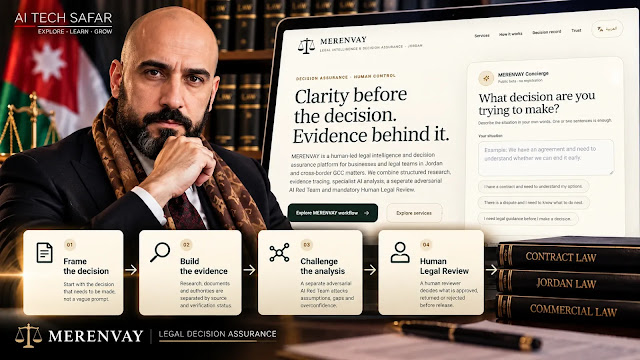
Overview: MERENVAY Legal AI
Explore MERENVAY legal AI, its beta decision-assurance approach and the founder’s claims, with attention to evidence, uncertainty and professional review.
A Jordan-Based Lawyer Built an AI Tool That Refuses to Sound More Certain Than It Is
TL;DR
- MERENVAY is a public-beta legal decision assurance platform built by Mohammed Mazen Al Nasser, a Jordan qualified lawyer and member of the Jordan Bar Association.
- Instead of returning one confident answer, it’s built to show evidence state, competing hypotheses, reversal conditions, and release blockers, with a human review step before anything is finalized.
- The internal pilot covers 10 fixed synthetic legal-decision cases with 30 fingerprinted runs. Human adjudication of those runs is 0 of 10 so far, so no accuracy or superiority claim is being made yet.
- Al Nasser filed an INPI e-Soleau deposit (No. DSO2026035733, dated 24 September 2026) for the project. We reviewed the official receipt directly it’s a French dating mechanism, not a patent or an accuracy certification, a distinction Al Nasser raised himself before we asked.
- MERENVAY isn’t a separately incorporated company. It runs as a project under Al Nasser’s legal practice, Al Nasser Legal Services.


Photo credit: Mohammed Mazen Al Nasser / MERENVAY
Reviewed by Imran Khan Pathan, Editor at AI Tech Safar. This piece is based on direct correspondence with Mohammed Mazen Al Nasser, an INPI e-Soleau receipt we reviewed directly, a verification pack describing the Pilot-10 test cases, and his publicly listed LinkedIn history. Where a claim couldn’t be independently confirmed, it’s attributed to Al Nasser rather than stated as fact.
Last updated: September 29, 2026.
The Problem MERENVAY Is Built Around
Most AI tools built for legal or decision-support work are optimised to produce an answer. Al Nasser’s starting point was different: AI confidence isn’t the same thing as legal certainty, and a tool that presents both the same way sets users up to trust something that hasn’t actually been tested.
MERENVAY’s approach is to surface the parts of a decision that usually stay hidden. Every case moves through six components: decision state, evidence state, competing hypotheses, release blockers, a counterfactual or reversal condition, and the action that follows. A user isn’t just told what MERENVAY concluded, but what’s actually holding that conclusion up, and what would need to change for it to fall apart.
One example from the verification material makes the logic concrete. In a scenario about a completion certificate with surviving liability, MERENVAY doesn’t return a clean yes or no. It separates what’s known from what’s missing and states outright that release is blocked until specific gaps close a missing controlling document, say, or an unverified change in the underlying facts. In one case, a prior sign-off is marked stale the moment a material input changes, and the system requires re-approval bound to the new evidence before it moves forward.
What Exists Right Now
MERENVAY is live in public beta at merenvay.com. Al Nasser was direct about the current scope: the guest version anyone can try is deliberately privacy-minimised and runs browser locally, using deterministic issue mapping rather than the full AI-assisted workflow. The fuller system permitted evidence and document handling, AI-assisted legal research and analysis, a separate adversarial AI red team, human legal review, and a release gate sits behind an authenticated, private workspace.
The internal pilot, which Al Nasser calls Pilot-10, covers 10 fixed synthetic legal decision cases:
| ID | Synthetic scenario |
|---|---|
| V01 | Jordan investment due diligence |
| V02 | Concession term / contractual fee |
| V03 | Saudi-law final opinion boundary |
| V04 | Change in law / force majeure |
| V05 | Stale analysis after material change |
| V06 | Public procurement authority |
| V07 | Completion certificate / surviving liability |
| V08 | Special economic zone land rights |
| V09 | Missing controlling document |
| V10 | Variation / extra works claim |
The 10 fixed cases produced 30 fingerprinted runs in total across three conditions: 10 MERENVAY governed runs, 10 same-model procedural-baseline runs, and 10 earlier-mode/Compact Proof runs. Human adjudication of those runs is listed as 0 of 10 so far, meaning nobody has yet independently reviewed and scored the results. Al Nasser was explicit that this means no legal accuracy or superiority claim can currently be made about the tool.

Verifying the Claims
Two things in the original pitch were checkable, and both held up.
The INPI e-Soleau deposit, number DSO2026035733, is real. We reviewed the official INPI receipt directly: it lists the deposit date as 24 September 2026, a 5 year retention period, and Al Nasser’s name as the filer. It’s worth being precise about what this does and doesn’t mean, since it’s an easy thing to overstate. An e-Soleau deposit is a low cost French mechanism for proving a specific document existed at a specific point in time. It is not a patent, not a certification, and not any kind of accuracy or quality validation a distinction Al Nasser volunteered himself before we even asked about it.
His professional background also checks out. Al Nasser is a Jordan qualified lawyer and a member of the Jordan Bar Association, practicing since 2009, with an LL.B, a Master’s in Intellectual Property from the German Jordanian University, and a Master’s in Journalism and New Media from the Jordan Media Institute. His LinkedIn profile, which independently surfaced in our own search before he sent it, shows a background spanning in house and advisory legal roles across banking, telecom, and public law reform work in Jordan.
What MERENVAY Is Not
Al Nasser was unusually direct about the platform’s limits, and it’s worth listing them plainly rather than softening them:
- Using the site does not create an attorney client relationship or confirm legal representation.
- AI output is draft work product. It cannot approve its own legal opinion.
- No confidence label the system produces guarantees legal accuracy or completeness.
- The guest beta doesn’t accept client documents and doesn’t save guest questions.
- Full release within the protected workflow requires human legal review and clearance of any release blockers first.
On jurisdiction, the current automated final release policy is enabled specifically for Jordan. Other jurisdictions remain in a draft or issue-spotting state until jurisdiction specific source coverage and appropriately licensed human review are added.
Why a French Registry, for a Jordan-Based Project
The combination is worth explaining, since it isn’t the obvious pairing. Al Nasser said the choice came down to what e-Soleau actually offers: an official, timestamped evidentiary record for a frozen package, useful for establishing when the project existed in a given form. He was clear the purpose was proof of date and package integrity, not French regulatory approval, and not a claim that France governs the project in any way.
What’s Next
The near term work, by Al Nasser’s own account, is getting human adjudication done on the existing Pilot-10 runs and building out jurisdiction specific coverage beyond Jordan. Until that adjudication happens, MERENVAY’s own materials are careful not to claim accuracy superiority over other approaches, a more conservative posture than most early stage legal AI pitches take.
Update: A Third-Party Listing, Read With the Same Caution as Everything Else Here
After this piece was first reported, Al Nasser got in touch with one more data point: SaaSHub, an independent software marketplace that says it has tracked roughly 247,000 software products and more than 444,000 competitor relationships since 2014, currently places MERENVAY at number 9 on its ranking of Legal AI products.
It’s a reasonable signal that the project has started showing up on independent radars, but it deserves the same scrutiny we applied to the e-Soleau deposit earlier in this piece. A marketplace ranking isn’t an accuracy score, a legal-quality audit, or any form of regulatory approval, it reflects how a third-party directory categorizes and ranks listed products, nothing more. Al Nasser made this distinction unprompted when he shared the news, which is consistent with how he’s handled every other claim in this story: cautiously, and without letting a favourable data point get dressed up as more than it is.
Update: A Second Checkable Result, From a Different Kind of Source
On 8 October, a separate platform called Fold Certification published what it calls a “Verified Result” for MERENVAY’s underlying engine, MERENBRAIN, under certificate number FOLD-20261008-01644-D1RGKR. On Fold’s public leaderboard, as it stood on 9 October, MERENVAY was listed second with an average score of 78.67 out of 100, a few points ahead of entries labelled Gemini (76.33), Claude (75.33), and GPT (74.33), and ahead of an entry labelled Deepseek (74.67) at seventh.

We reviewed Fold’s own leaderboard and certificate-verification pages directly rather than taking the numbers secondhand, and a few things are worth being precise about, because it would be easy to describe this result in a way that oversells it.
- Fold’s own site states explicitly that a “Verified Result” means a submitted record was reviewed and authenticated by Fold’s admin process, not that the system being tested achieved some universal pass. Al Nasser flagged this distinction himself before we had a chance to ask.
- The entries on the leaderboard, including the ones labelled Gemini, Claude, GPT, and Deepseek, are run under different named frameworks and dates rather than one controlled, head-to-head test. Fold’s own classification for MERENVAY’s result is “Tool-Functional Integrity Profile,” not an accuracy or superiority rating.
- This is a separate exercise from the SaaSHub marketplace ranking covered in the update above. One is a software directory’s category placement; the other is a self-submitted, third-party-reviewed benchmark run. Neither should be read as the other, and neither amounts to independent proof of legal accuracy.
Al Nasser also shared a self-authored, interactive explainer about the project, published separately from this piece. We’re noting it here for completeness, but it’s worth flagging plainly: that page is MERENVAY’s own editorial material, not third-party coverage, and we’re treating it accordingly, the same way we’ve treated every other piece of self-reported evidence in this story.
FAQ
Is MERENVAY a registered company?
No. It operates as a project under Al Nasser’s legal practice, Al Nasser Legal Services, rather than as a separately incorporated entity.
Is Mohammed Mazen Al Nasser a real, licensed lawyer?
Yes. He’s a member of the Jordan Bar Association, practicing since 2009, with legal and IP postgraduate qualifications.
Does the INPI e-Soleau deposit prove MERENVAY is accurate or certified?
No. It only proves a specific document existed on 24 September 2026. It carries no accuracy, quality, or regulatory certification.
Can I use MERENVAY for real legal advice today?
The platform’s own terms say no. Using the guest beta doesn’t create an attorney client relationship, and any output requiring licensed advice needs escalation to an authorised lawyer.
Has MERENVAY’s accuracy been independently tested?
Not yet. Human adjudication of the Pilot-10 test runs is listed as 0 of 10 completed as of this writing.
Related Reading on AI Tech Safar
- AI Agent Security: The Complete 2026 Guide to Protecting Against Rogue AI
- AI Giants Sued for Collusion: Inside the Antitrust Lawsuit That Could Reshape the Industry
- EU AI Act Compliance in 2026: The Complete Guide
- Trump Renames AI to “Super Intelligence”: The Full Story, Expert Reaction & What It Actually Means
- Altman and Amodei Tell the UN What Trump Wouldn’t Hear
Useful Sources
- MERENVAY public beta
- MERENVAY – Terms
- MERENVAY – Privacy
- Mohammed Mazen Al Nasser – LinkedIn
- INPI e-Soleau deposit receipt, No. DSO2026035733 (reviewed directly by AI Tech Safar)
For the broader context and related reading, explore our AI Tools 2026: Free Options, Categories and Companies.