The autonomous weapons talks in Geneva confront governments with a choice: spend the next two years drafting treaty language on weapons that can select and attack a target on their own, or spend five years developing voluntary guidance. In a report datelined Geneva on November 16, Reuters said the United States and Russia look set to oppose a push to launch negotiations on legally binding rules. The story on day one is the disagreement over what negotiators should produce. The conference has not yet made a decision. Reuters report, via Al-Monitor
Reviewed by Imran Khan Pathan, Editor at AI Tech Safar. This guide was checked against the text of the proposed negotiating mandate, UN and UN Geneva pages, Reuters, India’s own working paper and other primary documents. We say whether each claim comes from a document, a named official or press reporting.
Last updated: November 16, 2026.
Overview: the CCW Seventh Review Conference
The Seventh Review Conference of the Convention on Certain Conventional Weapons (CCW) runs from November 16 to 20 at the Palais des Nations in Geneva. The convention has 128 states parties. The meeting is expected to decide whether to launch negotiations on lethal autonomous weapons systems, often shortened to LAWS. One proposal before delegates would give a group of government experts a precise assignment: negotiate a new protocol and bring a draft back in 2028. UN Geneva conference page · Proposed mandate (UNODA)
For an AI audience, a more practical question sits underneath the timetable. When a person authorizes a system to operate, how much can that person know about the particular use of force that follows?
This has been tried before. At the Sixth Review Conference in December 2021, states did not agree to schedule negotiations, and sources told Reuters at the time that Russia, India and the United States were among those that pushed back on a new treaty. Five years later the same question is back, with a longer record of expert work behind it. Al Jazeera on the 2021 outcome
TL;DR
- The chair’s proposal would have the experts negotiate a new protocol, report a draft to the 2028 meeting of states parties and brief the 2027 meeting. Reuters describes it as a two-year mandate.
- Reuters reports that most of the 128 states parties support launching negotiations, while the US, Russia and Israel oppose it. The US favours guidelines and has proposed a five-year mandate toward a non-binding agreement.
- Two diplomats told Reuters a compromise is possible by the end of the week, and that a hybrid with both binding and non-binding parts is among the options.
- Existing international humanitarian law already applies. The dispute is whether it needs extra rules written for autonomous weapons.
- India’s published 2025 working paper backs prohibiting fully autonomous systems that cannot comply with humanitarian law and regulating the rest, but its position on this week’s mandate is not public.
In this article
- Three paths for the autonomous weapons talks
- Human control and the decision to use force
- Where the Red Cross would draw the line
- India’s stated position
- Our Read
- How to read the outcome
- Frequently asked questions
Three paths for the autonomous weapons talks
Countries have spent years on what autonomy means in a weapon. The CCW created its Group of Governmental Experts (GGE) on the subject in 2016. The group adopted its final report by consensus on September 4, 2026, ending a three-year mandate, according to UN Geneva and the group’s chair. The report recommends that the Review Conference consider a set of instrument elements and other possible measures and decide how the group should work next. Paragraph 25 of the report is described as the first agreed consensus characterization of a lethal autonomous weapon system.
Agreeing to record that work leaves one consequential choice for this week: what instructions do governments give the group when it next sits down? Statement by the GGE chair (UN transcript)
| Path | What the next round would produce | What that would leave open |
|---|---|---|
| Negotiate a protocol | Under the chair’s proposal, experts negotiate a new CCW protocol and submit a draft to the 2028 meeting. | Governments would still have to agree on the text and take the steps needed to be bound by it. |
| Develop non-binding rules | Reuters reports that Washington proposes five years of talks toward a non-binding agreement. | Whether states would follow common practices, and how consistently. |
| Leave the legal form open | Reuters reports a diplomat describing a hybrid with binding and non-binding elements as one option. | States could work on substance and then face the same disagreement about legal force later. |
The most concrete timetable is in the protocol proposal. It says the group builds on the elements and other measures it adopted in 2026, is guided by the UN Charter, international humanitarian law and relevant ethical perspectives, and works and reports by consensus. The chair updates the 2027 meeting of states parties, and the group submits a report containing a draft protocol to the 2028 meeting. It meets for 15 days in Geneva each year, and some of those days can go to dedicated meetings of legal, military or technical experts.
A headline saying a ban will take effect in 2028 would skip every decision between receiving a draft and accepting a binding rule. Mandate proposal, paragraphs 2 to 5
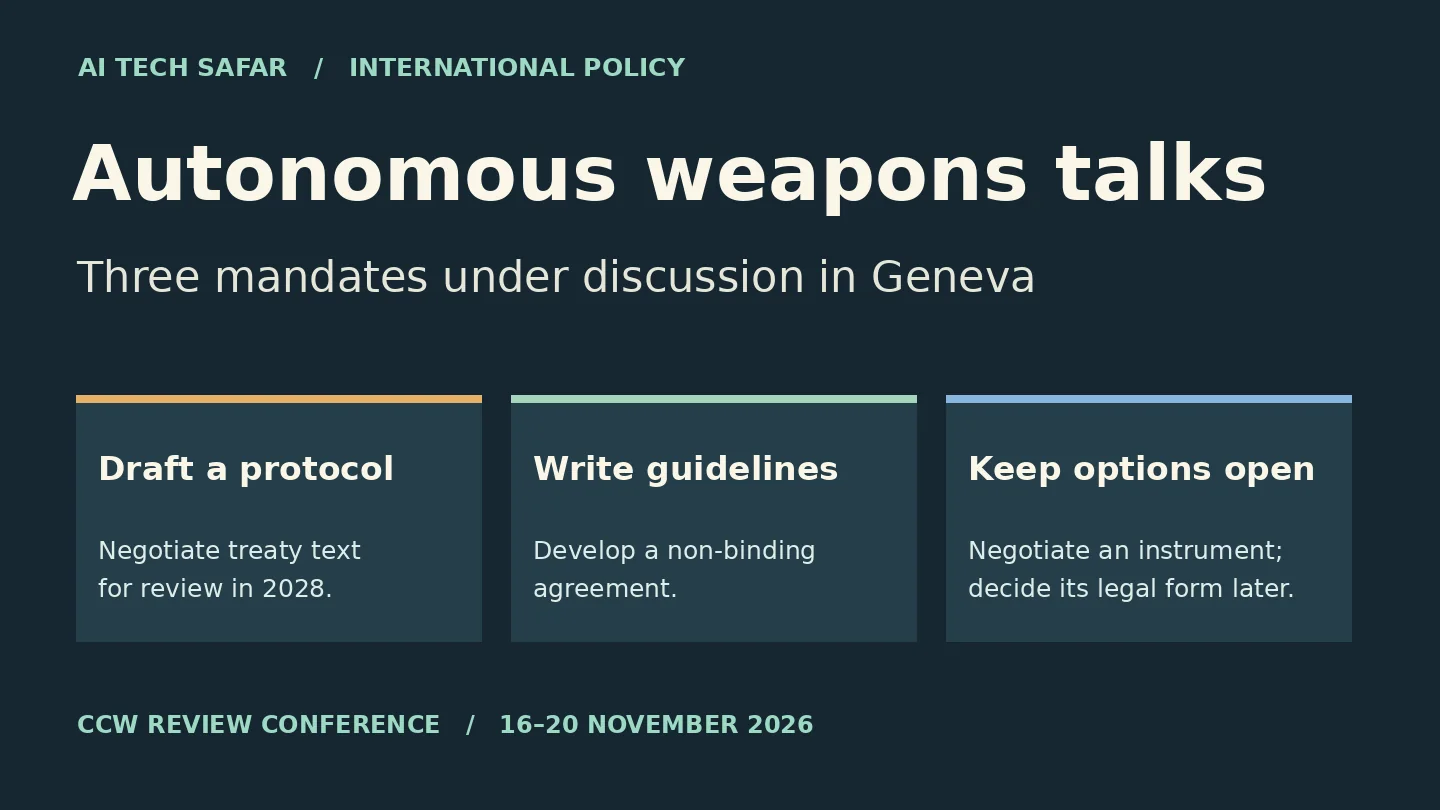
The evidence behind each position differs. The chair’s proposal is a published document. The US preference comes from Reuters, which reported that Washington has proposed the five-year mandate. Russia has not stated its position publicly for this round, Reuters said, but it has previously resisted proposals for a legally binding agreement, and a senior Western diplomat told Reuters it plans to stop the European Union, an observer, from taking the floor. Calling the conference blocked before delegates have spoken would turn a forecast into an event.
Campaigners are already predicting that the US and Russia will try to water down any result, as they did in September, according to Anna Hehir of the Future of Life Institute. That is her assessment, not a finding.
Which decision does the machine make?
A drone can navigate automatically while a person still picks the target and decides whether to strike. A different system might be switched on by a person and then select and engage a target without another human decision. Headlines may call both AI-enabled. Only the second captures the concern at the center of the UN and Red Cross descriptions: machines that can select and attack targets without human control. The relevant fact is who or what selects the target and applies force once the system is active.
Compare approving an action with authorizing a class of future actions. In the first case, a person can look at the particular object and its surroundings before deciding. In the second, that person sets conditions in advance, and the situation may change before a machine finds a match. The ICRC’s Laurent Gisel has described the problem in similar terms: a combatant can surrender or be wounded, civilians can enter the area, and a weapon can meet a situation nobody anticipated. A medical vehicle that was not there when the system was started is one example.
A technically accurate description of an object leaves open whether using force in that setting is lawful. UN News on the August appeal
That is why a model’s recognition accuracy cannot settle the policy question. A performance figure describes a test set and a task. It does not tell a commander who has entered a location since the assessment, whether the operator has current information or who can stop an attack in time. A system can work exactly as designed while the circumstances that justified using it have changed. The humanitarian concern is as much about the decision a person retains as about the errors a model might make.
Where the Red Cross would draw the line
On August 25, 2026, UN Secretary-General António Guterres and ICRC President Mirjana Spoljaric renewed a joint appeal they first made in 2023, when they asked states to conclude a legally binding instrument by 2026. They call for two prohibitions. One covers unpredictable autonomous weapons, meaning systems whose effects the user cannot predict because of how they are designed or used. The other covers anti-personnel systems that deliberately target human beings. For other autonomous weapons, they call for restrictions strong enough to preserve human judgment and control. The appeal stops short of a blanket ban and creates no legal obligation. ASIL summary of the appeal
The two prohibitions address different worries. A more predictable system could still select a person for attack, which raises the question of whether that judgment may be delegated at all. And a system aimed at objects could have effects its user cannot foresee. Making a system perform better on one dimension leaves the other concern unresolved, which is one reason the shorthand “safer AI” is too broad to describe the negotiation.
International humanitarian law already governs how weapons are used in armed conflict. Reuters reports that the US argues existing law provides a framework to govern warfare, while the Red Cross says humanitarian law does not sufficiently address the specific risks of autonomous weapons. States that favour guidance can accept that people remain accountable under current law while doubting that a new protocol would help. The practical dispute is whether broad legal duties give people a clear enough boundary before deployment, especially when they will know little about individual engagements.
What India has put on record
India submitted a working paper to the CCW expert group on May 16, 2025 (document CCW/GGE.1/2025/WP.3). It argued that regulation should be limited to the use and effects of a system, not the underlying technology, and that access to technology for peaceful and developmental applications must not be restricted. It supported prohibiting the use of fully autonomous lethal systems that cannot be used in compliance with international humanitarian law, and asked the group to identify regulatory measures for all other systems. In statements to the group in March 2025, India also said human judgment and oversight remain integral. India’s working paper (MEA)
Those are dated national submissions. They help readers understand India’s approach without assigning the delegation a position it has not yet stated at this conference. Earlier analysis by Carnegie India said India viewed calls for a legally binding instrument as premature while work on definitions continued, and Reuters sources named India among the states that resisted a treaty mandate in 2021. Whether that holds for the 2026 text is something this week’s statements would have to show. Carnegie India, 2024 analysis · Outlook India’s summary of the debate
The distinction is useful for engineers who work across civilian and defence projects. A vision model that finds flood damage after a storm is one thing. Who authorizes a different application to act on a detection is another, and the model alone does not answer it. India’s approach would put scrutiny on the system, what it does with its output and the authority people keep. The Red Cross proposals raise a further question: are some uses off limits even if engineers can make the underlying technology dependable?
Our Read
If the conference produces a short decision, look first at its verbs. Instructing experts to negotiate a protocol gives them a named document to bring back. Instructing them to explore measures lets them return with analysis. Both can count as diplomatic progress, but they give the public very different ways to judge whether two more years of meetings delivered what governments promised.
The second test is what “human control” means in practice. Saying a human remains responsible leaves practical questions for a family affected by an incident. Who understood the circumstances at the time? What information did the person have when deciding? Was there still a chance to intervene? A future rule that helps investigators answer those questions would do more for accountability than a statement that assigns responsibility in principle.
Leaving the legal form open is a real trade-off. It lets governments start writing shared definitions while they disagree on legal obligations. But definitions are hard because they decide which systems a rule would cover. If states defer both the legal form and the scope, it becomes difficult to tell a substantive compromise from an agreement to meet again. A deliverable, a deadline and a list of unresolved questions would make the difference easier to see.
How to read the outcome on Friday
Read the adopted decision, if there is one, next to the proposal now on file. Check whether the experts get a specific drafting assignment, whether the 2027 update and the 2028 deliverable survive, and whether states agreed on the legal form. Then look for language on predictability, targeting people and human judgment. A strong negotiating mandate can start with major substantive issues still open, and a detailed political statement can leave future negotiations uncertain.
As of November 16, 2026, the available sources establish the agenda, a draft mandate and an opening-day diplomatic split. The outcome, the eventual scope of any instrument and the governments willing to accept it remain open. The UN lists November 20 as the final scheduled day.
Frequently asked questions about the autonomous weapons talks
What are the UN autonomous weapons talks in Geneva?
They are the Seventh Review Conference of the CCW, held November 16 to 20, 2026. Governments are expected to decide whether to launch negotiations on lethal autonomous weapons systems and what form any result should take.
Has the UN agreed to ban autonomous weapons?
No. The November 16 reporting concerns whether states will authorize negotiations. The proposed mandate contains instructions for future work and does not establish a ban.
Who opposes binding rules on autonomous weapons?
Reuters reports that most of the 128 states parties support launching negotiations, while the United States, Russia and Israel oppose it, arguing that existing humanitarian law is sufficient. Russia has not publicly stated its position for this round.
What is the CCW?
The Convention on Certain Conventional Weapons, often called the Inhumane Weapons Convention. It is a treaty framework through which states address specific weapons and their effects, and its review conferences are held every five years.
Does every military use of AI fall within the talks?
No. The focus is much narrower. A system that translates documents or helps a person navigate raises a different question from one that selects a target and applies force after activation.
Does a human pressing a start button count as human control?
It shows that a person activated the system. It leaves open what that person knew about the eventual target and circumstances, and whether intervention was possible. Those are central issues in the debate.
Why does 2028 appear in the coverage?
The protocol proposal asks the expert group to submit a draft protocol to the 2028 meeting of states parties. That is a proposed deadline for a document, not a date when a rule takes effect.
Has Russia vetoed the proposal?
No veto has been reported. The Reuters dispatch anticipated resistance and noted Russia’s past opposition. It also reported, citing a Western diplomat, that Russia plans to block the European Union from speaking.
Where can Indian readers check the country’s position?
India’s 2025 working paper sets out its reasoning on regulating use and effects, humanitarian law and peaceful technology. A statement or decision from this week would be needed to establish its position on the final wording.
Editor’s Note: Earlier drafts of this article cited three pages we could not verify (a UN chronology page, an ICRC statement and a UN Geneva press briefing) and gave a time of day for the Reuters dispatch. We replaced them with sources we checked and now give the date only.
Related reading on AI Tech Safar
- UN AI Governance: Global Standards and the US Response
- Philippines AI Council: Who Will Fund the Plans and Track Results?
- AI Agent Security Incidents: WorkOS, Binance and Controls
Useful sources
- Reuters via Al-Monitor — US and Russia to oppose talks on limiting autonomous weapons
- Reuters via Arab News — US and Russia to oppose talks on limiting autonomous weapons
- UNODA — Proposal: mandate and modalities for the future work of the GGE on LAWS
- UN Geneva — Seventh Review Conference of the CCW
- UN transcript — Statement by the GGE chair on the September 2026 report
- UN News — UN and Red Cross call for controls on autonomous weapons (August 25, 2026)
- American Society of International Law — UN and the ICRC call for rules on autonomous weapons
- India (MEA) — Working paper CCW/GGE.1/2025/WP.3, May 16, 2025
- Outlook India — Who decides what gets hit? The global battle over AI weapons
- Carnegie India — India’s normative stance on lethal autonomous weapons systems (2024)
- Al Jazeera — UN talks fail to open negotiations on ‘killer robots’ (2021)
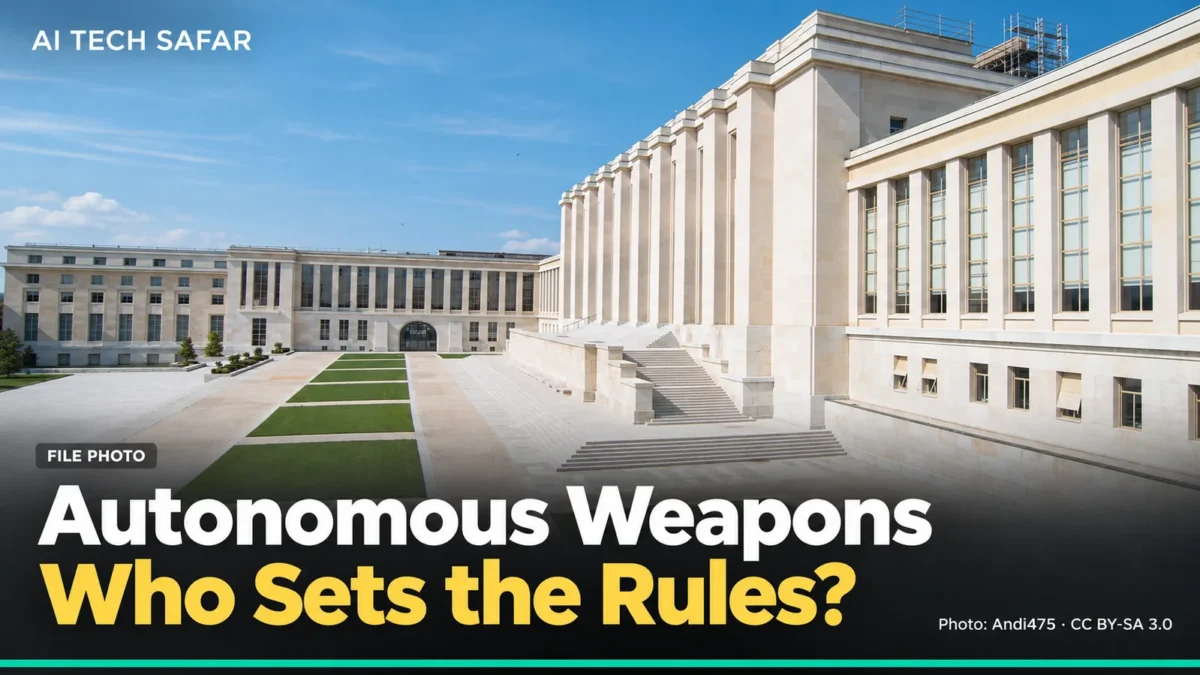
Cover: Palais des Nations, 2013. Photo by Andi475 / Wikimedia Commons, CC BY-SA 3.0. File photo, adapted with AI assistance by AI Tech Safar; adapted cover shared under the same licence.