
The year in the title needs a little context. 4now.ai published its AI Tools Market Index 2027 on November 17, 2026, but every one of the 248 profiles in the index CSV carries an October 7, 2026 review date. 4now presents “2027” as the edition title and describes the data as a snapshot reviewed on October 7, 2026. The page makes no forecast. Read this as a dated snapshot of one directory, not a prediction of where the AI market is heading. 4now’s research page
Reviewed by Imran Khan Pathan, Editor at AI Tech Safar. Data checked on November 18, 2026. We recomputed the headline counts and percentages from the CSVs 4now supplied, compared them with the live research pages and wrote down where they disagree. This is a review of 4now’s source-based directory research. We did not hands-on test any of the listed products.
Source and disclosure: 4now’s founder, Adrien de Malherbe, shared the research with us and, at our request, the CSVs and methodology. We were not paid, and 4now did not ask for a link exchange. 4now is an AI-tool directory that also offers optional tool matching and ROI guidance, and its site includes vendor listing and submission pages. This research therefore reflects its own editorial choices and commercial context, and we have not independently verified how its vendor program works. If you spot an error in this article, tell us through our contact page and we will correct it and note the change here.
Last updated: November 18, 2026.
The short version
- The AI Tools Market Index contains 248 profiles across 136 editorial categories, drawn from a directory of 501 canonical profiles.
- 86 categories have one profile each. The ten largest categories contain 58 profiles combined.
- All index rows show the same review date: October 7, 2026. The title does not signal a 2027 forecast.
- The companion Radar has 285 profiles in its CSV, and 248 of them are already in the Index. Together, the files cover 285 distinct tools, not 533. The Radar page itself shows 286 in places, which we explain below.
- The data can help describe 4now’s directory. It does not measure the whole market, product quality, adoption, revenue or market share.
How we checked this article
Because the numbers come from one publisher, we verified what we could and labeled the rest. This table shows each check and its result.
| What we checked | How | Result |
|---|---|---|
| Index counts: 248 profiles, 136 categories, 86 single-profile categories | Counts from the supplied CSV, compared with 4now’s research page | Matches |
| Percentages: 63.2% single-profile categories, 23.4% in the top ten, 89.9% industry-specific | We recomputed each (86/136, 58/248, 223/248) | Correct |
| Pricing fields: 237 unknown, 10 freemium, 1 paid, 9 with a monthly price | Counts from the supplied CSV, compared with the research page | Matches; 4now says only 11 records have a captured pricing source |
| Review dates: all Index rows October 7, 2026 | CSV review-date column and the research page | Matches |
| Radar rings: 4 Shortlist, 22 Pilot, 258 Watch, 1 Caution | Counts from the supplied CSV, compared with the live Radar page | Differs by one entry; see below |
| Index and Radar overlap: 248 shared, 37 Radar-only | CSV comparison and the Radar page’s methodology note | Matches |
| Product quality, accuracy of individual profiles | Not checked | Out of scope |
A directory with a long tail of categories
The index lists 248 tools in 136 categories. That works out to fewer than two profiles per category on average, but the average hides the shape of the file: 86 categories, or 63.2% of the total, contain just one profile. The ten most populated categories account for 58 tools, or 23.4% of the index. According to 4now, AI Customer Support is the largest category with nine profiles.
| Largest categories in the Index | Profiles |
|---|---|
| AI Customer Support | 9 |
| AI Clinical Documentation | 7 |
| AI Contract Management and AI Voice Agents | 6 each |
| AI Architectural Rendering, AI Interior Design, AI Accounting, AI Document Processing, AI Agent Platform and AI Product Photography | 5 each |
That is a useful description of how 4now has organized its own catalogue. It points to a broad set of specialised labels rather than a few giant buckets. It does not show that the wider AI market is equally fragmented. The categories are 4now’s editorial taxonomy, and the sample comes from profiles that passed 4now’s approval requirements.
Those requirements shape the sample. According to 4now, a profile has to have a primary source URL, source evidence, a stable source hash, review and modification dates, at least two features, at least three use cases and at least one alternative. Of the 501 profiles in the directory, 248 (49.5%) met that standard for this edition. A different approval rule would produce a different sample, and different counts.
The industry field adds a related picture. 223 of the 248 profiles (89.9%) are assigned to a named industry, and 25 are cross-industry (marked “general” in the CSV). Marketing has the most profiles at 26, followed by cross-industry tools (25), healthcare (24) and architecture (23). That makes the file useful for seeing how a directory maps AI products to professional work. It cannot tell us how many businesses in those industries use the tools, or whether one category is growing faster than another.
The pricing fields are mostly blank or unknown
For readers comparing costs, the CSV has a clear limit. It marks 237 of 248 pricing models as “unknown,” ten as “freemium” and one as “paid.” Only nine rows include a monthly starting price. “Unknown” does not mean free; it means the file does not establish a pricing model for that profile.
4now’s page says the median of those nine source-checked USD starting prices is $19.75 a month, and warns that this is a small subset and not a market-wide median. We agree. Nine data points cannot support a claim about what AI tools cost. 4now also states that missing pricing metadata is treated as missing information, not as evidence that a vendor has no public price. Prices and plans change, so anyone shortlisting a product should check the vendor’s current pricing page.
What the companion Radar adds
The AI Tool Radar classifies profiles into four evidence rings. The CSV marks 248 of those profiles as already included in the Market Index; the remaining 37 are additional profiles. The two files therefore describe 285 distinct tools in total, and 4now’s own note says the overlapping samples should not be added together as independent observations.
Its largest group is Watch, with 258 profiles in the CSV. In 4now’s method, Watch means an approved profile has narrower evidence. It is not a finding that the product failed. Pilot (22) requires an expanded editorial profile with clear buyer fit, limitations, implementation and security guidance. Shortlist (4) has the most demanding threshold: an expanded profile, a practical evaluation task and source-checked pricing evidence. Caution (1) records an explicit editorial concern, such as an inactive or status-reference product. 4now says it does not automatically place unreviewed products in Caution.
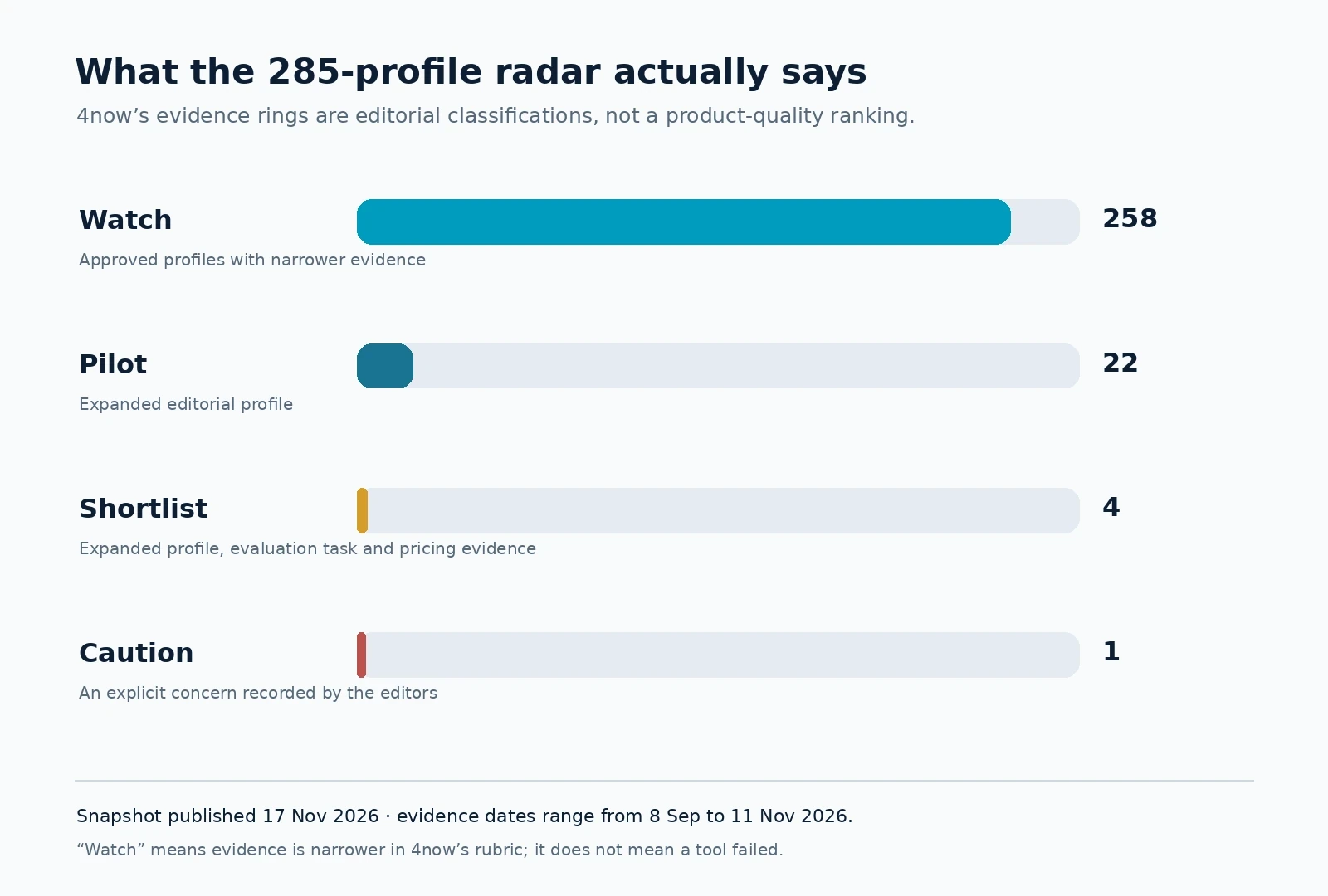
That distinction matters. The Radar is best read as a map of how much supporting material 4now has assembled for each profile. It is not an independent contest naming the “best” AI products, and its ring labels should not be turned into a product recommendation without further testing. 4now also says paid vendor publication and sponsored placement do not affect radar placement. That is the publisher’s statement, and we have not tested it.
One pattern is visible on the Radar page itself. Of the 22 Pilot profiles listed, 15 sit in the “Knowledge and regulated work” group (legal, clinical documentation and accounting tools), six in “Customer and growth” (mostly real estate) and one in “Design and operations.” The four Shortlist profiles are Autodesk Forma, LookX AI, PandaDoc AI and Veras, three of them in architecture and design. This is our count from the page’s listing. It suggests that 4now’s deepest evidence is concentrated in a few professional fields. It does not suggest those tools are better than the 258 Watch profiles.
A one-entry discrepancy on the Radar page
While checking the numbers, we found that 4now’s own Radar page disagrees with itself by one entry. The page header and ring cards show 286 entries (4 Shortlist, 22 Pilot, 259 Watch and 1 Caution). The methodology text, the “37 additional profiles” note and the CSV link label all say 285. The CSV supplied to us has 258 Watch profiles, which gives 285. This article uses the CSV figures.
One entry does not change any conclusion here, but it is a reminder to cite the file and the date, not just a headline number. The Radar page offers a correction link for exactly this kind of issue. We will update this article if 4now reconciles the counts.
The dates matter more than the edition number
Every Market Index row has an October 7, 2026 review date. The Radar is less uniform: its evidence dates run from September 8 through November 11. 4now says its November 17 baseline date is not a claim that every vendor was rechecked that day, and it does not have a separate collection timestamp for each Index record.
So the files are not a live crawl. A product may have changed its name, features, availability or pricing since its evidence was reviewed. Before relying on a listing for a buying decision, follow the primary source link and confirm the details with the vendor.
What these files cannot tell us
4now says profiles are selected from its directory, not from a random or exhaustive market sample. Its reviews use vendor pages and documentation, with automation helping to structure and check records; the publisher has not independently tested every product. The CSVs include source URLs and review dates, but not the source hashes or underlying evidence notes described in the methodology. We can check the counts and dates in the exports, but we cannot recreate every source review from the files alone.
That rules out several tempting conclusions. The counts do not measure market share, adoption, revenue or proven return on investment. The dates do not support a trend line, and that includes the research page’s own headline that AI software is “fragmenting faster than categories can consolidate.” A word like “faster” describes change over time, and a single snapshot taken on one date cannot show change. And the ring totals do not establish that a Shortlist tool performs better than a Watch tool. Those would require different evidence.
Our read
The most useful finding is about the directory itself: 4now has mapped a wide range of professional use cases, but its own review framework has deeper evidence for only 26 of the 285 Radar profiles (9.1%), the 4 on Shortlist and the 22 on Pilot. That makes the files a starting point for discovery, not a ready-made buying guide.
If you are researching a tool, use the category to build a shortlist, then check the product’s current documentation, price, integrations and data terms. If you are writing about the numbers, keep the claim just as narrow: this is what appeared in 4now’s reviewed directory sample at the dates shown. It is also worth saying who made the data. A directory that sells vendor listings, publishes its own rubric and ranks its own evidence is a useful source for how it organizes the market, and a weak one for deciding which product to buy.
Frequently asked questions
Is the AI Tools Market Index 2027 a forecast?
No. 4now presents 2027 as the edition title. The 248 Index profiles in the CSV carry an October 7, 2026 review date.
Does the Index cover every AI tool on the market?
No. It is a structured subset of 248 profiles from a directory of 501, not a random or exhaustive census of AI products.
Does “Watch” mean a tool is poor or unsafe?
No. In 4now’s rubric, Watch means the profile has narrower evidence. It is not a measured quality or safety rating.
Can I compare tool prices using this CSV?
Only to a very limited extent. Most rows mark pricing as unknown, and just nine include a monthly starting price. Check the vendor’s current pricing page before comparing costs.
How many tools are in the Radar, 285 or 286?
4now’s methodology text and CSV say 285, which matches the file supplied to us. The Radar page’s header and ring cards show 286. We use 285 and flag the one-entry difference above.
Did AI Tech Safar test any of these tools?
No. This is a review of the published data and methodology. We recomputed the counts and compared the files with the research pages, but we did not use the listed products.
Was AI Tech Safar paid for this article?
No. 4now shared the research and, at our request, the CSVs and methodology. We were not paid, and it did not ask for a link exchange. See the disclosure at the top.
Does 4now sell vendor listings, and does that affect the Radar?
4now’s site includes vendor listing and submission pages. Its Radar page says paid vendor publication and sponsored placement do not affect ring placement. That is 4now’s statement, and we have not independently tested it.
Related reading
- AI Tools Explained: Types, Free Options and How to Choose
- Best Free AI Tools: 15 Options by Task and Limits