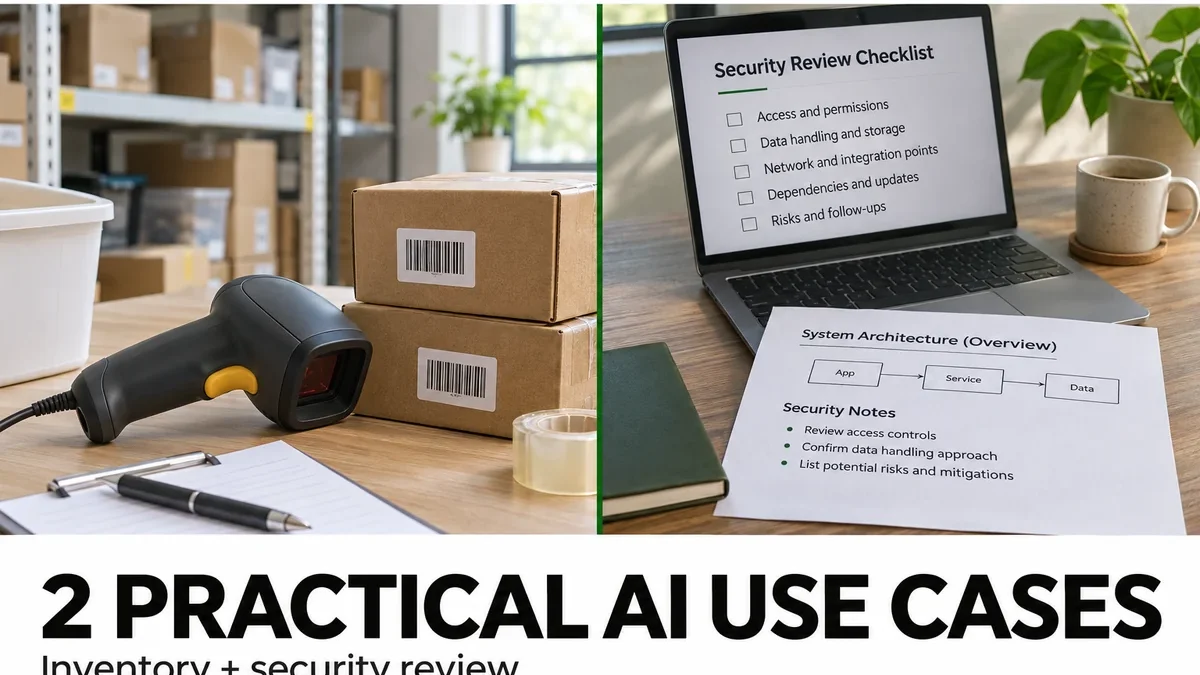
Two useful AI workflow ideas are easier to evaluate than a broad promise to “automate the business”: flagging inventory exceptions and organizing evidence before a security review. The examples below are illustrative, not claims that we interviewed named professionals or measured their results.
Example 1: prepare an inventory-exception list
A retail operator may already have sales and stock data from connected equipment. A published guide from MM Healthy Vending describes the use of sensors, purchase records and stock information. That account does not establish that every inventory record is correct or that an autonomous restocking system needs no human checks.
A bounded pilot could ask an assistant to flag mismatches between expected and recorded stock. An operator then checks a sample and decides what action is justified. A missing record, delayed synchronization or counting error should remain a possible explanation.
Compare the supplied stock and sales records. List discrepancies with the source rows and dates. Do not change orders or dispatch a route. Put incomplete records in a separate review list.
Example 2: prepare questions for a security review
An assistant can be asked to organize supplied architecture notes and identify questions a reviewer needs to answer. That is preparation, not a security sign-off. A summary should distinguish a control described in a document from a control verified in the running system.
From these architecture notes, list the assets, trust boundaries and stated controls. For each control, show its source and identify what evidence would be needed to verify it. Do not declare the application secure.
This prompt is our example, not a tested security product or a claim about a named analyst’s process.
Keep source material separate from authority
OWASP’s prompt-injection guidance distinguishes trusted instructions from untrusted data and emphasizes permissions at the tool boundary. A document being summarized should not gain authority to send data, change settings or run an action merely because it contains an instruction to do so.
For a preparation task, start with read-only access and require appropriate review before consequential actions. Prompt wording alone does not enforce those boundaries.
What counts as success?
- The result points to the source evidence.
- Missing information stays visible.
- A reviewer can check the work without reconstructing it entirely.
- The process creates no unintended external action.
- Measured time savings include checking and rework.
The earlier interview quotations and claims that manual inventory audits had been eliminated were not supported by evidence available for this review. They have been removed. The useful idea remains: test a narrow preparation task before delegating a decision.
Sources and scope
Source check: November 17, 2026. Removed unverified interviews and elimination-of-audit claims; replaced them with labelled inventory and security-preparation examples. This is source-based reporting and editorial analysis, not a hands-on product or investment test.