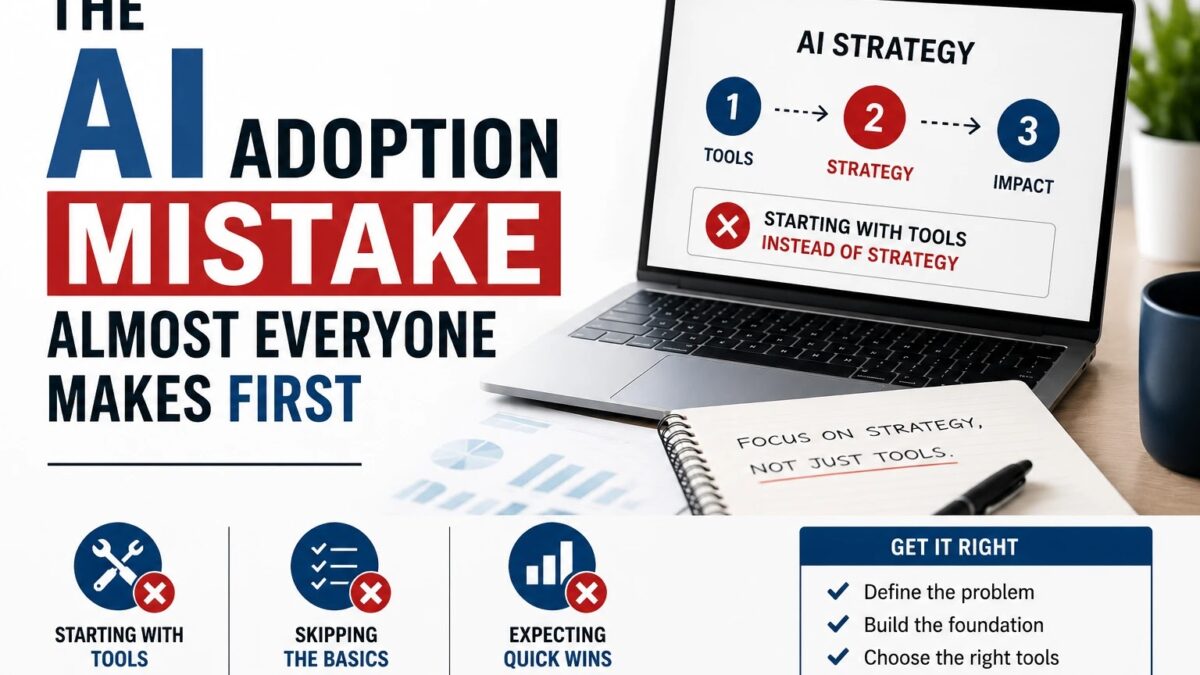
A common AI adoption mistake is giving a tool responsibility for a whole job before defining the evidence and review the job needs. The two workflows below are illustrative examples, not reports of verified customer deployments or original interviews.

Example 1: a service report that skips required fields
Imagine a service business asking an assistant to turn technician notes into a customer report. The draft reads smoothly, but it omits a required observation because nobody supplied the company’s reporting checklist. Fluent text is not evidence that the inspection was complete.
A better pilot provides the required fields and permits an explicit “not recorded” value. The assistant organizes information already captured; it does not invent measurements, infer the condition of equipment or replace a qualified person’s inspection.
Use only the supplied notes. Fill each field in this reporting template. If a required observation is missing, write NOT RECORDED and list it for human follow-up. Do not infer measurements or diagnose equipment.
This is a suggested prompt, not a safety control or a tested guarantee. A responsible reviewer still checks the report against the original notes before it reaches a customer.
Example 2: an estimate that assumes missing site details
Imagine a trades business using AI to prepare an installation estimate. The source information does not establish every site condition. Asking the assistant to produce a final price and schedule can conceal those gaps behind a confident-looking document.
Instead, ask for a list of missing information and a draft administrative checklist. A qualified person verifies physical conditions and the business approves the estimate. The assistant should not supply engineering specifications or treat a photograph as a complete site assessment.
Separate confirmed information from assumptions. List what a qualified reviewer must verify before approving this estimate. Leave price, installation method and dates unresolved where the source information is insufficient.
Define the boundary before expanding
- Name the task the assistant may perform.
- Identify the source material and required fields.
- Allow missing or uncertain information to remain visible.
- Choose a reviewer and a release condition.
- Record errors and rework during the pilot.
NIST’s AI Risk Management Framework is a voluntary framework for incorporating trustworthiness into AI design, use and evaluation. The workflows here are our examples, not NIST-certified procedures.
Measure whether the pilot helps
Count omissions, unsupported additions and review time as well as drafting time. If the reviewer must reconstruct the job from scratch, a faster first draft may not save effort. Narrow the task until the output is both useful and checkable.
The earlier version contained named-professional quotations whose original interview evidence we could not verify. Those quotations have been removed rather than being presented as confirmed reporting.
Sources and scope
Source check: November 17, 2026. Removed unverified interview quotations and contributor claims; replaced them with explicitly illustrative workflows. This is source-based reporting and editorial analysis, not a hands-on product or investment test.