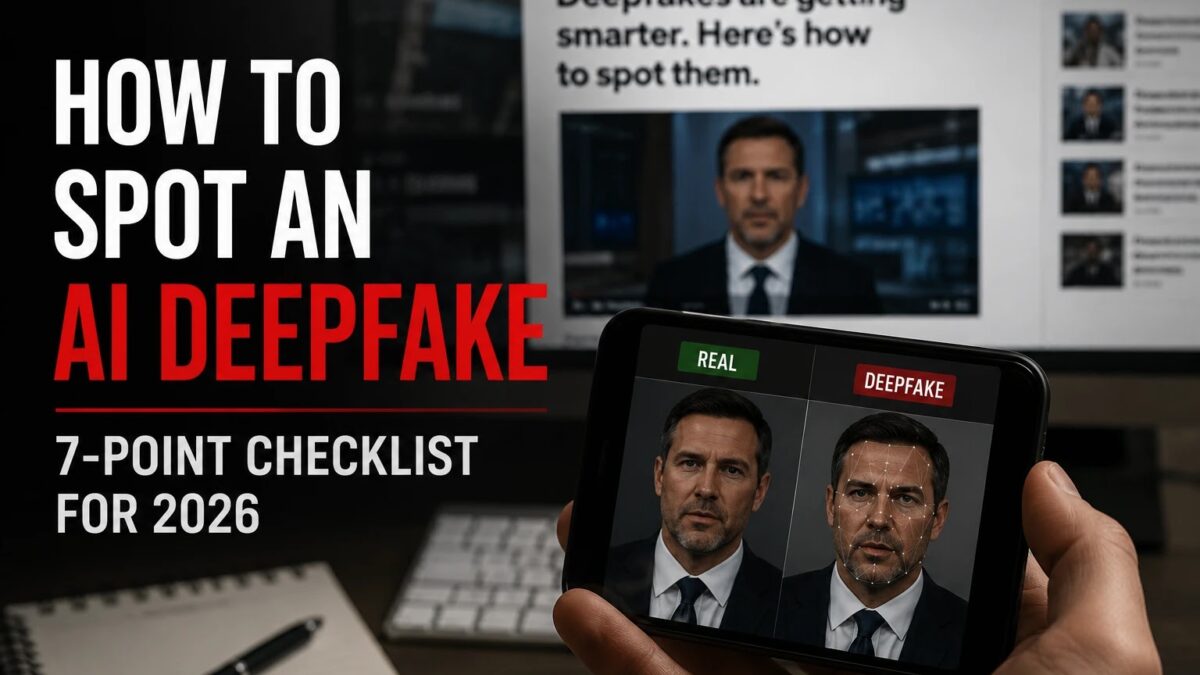
A deepfake checklist can help you investigate a suspicious claim, but visual oddities alone do not prove that an image, video or voice is AI-generated. Begin with the source and context, then use technical clues to guide further checks.

1. Identify the actual claim
Write down what the post asks you to believe: who appears, what happened, where and when. A genuine old video can still be shared with a false caption. Checking whether the media is synthetic is only one part of verifying the story.
2. Trace the earliest reliable source
Look for the original account, publication or full recording. Compare its date and description with the viral version. A repost with no attribution is a reason to investigate, not proof of fabrication.
3. Search for the image or representative frames
Use reverse-image search or a verification tool to look for earlier versions. If you find a match, inspect it rather than assuming the match proves the current caption. A cropped frame may omit the information that changes the meaning.
4. Compare independent evidence
Check whether reliable reporting, official records or another recording supports the same event. Several accounts copying one source are not independent confirmation. If nobody has enough evidence, keep the claim unresolved instead of filling the gap with a confident guess.
5. Inspect visual and audio inconsistencies
Hands, text, reflections, edges and lip synchronization may raise questions. Compression, editing, motion blur or a poor connection can also create artifacts. Blinking is not a dependable pass/fail test, and a clean-looking result is not proof of authenticity.
6. Treat detectors as supporting evidence
Read a detector’s limitations and avoid turning one score into a verdict. Record the tool and date if you use one. MIT’s Detect Fakes project provides research and exercises on human detection; it is not a guarantee that a short checklist can identify every current synthetic image.
7. Decide what to share
If the claim remains unverified, do not present it as fact. Save the original URL and explain what is known, what is disputed and what evidence is missing. Use an established fact-check if it addresses that exact media and claim, not merely a similar story.
A useful evidence note
Record: original post, earliest version found, claimed date/location, corroborating sources, suspicious details and unresolved questions. That note is more informative than “it looks AI” or “a detector said real.”
Our approach does not promise instant detection or assign accuracy to tools we have not tested. The earlier claims that hands or blinking are reliable modern giveaways, that search will find originals in seconds and that two or three clues establish a fake have been removed. For legal concerns or harmful impersonation, use the relevant platform’s reporting process and appropriate official advice.
Sources and scope
Source check: November 17, 2026. Replaced outdated visual-tell certainty with a source-first verification workflow; removed unsupported detector and turnaround guarantees. This is source-based reporting and editorial analysis, not a hands-on product or investment test.