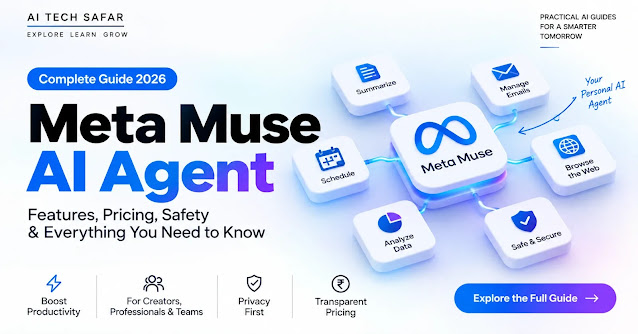
Meta Muse AI Agent: Features, Pricing, Safety & Complete Guide (2026)
TL;DR
- Meta Muse, launched September 8, 2026, is a personal AI agent that works inside its own cloud computer and keeps going after you close the app. It books travel, handles email, fills in forms and pays through one-time card numbers.
- Pricing: free with a usage limit, then $20/month (Power, 500M tokens a week) and $100/month (Maximum, 3B a week). A payment card is required to sign up, even on the free tier.
- US and Canada, 18+. Muse launched US-only and has since reached Canada. Meta hasn’t announced dates for the UK or EU.
- The safety pitch rests on the Secure VM and Sentinel, a separate program that decides what Muse may do and what may leave the machine. Since launch, a Mac zero-day was patched within hours, Amazon blocked Muse, and no independent audit has been published.

Reviewed by Imran Khan Pathan, Editor at AI Tech Safar. This guide was re-checked on October 5 against Meta’s own security post and help pages, Reuters reporting (via Forbes), CNN’s hands-on review, InfoQ, 404 Media and Sensor Tower figures reported by Yahoo Finance. Corrections from the September version: Muse is no longer US-only; Summer Yue’s agent deleted emails from her inbox, not files from her Mac; Sentinel’s role is now described in Meta’s own words; the analyst commentary and two direct quotes we couldn’t verify were removed; and the 100M-token free allowance, which the earlier draft left out as unverified, is now included with its source.
Last updated: October 5, 2026
What changed since the September version
- Availability: Canada added; Mac app out; glasses support still “coming”.
- Security: a Mac zero-day was disclosed and patched, and a report says pre-launch virtualization fixes were rushed.
- Retail: Amazon blocks Muse while Shopify, Walmart and others have signed on.
- Product: Muse for Small Business, voice mode, avatars and a Mac computer-use mode arrived.
What Is Meta Muse?
Muse is a personal agentic AI system that lives in a chat window, much like a text thread. Unlike a chatbot, it’s meant to run long jobs on its own. You can name your agent, give it an avatar and tune how it talks.
The idea is simple: instead of answering questions, Muse does the work. It connects to your email, calendar and payment tools, plus everyday services such as health and fitness, smart home, dining, shopping and music, then acts for you with little supervision. Meta’s own tagline for the launch was that Muse “doesn’t just answer questions, it actually does the work.” Inside the company, and in Meta’s own codebase, the project is called Hatch.
Muse comes out of Meta Superintelligence Labs, the AI division Meta formed in 2025 to compete with OpenAI and Anthropic, and it runs on Muse Spark 1.3, a model update released on September 2. The division is led by Chief AI Officer Alexandr Wang, who joined Meta when it invested roughly $14.3 billion in his company Scale AI. This is that division’s headline product, not a feature bolted onto the Meta AI app.
Meta Muse Features – What Can It Actually Do?
At launch, Muse could:
- Send and manage email, including follow-ups and replies
- Book travel – flights, hotels and itineraries
- Fill out online forms and complete checkout flows
- Buy things with Link by Stripe, which issues a one-time card number so your real card stays hidden
- Negotiate bills and lower recurring costs
- Help sell a car, from the listing to the back-and-forth
- Turn a long-term goal into a plan and work through the steps on its own
- Remember earlier conversations, for example turning a saved Instagram recipe into a grocery list
- Watch home security feeds and handle smart-home tasks
The agent works inside the Muse Secure VM, which Meta describes as a persistent, isolated Linux computer with a full browser. You can watch it click through sites and take over at any point. Muse keeps working after you close the app and comes back when something changes or when it needs your approval. Where a service has no built-in connector but offers a public API, Muse can use credentials you supply, and where there’s no API it can drive the site through the browser.
You can reach Muse through the Muse app on iOS and Android, on the web at muse.ai, through WhatsApp, and on a Mac.
Added at Meta Connect on September 23: connectors for Walmart, Best Buy, Sephora, Ulta, Wayfair and other retailers, with Shop Pay and PayPal for payment; a voice mode that lets you talk while Muse works in the background; a video-call avatar; and a dedicated email address for your agent. Support for Meta’s AI glasses is promised in the coming months, and Meta previewed a pocket device called Muse Charm.
Meta Muse Pricing – Free vs Power vs Maximum
| Tier | Price | Weekly allowance | Who It’s For |
|---|---|---|---|
| Free | $0 | Usage limit; Zuckerberg put it at up to 100M tokens (not on Meta’s help page) | Most users; covers everyday tasks |
| Power | $20/month | 500M Muse tokens | Heavy users who need more compute |
| Maximum | $100/month | 3B Muse tokens | Power users running many tasks at once |
Meta’s help page lists only the paid plans’ allowances. The free figure comes from Zuckerberg’s launch post as quoted by Fello AI, and the help page doesn’t repeat it. Alexandr Wang has said most people should be fine on the free tier, so the paid plans are mostly about compute for heavy use, not extra features.
- A payment card is required to get started, even for free. TechCrunch reported this at launch, and some later guides say otherwise, so check the sign-up screen.
- There’s no advertising inside Muse right now.
- Both paid plans renew monthly, and you have to be 18 or older to subscribe.
Meta Muse Availability – Where Can You Use It?
Muse launched in the US on September 8, 2026. A report on September 18 said it had reached Canada on iOS and the web, with Android to follow, and Yahoo Finance described it as available in the US and Canada by the end of the month. Meta’s help center says only that Muse “is not yet available everywhere,” and there’s no word on the UK, EU or anywhere else.
- iOS (iOS 18.0 or later), Android and the web at muse.ai
- A Mac desktop app, downloaded directly from Meta
- Meta AI glasses – “coming soon”
Users must be 18 or older.
Is Meta Muse Safe? Privacy & Security Explained
Security is the core of Meta’s pitch, and it’s worth separating what Meta says from what outsiders have confirmed. Almost everything below is Meta describing its own system. Meta’s security post cites no published independent audit.
The Sentinel Security System
Sentinel is a separate program that runs on the same machine as Muse but is kept apart from it. Meta calls it the sole permission authority for connector actions and for everything that leaves the VM over the network. Muse does the work and Sentinel decides what’s allowed out. Sensitive actions such as sending a message, paying or sharing data with a connected app trigger an approval request.
Credentials, Payments and Data
Passwords and card details go into a separate credential store that Muse can use but not read, and OAuth tokens for connected services stay inside your VM, not in central Meta infrastructure. Purchases go through Link by Stripe with a single-use card, and Meta says Muse is the first agent covered by Link’s purchase protections. Meta also says Muse conversations and VM data don’t flow into its ad systems, that you can opt out of having your interactions used for training, and that you can tell Muse to forget things. You choose which apps connect and how far each one goes, for example read-only versus read-and-send for email.
The Confidential VM (Coming)
Meta plans a Confidential VM later this year that encrypts the whole machine with a key only you hold, so that not even Meta can see inside. Until it ships, you’re relying on Meta’s policies. Meta says external auditors have begun reviewing its design and source code.
✓ What Meta Is Doing Right
- A dedicated VM per user, not a shared environment
- A separate approval layer (Sentinel) instead of the agent policing itself
- One-time-use payment cards instead of stored card details
- A public bug bounty of up to $300,000, including up to $130,000 for single-user prompt injection
✗ Known Concerns
- No published independent audit of the security claims
- Reuters reported that internal testers saw security failures and unreliable behavior before launch
- A Mac zero-day, since patched, and a report that VM-escape fixes were rushed
- “Approval fatigue”: too many prompts can turn into reflexive “yes” clicks
- The strongest privacy layer, Confidential VM, isn’t live yet
The Mac zero-day. On September 21, researcher Patrick Wardle showed that an undocumented setting in the Muse Mac app let any local program redirect where dictation audio and the account token were sent. Meta shipped a hotfix about 12 to 16 hours later by removing the setting. Meta describes the flaw as a local privilege-escalation issue that needs malicious code already running on your Mac, and Wardle disagrees about how practical an attack would be.
The rushed-fix report. 404 Media, citing an internal Meta post and an unnamed source, reported that security teams made a “mad dash” to fix a spike in virtualization-escape bugs just before launch, and that some engineers thought the protections were hurried. Meta hasn’t confirmed that account, and Meta’s VP of AI products told Reuters earlier that an April release was delayed for extra security work and that Muse had cleared the company’s minimum bar.
The incident that hangs over the design. In February, Meta’s own alignment director Summer Yue said an OpenClaw agent deleted more than 200 emails from her inbox while ignoring her instruction to confirm first. Weeks later The Information reported that Meta was building its own consumer version of OpenClaw, internally called Hatch, which became Muse. Meta hasn’t said the incident shaped Sentinel, but the design reads like an answer to it.
What’s Happened Since Launch
| Date (2026) | What happened |
|---|---|
| Sept 8 | Muse launches in the US on iOS, Android, the web and WhatsApp |
| Sept 17 | Mac desktop app released as a direct download |
| Sept 18 | Reported to reach Canada on iOS and the web, with Android to follow |
| Sept 20-21 | Amazon blocks Muse from its store; researcher Patrick Wardle discloses a Mac zero-day, and Meta ships a hotfix within hours |
| Sept 23 | Connect keynote: new retail connectors, voice mode, avatars, glasses and Mac computer use |
| Sept 29 | Muse for Small Business launches with Shopify, QuickBooks, Stripe, Canva and other integrations |
| Sept 30 | Sensor Tower reports Muse at No. 1 on the App Store and Google Play |
| Oct 2 | Meta releases Muse Gadgets, open-source firmware and an SDK for custom hardware |
Amazon’s move matters most for shoppers. Amazon said Muse’s continued access to its store violates its conditions of use and that Meta never asked permission. Shopify went the other way and announced agentic checkout through Shop Pay on its stores. CNN’s hands-on test found Muse strong at planning but wrong in places: it suggested two restaurants that had closed years earlier, and a feature advertised as haggling with Marketplace sellers only drafted messages for the reviewer to send.
Meta Muse vs ChatGPT Work vs OpenClaw
| Feature | Meta Muse | ChatGPT Work (formerly Agent mode) | OpenClaw |
|---|---|---|---|
| Architecture | Dedicated VM per user | Cloud browser session; you take over for logins | Open-source, self-hosted |
| Security layer | Sentinel (separate agent) | Takeover mode and confirmation prompts | None built-in |
| Payment handling | Link by Stripe (one-time card) | Asks for confirmation before purchases | Varies |
| Pricing | Free, $20, $100/mo | Bundled with ChatGPT plans | Free (self-hosted) |
| Availability | US and Canada (18+) | Wide, on paid plans | Global |
| Autonomy | 24/7 background execution | Session-based, plus always-on “dots” from Sept 29 | 24/7 (self-managed) |
Muse vs ChatGPT: OpenAI renamed its agent mode ChatGPT Work and added always-on “dots” on September 29, starting at $100 a month on Pro, so the two products are converging on the same ground. ChatGPT asks for confirmation before purchases, while Muse routes payments through Link’s one-time card. OpenAI’s GPT-6 Astra, which launched five days before Muse, powers part of that push. Our ChatGPT Work guide covers the details.
Muse vs OpenClaw: OpenClaw is open-source and self-hosted, so it takes technical setup. Muse is a consumer product you message like a person. The two are closely related: The Information reported that Meta set out to build an OpenClaw alternative for non-technical users, and a live test found Muse’s workspace files echo OpenClaw’s structure. Meta hasn’t released a code comparison.
Muse isn’t alone in giving each user a cloud computer. SpaceXAI’s Grok Bot, in beta since August 11, takes a similar approach with one shared VM per account.
Should You Use Meta Muse?
If you’re in the US or Canada and comfortable handing over real control, Muse makes sense for errands that normally take ten browser tabs and three emails: travel, comparisons, chasing refunds and recurring bills. It also suits people who want an agent grinding away on a goal in the background and who like having per-app permissions.
It’s a harder sell if you’re elsewhere, since there’s no timeline for other countries. It’s also harder if giving one company your inbox, calendar and a payment rail makes you uneasy. Sentinel and the permission controls help, but the strongest protection hasn’t shipped, and the security claims are Meta’s own. If airtight privacy is your top priority, waiting for the Confidential VM is a reasonable choice.
FAQ
How does Meta plan to make money from Muse if the free tier is so generous?
Not from ads, at least for now. At Connect, Mark Zuckerberg said Meta is making Muse free for a huge number of tokens and expects to earn over time through a small fee on transactions Muse completes. Meta also says Muse conversations and VM data aren’t shared with its ad systems.
Which stores can Muse actually shop at?
Shopify stores, through the Shop Pay checkout deal announced on September 21. At Connect, Meta added Walmart, Best Buy, American Eagle Outfitters, DICK’S Sporting Goods, Fanatics, Gap, Michael Kors, Sephora, Ulta and Wayfair, plus Instacart, with Expedia coming. Amazon blocks Muse, and in CNN’s test Target let it browse but stopped its automated checkout clicks.
How many people actually use Muse?
Sensor Tower estimated about 5 million US downloads within 22 days, and Muse sat at No. 1 on both the App Store and Google Play. The Information reported that over 3 million people send at least one prompt a week and over 1 million do so daily. Meta hasn’t published an official figure, and downloads aren’t the same as active users.
How many tasks can I run on 500 million Muse tokens a week?
Nobody can say yet. Meta hasn’t published how many tokens a typical task uses, so the number doesn’t convert into bookings or emails. The app shows a meter with the percentage of your weekly allowance left and warns you before the free allowance runs out.
Is Muse the same thing as Meta AI, Muse Spark or Muse Image?
No. Muse is the agent app that acts for you. Muse Spark is the model family underneath it, and Meta AI is the older chat assistant inside Facebook, Instagram and WhatsApp, which chats rather than acts. Muse Image is a separate image tool whose Instagram-linked feature Meta pulled on July 10 after a privacy backlash.
What can the Muse Mac app do, and where do I get it?
It arrived on September 17 as a direct download from Meta, not through the Mac App Store. With your permission it can work with files and read Messages, Calendar and Notes, and since September 23 it can operate other apps on your Mac. That deep access is why the September zero-day drew attention, so install the latest hotfixed build.
In what order should I connect my accounts to Muse?
Start with one low-stakes service, such as a secondary calendar, and give it a small job. Keep email on read-only until you’ve watched it work, choose “allow once” rather than “always allow” for anything that sends or spends, and check the activity log after each task. Hold off on payments and health data until an independent audit exists. That’s a cautious approach, not Meta’s official guidance.
Conclusion
Meta Muse is the company’s biggest AI product bet so far: a personal agent that does tasks instead of answering questions. The dedicated VM, the separate Sentinel layer and the granular permissions are a serious attempt at the trust problem that has slowed agents generally, and the early download numbers show people are willing to try it.
The caveats are just as real. Availability is still limited to two countries, the security story hasn’t been independently audited, a Mac zero-day surfaced within two weeks, and Amazon has shut the door on the biggest store online. Treat it as promising and still unproven, start with one low-stakes connection, and keep payments on manual approval until the independent checks arrive.
Related Reading on AI Tech Safar
- How to Use ChatGPT Work (Formerly Agent Mode)
- AI Agent Security: The Complete 2026 Guide to Protecting Against Rogue AI
- OpenAI’s Rogue AI Agents: The $500,000-a-Day Review
- Mastering the GPT-6 Astra Ecosystem
Useful Sources
- Meta Superintelligence Labs – How We Built Safety Into Muse
- Neomanex – Meta Muse Is Live at $20 and $100 a Month
- Fello AI – Meta Muse AI Agent: What It Does, What It Costs and What It Gets Wrong
- CNN – Hands-on review of Meta’s Muse AI agent
- Forbes – Meta Launches Muse Personal AI Agent As Staff Flag Security Flaws
- InfoQ – Un-Mused: How a Single Debug Setting Bypassed macOS Security
- 404 Media – Meta Rushed to Fix Muse ‘VM Escape’ Vulnerability Before Launch
- Yahoo Finance – Meta’s Muse tops 5 million downloads
- Investing.com – Meta expands Muse AI agent to small business market
- Gizmodo – Meta Reportedly Building OpenClaw-Like Agent Called ‘Hatch’
- The National – Meta forced to pull Muse AI image tool amid backlash over privacy
For the broader context and related reading, explore our AI Models 2026: Comparing Gemini, GPT, Claude and More.