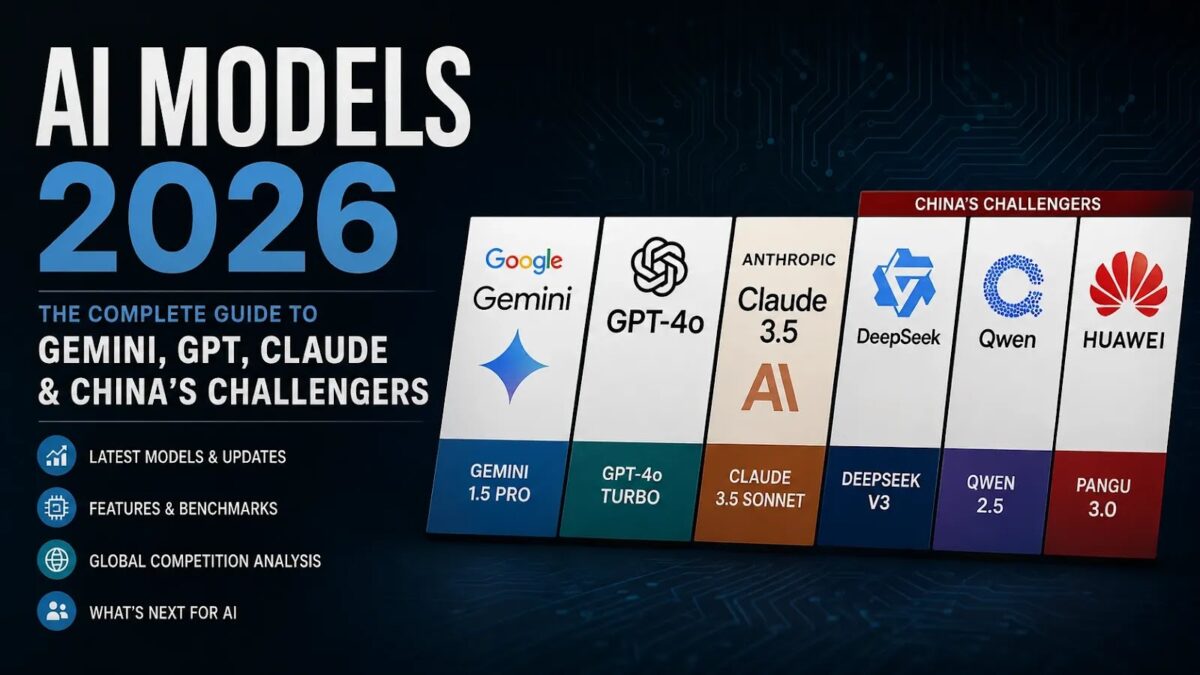
AI model comparisons are most useful when they distinguish a model, a consumer app and a tool-enabled workflow. This guide maps the main families and shows how to compare them without treating a single benchmark or an old default-model list as a permanent ranking.

Model family versus product
| Name | What to distinguish |
|---|---|
| OpenAI models and ChatGPT | The API model identifier, app plan and available tools can differ. |
| Anthropic models and Claude | Model capabilities, context and product allowances are separate questions. |
| Google models and Gemini products | A consumer account’s access is not the same as every developer or specialized model. |
| Qwen, Kimi, DeepSeek and other open-weight families | Check the exact release, license, serving setup and hardware requirements. |
Use the current provider catalog for release names and availability. This update removes the earlier table of supposed current leaders, outdated free-plan defaults and unsourced company-leadership claims.
Compare the same task
- Choose representative inputs and define success before testing.
- Record the exact model, date, effort settings and tools.
- Score factual correctness and task completion separately from style.
- Include latency, retries and review effort in the comparison.
- Keep failed outputs rather than reporting only the best example.
A benchmark may test coding, a particular form of reasoning or a tool-use harness. It does not establish that the model wins every writing, research or business workflow. Vendor results should remain attributed, and independent reproductions should be identified as such.
Access and deployment change the decision
Open weights can enable a different deployment approach, but the license and runtime still matter. A hosted app can make a workflow convenient while limiting model selection or tools. Compare the configuration you can actually use rather than a model name detached from its product.
Free access, a trial, API billing and an enterprise agreement have different limits and controls. Before choosing, inspect the current plan and test the feature required for your task. Do not assume that a paid chatbot subscription covers all developer usage.
A company-structure correction
OpenAI’s current structure page describes OpenAI Foundation controlling OpenAI Group PBC. The previous capped-profit description in this hub was outdated and has been removed. Governance is a separate topic from model quality.
How to use this hub
The existing topic map below points to model announcements, company explainers and tutorials. Read their sources and dates. This page is a navigation and evaluation guide, not an independently measured league table or a promise that any model is best for every reader.
Sources and scope
- OpenAI current model catalog
- Claude platform documentation
- Google DeepMind model families
- OpenAI current corporate structure
Source check: November 17, 2026. Removed stale model-leadership rankings, free-plan assumptions and outdated corporate-structure wording; preserved the internal model topic map. This is source-based reporting and editorial analysis, not a hands-on product or investment test.
Continue exploring this topic
Use these supporting articles to explore the topics in this guide. Reports describe the evidence available when each article was written; check its sources and date for context.
Google Gemini Updates
OpenAI & Anthropic Models
- GPT-6.2 Astra Leaks and Claude Fable 5.5: Claim Check
- OpenAI Math Papers: 722 Manuscripts and the Debate
- GPT-4o vs GPT-6 Astra: Features, Pricing and Migration
- Siri and Google Gemini: Apple's AI Strategy Explained
- ChatGPT Agent Mode: Workflows, Setup and Human Review
- Claude vs ChatGPT: Coding, Writing, Tools and Pricing
- Is Claude Down? Status Checks, Outages and Fixes
- Grok vs ChatGPT: Benchmarks, Pricing and Real-World Tasks
- GPT-5.6 Model Tiers: Sol, Terra and Luna Explained
China AI Models
- Kimi K3.1 Pro: Coding Benchmarks and Safety Trade-offs
- Moonshot AI Revenue Share Talks: The Kimi K3 Proposal
- Ox Alpha AI Model: OpenRouter's Stealth Model Explained
- Alibaba Qwen Downloads: The 3 Billion Claim Explained
- Chinese AI Founders: DeepSeek, Moonshot and Zhipu