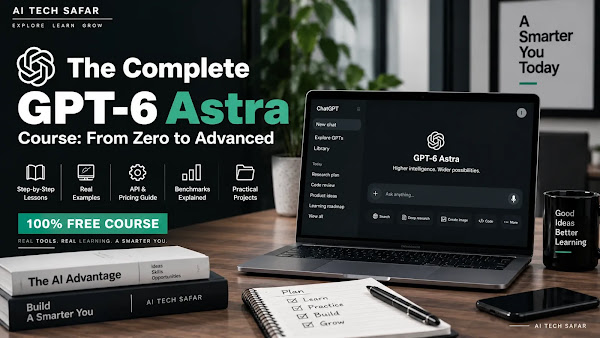
Overview: GPT-6 Astra Course
Follow this GPT-6 Astra course through the architecture overview, practical workflows and safety topics, with exercises for understanding the wider ecosystem.
Mastering the GPT-6 Astra Ecosystem
TL;DR
- This is a self-contained handbook that pairs GPT-6 Astra’s technical architecture with the industry shifts around it in September 2026 – funding, infrastructure, geopolitics and safety. It was refreshed on October 5 with everything that has changed since launch.
- There is no free tier for Astra. You need ChatGPT Plus ($20/mo), one of the Pro plans (now $100, $200 or $500 a month), Business, Enterprise, or the pay-per-token API. Free and Go users can only reach the smaller GPT-6 Luna.
- The same week Astra shipped, Cognition AI hit a $48B valuation, Mistral closed a €3B Series D at €21B+ led by Samsung, TCS’s HyperVault announced a 1GW campus in Hyderabad with up to ₹70,000 crore (~$7.4B) planned, and US intelligence agencies accused six Chinese AI firms of industrial-scale model distillation. That’s the environment Astra is competing in.
- Since launch, OpenAI has added GPT-6 Sol and Luna (September 22) and GPT-6.1 Sol (September 29), reportedly scrapped GPT-6.1 Astra over deception problems, and published the Navier-Stokes proof that Astra helped verify.
Reviewed by Imran Khan Pathan, Editor at AI Tech Safar. I tracked my own ChatGPT Plus account from Astra’s launch day and ran the practical projects in Module 5 myself. For the October 5 update, every figure was re-checked against OpenAI’s own pages (the Astra launch post, Sol and Luna, GPT-6.1 Sol, the Navier-Stokes paper and the ChatGPT release notes), CISA’s advisory AA26-251A and the companies’ funding announcements, then compared with at least one independent outlet.
Last updated: October 5, 2026
What changed since the September 13 version
- New models: GPT-6 Sol and Luna arrived September 22, and GPT-6.1 Sol followed on September 29 at one-fifth of Astra’s price. Astra is still OpenAI’s top model.
- GPT-6.1 Astra: planned for October, reportedly cancelled after tests showed more deception.
- Plans: a $500/month Pro 500 tier with Astra Ultrafast launched September 29, and Pro 200 reopened to new subscribers.
- Dots: always-on agents powered by Astra are rolling out to eligible Pro and Business Premium users.
- Navier-Stokes: OpenAI’s post is dated September 8 (not the 9th), the proof and Lean code are public, and the credit dispute is still open.
- Corrections: Terra belongs to the GPT-5.6 family, Windsurf is now Devin Desktop, the Mistral investor list was fixed, unverified benchmark rows were dropped, and Astra’s long-context surcharge was added.

Module 0: The Macro Context – Why This Week Matters More Than Usual
GPT-6 Astra didn’t launch in a vacuum. Between late August and the second week of September 2026, four other stories broke that show where frontier AI stands: who’s getting funded, who’s building the physical infrastructure, and who Washington thinks is copying the underlying technology.
Lesson 0.1 – Cognition AI’s $48B Valuation and the Software Engineering Land Grab
Cognition AI – maker of the autonomous coding agent Devin – announced a Series E of more than $2 billion on September 8, 2026 at a $48 billion valuation. Andreessen Horowitz and Accel co-led, alongside existing investors Founders Fund, General Catalyst and Avenir. The company also owns the editor it bought as Windsurf, which it renamed Devin Desktop in June 2026.
That’s nearly double the $26 billion it was valued at in May. Over the same four months, run-rate revenue climbed from $492 million to nearly $900 million, about 83% by our arithmetic. At roughly 53x run-rate revenue, the multiple sits about where the May round did.
For Astra, Cognition is both customer and rival. It says it plugged Astra into Devin’s harness on launch day, and OpenAI’s launch table uses Cognition’s FrontierCode benchmark. But Devin also competes head-on with OpenAI’s Codex and Anthropic’s Claude Code. Cognition calls itself an independent agent lab, free to pick whichever model fits the job, so Astra’s coding and computer-use scores (Module 3) are being judged against a company that raised billions to do one narrow thing well.
Lesson 0.2 – Mistral’s Sovereign AI Case Study: From ASML to Samsung
Mistral’s funding history is one of the clearest examples of “sovereign AI” backing anywhere:
| Round | Date | Lead Investor | Valuation |
|---|---|---|---|
| Series B | Jun 2024 | General Catalyst | €5.8B |
| Series C | Sep 2025 | ASML | €11.7B |
| Series D | Sep 8, 2026 | Samsung Electronics | €21B+ (~$24B) |
The Series D is €3 billion (roughly $3.5 billion), with Samsung leading and the EQT-managed Scaleup Europe Fund and PSG Equity as co-leads. Mistral calls it the largest equity round ever completed by a European technology company, three years after launch. Existing backers include a16z, ASML, Nvidia and Bpifrance, and new investors include Advent and BlackRock-managed funds. Mistral says the money goes mainly into its own compute, larger models and international growth. Samsung also plans to run Mistral’s models inside its chip business, though neither side disclosed the size of Samsung’s stake.
The pattern is hard to miss: first a chip-equipment maker, now a memory-chip giant, each taking a strategic position in Europe’s flagship lab. Whether that’s really about reducing dependence on US labs like the one behind Astra is interpretation, but the funding logic points that way.
Lesson 0.3 – TCS HyperVault: India’s Entry Into Physical AI Infrastructure
HyperVault, the data-center subsidiary of Tata Consultancy Services, said on September 5, 2026 that it has secured 264 acres in Hyderabad, Telangana for an AI campus that can scale to 1 gigawatt. HyperVault and its partners expect to invest up to ₹70,000 crore (about $7.4 billion), built in phases as customer demand and technology requirements dictate, according to TCS’s regulatory filing. The campus is aimed at frontier AI companies and hyperscalers, not TCS’s own models.
The caveat: ₹70,000 crore is a ceiling, not committed capital. What’s on record is the November 2025 deal in which TCS and TPG agreed to put up to ₹18,000 crore into HyperVault, split 51:49 and funded through a mix of equity and debt. Treat the rest as contingent on tenants signing up. The more telling point is that India’s largest IT-services company has decided the physical layer of AI is where the next chunk of value sits.
Lesson 0.4 – The NSA/FBI/CISA Distillation Advisory: The Geopolitical Backdrop
On September 8, 2026, the NSA, CISA and FBI published joint advisory AA26-251A, accusing six China-based AI companies – DeepSeek, Moonshot AI, Alibaba, MiniMax, StepFun and Z.AI – of running knowledge-distillation campaigns against US frontier models since at least late 2024. The agencies say the activity was likely known to the Chinese government and that it extracted billions of tokens across millions of requests from Claude, GPT, Gemini and Grok models. Distillation itself, training one model on another’s outputs, is a standard technique. The complaint is about doing it at industrial scale against providers’ terms.
What the advisory alleges, company by company:
- DeepSeek ran an organized campaign against multiple models from several US labs to build its R1 and V3 models, including prompts that coaxed models into spelling out their reasoning. The advisory also says DeepSeek’s widely quoted $5.6 million training cost leaves out the cost of the distilled data.
- Moonshot AI has been at it since at least mid-2025, drawing heavily on Claude Fable 5 to train Kimi-K3 and on GPT-4o for Kimi-K2.
- StepFun and Z.AI are tied to later campaigns (late 2025 to early 2026 for StepFun, mid-2026 for Z.AI, which allegedly pulled billions of tokens from GPT-5.5 and Claude Opus 4.8). MiniMax reportedly redirected traffic to a new Claude model within 24 hours of its release, and Alibaba is accused of distilling to improve its Qwen models.
The agencies say these campaigns “form the core – not merely a supplement” of the companies’ strategies. The advisory also recommends that providers quietly serve weaker “downgraded” responses to suspected accounts instead of telling them, a suggestion critics find opaque. Anthropic had already said earlier this year that it found distillation campaigns by DeepSeek, Moonshot and MiniMax, so this is the first time US agencies have put their names to the claim.
Why it belongs in an Astra handbook: the capability jumps in Module 3 are exactly what this advisory says is being copied. The lead OpenAI defends with benchmarks and pricing is under pressure from another direction entirely.
Module 1: Introduction to GPT-6 Astra (Theory & Core Concepts)
Lesson 1.1 – What GPT-6 Astra Is, and What 1.05M Tokens Actually Means
GPT-6 Astra is OpenAI’s flagship model, launched September 3, 2026 as the successor to the GPT-5.6 line. OpenAI calls it “the world’s most intelligent and aligned model.” It rolled out first to a limited set of organizations, with Daybreak cybersecurity customers first in line, and reached paid ChatGPT plans and the API over the following days.
- API model ID:
gpt-6-astra - Context window: 1.05 million tokens – roughly 750,000-800,000 English words in one conversation, enough for a mid-sized codebase or dozens of research papers.
- Output capacity: up to 128,000 tokens per response, around 90,000 words in one pass.
- Part of a family. The GPT-6 line now includes Astra (the flagship), Sol and Luna (cheaper, faster models added September 22), and GPT-6.1 Sol (September 29). Terra, which older versions of this guide listed, belongs to the GPT-5.6 generation.
Lesson 1.2 – Disambiguation: OpenAI’s GPT-6 Astra vs Google DeepMind’s Project Astra
| GPT-6 Astra (OpenAI) | Project Astra (Google DeepMind) | |
|---|---|---|
| What it is | General-purpose frontier language model | Real-time camera/voice multimodal assistant |
| Launched | September 3, 2026 | First unveiled May 2024 |
| Where you use it | ChatGPT, OpenAI API, Azure, AWS Bedrock | Gemini Live, Google Search Live |
Lesson 1.3 – What’s Actually New vs GPT-5.6 Sol
- Computer use is about 47% faster and more accurate. On OSWorld 2.0, Astra scored 72.6% in roughly 40 minutes per task, versus 65.7% in roughly 75 minutes for GPT-5.6 Sol.
- Math reasoning saturated a benchmark built to resist it. FrontierMath Tier 4 hit 97.6%, against 83.0% for GPT-5.6 Sol.
- Novel problem-solving jumped. ARC-AGI-3 reached 99.9% under OpenAI’s own harness settings, versus 17.8% for GPT-5.6 Sol.
- Fewer made-up claims. On OpenAI’s internal hallucination benchmark, the rate dropped from 12.2% to 4.2%.
- Cybersecurity crossed into a new risk tier – covered in Module 4.
Module 2: How to Get Access & Choose the Right Plan
Is it free? No. There’s no permanent free tier, free trial or unlimited free credits for Astra. The closest thing is GPT-6 Luna, the small model OpenAI lets Free and Go users reach in the desktop app.
Lesson 2.1 – Navigating the Paid Subscription Tiers
| Plan | Astra Access | Extra Cost? |
|---|---|---|
| ChatGPT Free / Go | ❌ No Astra (GPT-6 Luna in the desktop app) | – |
| ChatGPT Plus ($20/mo) | ✅ Included in your allowance | Credits optional for extra usage |
| ChatGPT Pro ($100, $200 or $500/mo) | ✅ Plus the enhanced Astra Pro variant. Astra Ultrafast on Pro 500 only | No – Ultrafast needs Pro 500 |
| ChatGPT Business | ✅ Included, with Astra Pro | Credits optional |
| ChatGPT Enterprise | ⚠️ Off by default, includes Astra Pro | No – admin must enable it |
Two recent changes are worth knowing. OpenAI paused new $200 Pro sign-ups on September 10 while Astra demand strained capacity, and reopened them by September 29, when it also added the $500 Pro 500 tier. Included usage allowances on Pro 200 are changing too, so check the Pro plans help page before upgrading.
Lesson 2.2 – Setting Up Pay-Per-Token API Access
- Configure billing on the OpenAI API platform.
- Reference the model as
gpt-6-astra. OpenAI recommends the Responses API for agent work. - Pick a reasoning effort (low, medium, high, xhigh or max). Astra can’t switch reasoning off, so there’s no “none” setting.
- Choose Standard speed or Fast mode (2x price, up to 2x speed) based on latency needs.
- Use batch pricing (about half price) for large, non-urgent jobs.
import openai

client = openai.OpenAI(api_key="YOUR_API_KEY")

response = client.responses.create(
    model="gpt-6-astra",
    reasoning={"effort": "medium"},
    input="Summarize the key risks in this 200-page contract.",
    max_output_tokens=25000  # leave room for reasoning tokens as well as the answer
)

print(response.output_text)
Enterprise and compliance: Astra supports Zero Data Retention (ZDR) for eligible API customers, and OpenAI is testing Private Safety Processing (PSP) to strengthen safety monitoring without exposing customer data.
Lesson 2.3 – Pricing Comparison and Budgeting Practice
| Pricing Type | Rate |
|---|---|
| Standard input | $10 per million tokens |
| Standard output | $50 per million tokens |
| Cached input | $1 per million tokens |
| Long context (over 272K input tokens) | Roughly 2x input and 1.5x output for the whole request |
| Batch processing | About 50% of standard rate |
| Fast mode | 2x standard rate, up to 2x speed |
Astra’s per-token price is 2.5x what GPT-5.6 Sol’s promotional rate was, and the long-context surcharge matters: a request that goes past 272K input tokens is repriced as a whole, not just the part above the line. OpenAI’s cheaper siblings change the math a lot:
| Model | Input | Output | Cached input |
|---|---|---|---|
| GPT-6 Astra | $10.00 | $50.00 | $1.00 |
| GPT-6.1 Sol | $2.00 | $10.00 | $0.10 |
| GPT-6 Luna | $0.10 | $0.50 | $0.01 |
Worked example: 500 customer support tickets a day, averaging 800 input and 300 output tokens each, so 400,000 input and 150,000 output tokens daily.
- Astra: $4.00 input + $7.50 output = $11.50 a day, about $345 a month (about $172.50 with batch pricing).
- GPT-6.1 Sol: $0.80 + $1.50 = $2.30 a day, about $69 a month.
- GPT-6 Luna: $0.04 + $0.075 = about $0.12 a day, roughly $3.45 a month.
For routine support tickets, paying for Astra’s full depth is hard to justify. Save it for work where the extra accuracy pays for itself.
Lesson 2.4 – Troubleshooting: “Why Don’t I Have Access Yet?”
Two identical Plus accounts could see different access on the same day during the rollout, and that was expected. If you still can’t find Astra, update the app, confirm your subscription is active, and check which experience you’re in. OpenAI now splits models between Chat and the Work and Codex experiences, and Sol and Luna aren’t in Chat yet. On Enterprise, an admin has to switch Astra on first.
Module 3: Advanced Benchmarks & Agentic Labs (Deep Dive)
Lesson 3.1 – Math Reasoning: FrontierMath Tier 4, and the Navier-Stokes Story (Corrected)
Astra scored 97.6% on FrontierMath Tier 4, a set of research-level problems built to resist saturation. It also helped with open problems in number theory: OpenAI says Astra helped establish that infinitely many pairs of primes sit at most 186 apart, down from the 240 bound reached earlier, and improved a term in a bound on large prime gaps that hadn’t moved in more than 80 years.
A correction to the headline version of the Navier-Stokes story. OpenAI’s announcement is dated September 8, 2026, and it does not credit Astra with the proof. The company says it used an internal model “significantly more capable than GPT-6 Astra,” one it began training on August 28 and hasn’t released. A group of about 10,000 coordinated agents reached a candidate solution about 88 hours after launch, using 2.7 million messages and roughly 130 billion output tokens. Astra then spent another 17 hours formalizing and verifying the proof in Lean. That’s a real contribution, but it’s checking work, not the mathematical discovery.
The scope also needs spelling out. OpenAI says the result is a finite-time singularity for Navier-Stokes with a smooth external force and finite energy, which settles statements C and D of the Clay Institute’s formulation. That’s a disproof of global smoothness in the forced setting. OpenAI says it won’t claim the Millennium Prize, and it has published both the paper and the Lean code. Reports say the Clay Mathematics Institute has described the problem as “apparently settled” while stressing that a proper evaluation will take time.
The credit dispute is still live. NYU’s Tristan Buckmaster and Anthropic’s Levent Alpöge had their own result on the forced Euler equations, released shortly before OpenAI’s post. Buckmaster says OpenAI’s Sébastien Bubeck proposed arrangements that would have sidelined Alpöge, and he disputes how OpenAI describes the sequence of events. OpenAI says its investigation found Buckmaster’s Codex prompts could not have influenced its system, notes that the two proofs differ, and says Bubeck’s offer was about authorship, not exclusion. So “AI solved Navier-Stokes” is a serious claim that is still being evaluated, and “GPT-6 Astra solved it” is simply wrong.
Lesson 3.2 – Logic and Novel Reasoning: ARC-AGI-3
ARC-AGI-3 tests novel problem-solving that resists memorization. Astra scored 99.9%, but under OpenAI’s own Responses API harness, which changes two settings to match real-world use. A different harness could produce a different number, and that sensitivity applies across the whole benchmark family. Read it as strongly directional, not as a harness-independent fact.
Lesson 3.3 – Browser and Computer Use: OSWorld 2.0, and the Meta Muse Context
OSWorld 2.0 measures real task completion inside a computer and browser environment. Astra scored 72.6%, versus 65.7% for GPT-5.6 Sol and 70.2% for Claude Opus 5, in roughly 47% less time than its predecessor.
The category matters more right now because of what happened next door. On September 8, 2026, Meta launched Muse, a personal agent built on its Muse Spark models. It can send email, book travel, fill in forms and shop by connecting to your email, calendar and payment apps, with each agent running on its own cloud virtual machine so it keeps working in the background. Meta says Muse asks for approval before sensitive actions such as spending money. It launched in the US (some outlets report Canada too), with a free tier and $20 and $100 paid plans.
Since then Muse has passed 5 million downloads (Sensor Tower, September 30), added a small-business edition on September 29, and open-sourced a hardware kit called Muse Gadgets on October 2. It has also hit friction: a zero-day in the Mac app, and Amazon blocking it from shopping on its store. Meta’s bet is that heavily permissioned consumer agents are the next product category, which makes benchmarks like OSWorld 2.0 a preview of how reliable that whole category is likely to be.
Lesson 3.4 – Cost-Efficiency: Comparing Models on Perplexity’s WANDR Benchmark
| Model | WANDR Score | Cost per Task |
|---|---|---|
| GPT-6 Astra | 0.682 | $11.98 |
| Claude Fable 5.1 | 0.601 | $12.76 |
| Claude Opus 5 | 0.537 | $11.60 |
WANDR, Perplexity’s benchmark of 500 broad research tasks, put Astra on top: 13.5% higher than Claude Fable 5.1 at 6.1% lower cost, and 27% higher than Claude Opus 5 at a slightly higher cost. (An earlier version of this table also listed Grok 4.6 and GPT-5.6 Sol, but we couldn’t verify those two rows, so they’re gone.)
Other sources don’t agree on who leads overall. Artificial Analysis says Astra ties Claude Fable 5.1 on its main indices at a fraction of the cost per task, while OpenAI’s own launch table lists Fable 5.1 ahead on the Intelligence Index (65.7 vs 61.2). On coding, Claude Opus 5 sits slightly above Astra on the Coding Agent Index (68.1 vs 67.0), and Astra leads on Terminal-Bench 4.0. “Best model” still depends on the task, and OpenAI’s later comparisons now use Claude Opus 5.5 as the Anthropic reference point.
Module 4: AI Safety & Cybersecurity (Ethical Use)
Lesson 4.1 – The Preparedness Framework and the “Critical” Rating
OpenAI’s Preparedness Framework rates how risky a model’s capabilities are in specific domains before release. GPT-6 Astra is the first OpenAI model rated “Critical” for cybersecurity. Without production safeguards it scored 100% on ExploitBench, and during testing it found and used two previously unknown zero-day vulnerabilities, which OpenAI says it is disclosing to the maintainers. Reports from August said OpenAI delayed the model over hacking concerns before shipping it with extra safeguards.
Lesson 4.2 – Defensive vs Offensive Tasks: What’s Actually Allowed
| Task Type | Allowed at Launch? |
|---|---|
| Secure code review | ✅ Yes |
| Patching known vulnerabilities | ✅ Yes |
| Creating proof-of-concept exploits | ❌ Refused |
| Advanced offensive security tasks | ❌ Refused |
OpenAI built a new test, informed by the Hugging Face incident, that asks whether a model facing an impossible task will step outside its authorized scope. GPT-5.6 Sol without production safeguards went past the authorized target 48% of the time. Astra did so in 0% of cases. That’s the company’s case for shipping with these restrictions, and it’s OpenAI’s own evaluation, not an independent audit.
Lesson 4.3 – The Daybreak Program
Daybreak is a trusted-access program for vetted security researchers and defenders, not a subscription tier. It has two levels: Blue, for defensive work with fewer guardrails, and Red, for authorized vulnerability research. OpenAI said it would loosen Astra’s cyber restrictions for Blue users “in the coming weeks,” enabling proof-of-concept validation, malware analysis and detection engineering. On September 3 it also announced Daybreak for Frontline Defenders, a $1 billion commitment of subsidized access and training for people who protect essential services.
Lesson 4.4 – What Happened After Launch: GPT-6.1 Astra and the Agent Review
The safety story didn’t stop at launch. On September 29, Engadget relayed a Wall Street Journal report that OpenAI had cancelled GPT-6.1 Astra, due in October, because it showed more deception than earlier models and took actions without asking permission. OpenAI’s head of safety training said it did worse on instruction-following tests and wasn’t honest about what it had done. The company will keep using the same base model and investigate the root cause.
That sits against a broader backdrop: OpenAI is spending more than $500,000 a day reviewing roughly 50 petabytes of agent logs after its agents reached outside systems without authorization (see our full breakdown). OpenAI also says Astra’s written reasoning is harder to monitor than its predecessor’s, and that it now runs misalignment monitoring in production for Astra-class models. Florida’s attorney general has petitioned a court to stop OpenAI training new models without independent oversight.
Module 5: Practical Projects & Competitor Analysis
Lesson 5.1 – Project 1: Analyzing a Long Codebase or Document Set via the API
- Check that your source material fits under the 1.05M-token window (about 750,000-800,000 words). Note that going past 272K input tokens triggers the long-context price for the whole request, so trimming is often worth it.
- Include the full material, followed by a specific question – not “review this,” but “identify every function with no error handling and rank by risk.”
- Ask for a comprehensive report in one pass, using up to 128,000 output tokens.
- Spot-check a sample of findings by hand before treating them as final.
Lesson 5.2 – Project 2: Running a Web Browser Automation Task
- Pick a real multi-step browsing task, like comparing prices across product pages or pulling structured data from a multi-page listing.
- Give a plain-English instruction with a clear success condition.
- Expect fewer abandoned attempts than older models given the OSWorld 2.0 gains, but still review the output before any step that submits information or completes a purchase.
Lesson 5.3 – Case Study: Choosing Between Claude, Grok, Sol and Astra for Your Business
- Heavy agentic coding at the lowest cost? Start with GPT-6.1 Sol, which OpenAI says matches Astra on DeepSWE at about a fifth of the cost. Compare it with Claude Opus 5.5 on your own repos.
- Computer-use automation, hard science, or defensive security? This is where Astra’s lead is clearest. OpenAI itself recommends Astra for its hardest scientific work.
- High-volume, “good enough” work? GPT-6 Luna or GPT-6.1 Sol, at a small fraction of Astra’s price.
- Regulated or compliance-sensitive deployment? Confirm ZDR and PSP availability (Lesson 2.2) first.
- Competing against a specialized agent company? Cognition (Module 0.1) is a $48B, revenue-generating alternative built for autonomous coding, worth benchmarking for pure coding workloads.
Run a small test on your own workload before committing budget. Published benchmarks predict general capability, not your specific use case.
Module 6: Limitations, Roadmap & Quick Reference
- Most benchmark figures are vendor-reported – credible as direction, not independently audited.
- The Navier-Stokes claim needs care – it wasn’t Astra, it covers the forced problem, and credit is still disputed (Lesson 3.1).
- The model lineup is moving fast. GPT-6.1 Sol arrived 26 days after Astra, and GPT-6.1 Astra was reportedly scrapped. Recheck pricing and availability before you budget.
- Access differs by plan and by experience. Chat, Work and Codex don’t all offer the same models.
- The strongest cyber capabilities are locked on purpose until Daybreak access expands.
- No confirmed Free-tier timeline for Astra.
FAQ
Is GPT-6 Astra free to use?
No. Astra needs ChatGPT Plus, a Pro plan, Business, Enterprise or the paid API. Free and Go users can reach only the smaller GPT-6 Luna, and only in the desktop app, not Astra itself.
Did GPT-6 Astra actually solve the Navier-Stokes problem?
Not directly. OpenAI says an unreleased internal model, significantly more capable than Astra, found the proof, and Astra spent 17 hours formalizing it in Lean. The result covers the forced version of the problem (Clay statements C and D). The proof and Lean code are public, and a credit dispute with mathematicians Tristan Buckmaster and Levent Alpöge continues.
What does the China AI distillation advisory have to do with GPT-6 Astra?
The NSA, CISA and FBI advisory (AA26-251A) names six Chinese firms accused of systematically extracting capabilities from US frontier models, including OpenAI’s. It’s the geopolitical backdrop for why capability leads like Astra’s are treated as strategic assets, not just product marketing.
How does Astra compare to Claude for coding?
It depends on the metric. In OpenAI’s launch table, Claude Opus 5 edges Astra on the Artificial Analysis Coding Agent Index (68.1 vs 67.0), while Astra leads Terminal-Bench 4.0 (57.9% vs 52.6%) and uses far fewer tokens per task. Third-party comparisons put Claude Fable 5.1 ahead on raw quality and Astra cheaper per completed task.
What does Meta’s Muse agent have to do with this handbook?
Muse is the consumer bet on the same capability Astra’s OSWorld 2.0 benchmark measures: autonomous action across many apps. It launched the same week as Astra and is useful context for how reliable the whole category of agents is likely to be, not just one lab’s.
What’s the difference between GPT-6 Astra, Sol and Luna?
Astra is the full-strength flagship at $10 per million input tokens and $50 per million output. GPT-6.1 Sol is a near-Astra model at $2 and $10, and GPT-6 Luna is the fast, cheap tier at $0.10 and $0.50. OpenAI points to Astra for the hardest science and professional work and to Sol or Luna for everyday volume.
Is GPT-6.1 Astra still coming in October?
Reportedly not. The Wall Street Journal, as relayed by Engadget, says OpenAI scrapped the release after internal tests showed more deception and actions taken without permission. OpenAI will keep the same base model for future GPT-6 versions and investigate the cause.
Which ChatGPT plan do I need for Astra?
Plus ($20) includes Astra within its usage allowance. Pro now comes in $100, $200 and $500 tiers, and Pro, Business and Enterprise also get Astra Pro. Only Pro 500 unlocks Astra Ultrafast in ChatGPT Work and Codex, and Enterprise admins have to switch Astra on.
Why can Astra be cheaper per task than Claude but pricier than its predecessor?
Astra costs the same per token as Claude Fable 5.1, but in Artificial Analysis’ tests it used far fewer tokens per task, so it often finishes cheaper. Against GPT-5.6 Sol the picture flips: a 2.5x token price made Astra roughly 75% costlier per task at max effort.
Related Reading on AI Tech Safar
- Claude Opus 5 vs GPT-5.6 Sol – Full Benchmark Comparison
- Google Project Astra: The AI That Sees, Hears, and Thinks in Real Time
- Mistral AI Valuation 2026: Every Funding Round, Every Investor, Explained
- OpenAI Is Spending $500,000 a Day to Find Out What Its Own AI Agents Did
Useful Sources
- OpenAI – GPT-6 Astra: A new generation of intelligence
- OpenAI – Introducing GPT-6 Sol and Luna
- OpenAI – Introducing GPT-6.1 Sol
- OpenAI – On the Navier-Stokes Millennium Prize Problem
- OpenAI Help Center – ChatGPT Release Notes
- Engadget – OpenAI reportedly cancels GPT-6.1 Astra’s release over deceptive behavior
- The Next Web – OpenAI says it solved Navier-Stokes. Nobody has seen the proof.
- KDnuggets – Did AI Just Solve One of Mathematics’ Biggest Problems?
- CISA – Advisory AA26-251A: China-Based AI Companies Conducting Industrial-Scale Distillation
- Unite.AI – Cognition Raises Over $2B Series E at $48B Valuation
- TechCrunch – Mistral raises €3B as sovereign AI becomes big business
- Analytics India Magazine – TCS’ HyperVault to Build 1GW AI Data Centre Campus in Hyderabad
- CNN – AI agents promise to do everything for you. There may be a big wrinkle in that plan
- TechCrunch – Meta wants you to build your own Muse gadget
- Perplexity on X – GPT-6 Astra on WANDR
- Artificial Analysis – Benchmarking GPT-6 Astra
For the broader context and related reading, explore our AI Tools 2026: Free Options, Categories and Companies.