President Ferdinand Marcos Jr. has signed Executive Order 131, creating the National Artificial Intelligence Council (NAIC), also called the Philippines AI Council, and giving it a recurring deadline: within 30 days of the end of each quarter, it must report to him on how the country’s AI plans are progressing. Palace Press Officer Claire Castro announced EO 131 at a briefing on Saturday, November 14. Marcos signed it on Thursday, November 12. The order sets up a structure and a reporting schedule. It does not yet tell the public what will be funded first or how anyone can apply for support. Philippine News Agency report on the briefing · GMA News on the order’s provisions
Reviewed by Imran Khan Pathan, Editor at AI Tech Safar. This guide was checked against reporting by GMA News, Tech Pilipinas, ASTIG, Philstar, the Inquirer and the Philippine News Agency. We have not seen the order’s text on the Official Gazette site, so the provisions below are as those outlets describe them, and we say so where it matters.
Last updated: November 15, 2026.
Overview: Executive Order 131 and the National AI Council
Executive Order 131 does two things. It adopts the AI Governance Framework as the country’s “national strategic guide” for policy, regulatory coordination, institution-building and skills. And it creates the National Artificial Intelligence Council to coordinate, facilitate and monitor how agencies carry that framework out. It builds on the National AI Strategy that the government approved in May 2025.
The order puts AI oversight inside existing agencies and does not create a new regulator. That choice matters because AI decisions rarely belong to one office. Which public services could use AI, where reliable data will come from, who needs training and who pays for computing capacity all sit in different departments. The Philippines AI Council gives those questions a common place to land.
TL;DR
- The Executive Secretary chairs the NAIC. The secretary of the Department of Economy, Planning, and Development (DEPDev) is vice chair, and DEPDev serves as the secretariat.
- Five technical working groups will draft action plans on institutions, data and research, skills, infrastructure, and investment and adoption.
- Initial funding comes from the existing budgets of member agencies and other available funds. Later costs go through the annual budget process, and no new total has been announced.
- Agencies update progress every quarter. The council reports to the President within 30 days after each quarter ends and reviews the AI Governance Framework at least every two years.
- Micro, small and medium enterprises (MSMEs) and startups are named as intended beneficiaries, but the reporting we found gives no application date, grant amount or eligibility rules.
In this article
Table of Contents
What the Philippines AI Governance Framework says
The framework has four connected parts: ethics and principles, standards and assurance, a risk-based policy toolkit, and enabling resources such as skills, data and infrastructure. It asks that AI be developed and used according to transparency and explainability, security and safety, accountability and integrity, human-centricity, fairness and equity, and sustainable development. It also calls for technical standards, testing, evaluation and conformity assessments, with governance that matches the risk of each AI application. Existing sector regulators keep their mandates, according to Tech Pilipinas. ASTIG’s summary of the framework · Tech Pilipinas on sector regulators
The order takes effect immediately upon publication in the Official Gazette or a newspaper of general circulation. On November 14 and 15, Philstar and the Inquirer reported that the text had not yet been posted on the Gazette’s website, while Tech Pilipinas linked a Gazette page for the order. We could not open that page, so check the Gazette for the published text of Executive Order 131.
Who sits on the Philippines AI Council? NAIC members
The National Artificial Intelligence Council has a chairperson, a vice chairperson and ten members: nine from government and one from the private sector. It reports directly to the President.
| Seat | Who holds it |
|---|---|
| Chairperson | Executive Secretary |
| Vice chairperson | Secretary, Department of Economy, Planning, and Development |
| Members (government) | Secretaries of Information and Communications Technology, Science and Technology, Trade and Industry, Finance, Education, Labor and Employment, and Budget and Management; the chairperson of the Commission on Higher Education; the director general of the Technical Education and Skills Development Authority |
| Member (private sector) | One representative appointed by the President from nominees put forward by reputable business groups, for a three-year term that can be renewed once |
The NAIC may also invite local governments, state-owned corporations, universities, civil society and other stakeholders to its meetings as resource persons. National agencies, including government-owned corporations, are directed to support it, and local governments, the private sector, academe and civil society are encouraged to do so. GMA’s breakdown of the membership
The mix of seats is the interesting part. Technology, science and trade secretaries sit beside the officials who control budgets, schools and labour policy. Illustration, not from the order: an office that wants software to sort incoming letters can test whether the software recognizes a request. Someone still has to decide who checks a misrouted letter and who has authority to pay for the service next year. Putting the budget and education officials at the same table as the technology ones brings those decisions into one discussion.
For comparison with debates at other levels, AI Tech Safar has also covered the argument over global AI governance at the UN.
EO 131 working groups and the decisions they face
NAIC members are to organize technical working groups. Each one drafts an action plan that names responsible agencies, deliverables, timelines, resources and key performance indicators, according to Tech Pilipinas. The first two columns below follow the order as reported. The third column contains our examples of questions a good plan would have to answer; they are not in the order. Working-group and action-plan requirements
| Working group | Its brief under the order | A question for its first action plan (our example) |
|---|---|---|
| Institutions | Strengthen agencies’ capacity to govern AI. | Who handles an error that crosses departmental lines? |
| Data and Research Development | Advance basic and applied AI research, build trustworthy data systems that comply with data privacy laws, improve the availability and quality of datasets, and speed up digital transformation for data interoperability. | Who can correct an inaccurate record, and how does the correction reach users? |
| Capabilities | Create a national AI competency and digital workforce program, promote AI and digital literacy, and support scholarships for AI research, development and use. | What should someone be able to do after the training that they could not do before? |
| Infrastructure | Align with the Philippines AI Infrastructure Masterplan 2026-2033, expand affordable, reliable and secure digital infrastructure, encourage investment in computing, and build the energy and water needs of AI infrastructure into national resource planning. | What resources will a service need once the pilot ends? |
| Demand Generation | Mainstream responsible AI investment in public-sector planning and budgets, mobilize private investment through public-private partnerships, and promote innovative financing, including for MSMEs and startups. | Which obstacle keeps intended users from adopting a useful tool? |
These briefs overlap, which is why a shared council makes sense. Illustration, not from the order: a local-language information service could buy faster computing and still fail a caller whose district is missing from its reference data. A training course could help a caseworker spot a wrong answer, but if no office owns the source, the next caller gets the same mistake. A credible plan lets a reader trace a problem from the person who noticed it to the agency able to fix it.
How EO 131 is funded
Per GMA, initial funding for Executive Order 131 comes from the existing appropriations of NAIC member agencies and other available funds identified by the Department of Budget and Management, subject to the usual budgeting, accounting and auditing rules. The council’s later funding is to be included in member agencies’ annual budget proposals through the regular budget process. No single peso total for the framework has been reported. GMA on initial and subsequent funding
That is different from a new grant programme. A department can propose a programme, seek funds, receive an allocation and eventually spend it, and each stage leaves a different record. Illustration, not from the order: a scholarship for technical staff might start as a working-group recommendation. A prospective applicant needs more than that: a funded intake, entry criteria, dates and a way to apply. A vendor reading about government demand for AI faces the same gap, because a work programme can signal a priority long before there is a contract to bid on.
Why power and water appear in an AI order
The infrastructure group is told to include the energy and water requirements of AI infrastructure in national resource planning and to follow the 2026-2033 infrastructure masterplan. That changes how a computing proposal can be judged. A price per hour for running a model says little about whether capacity will be available where a service runs, or whether its operating costs fit next year’s budget. A plan that writes those assumptions down gives other agencies something specific to challenge before a purchase.
Quarterly reporting under Executive Order 131
The Department of Information and Communications Technology (DICT) is to build and maintain a digital platform for monitoring and reporting. Agencies submit and update their deliverables there every quarter. The Philippines AI Council reports to the President within 30 days after each quarter ends, and it reviews the framework at least once every two years, or sooner if technology, regulation or the market changes enough to warrant it. Its review can end with proposed amendments to the President. Implementation and reporting timetable
| Item | Deadline or interval |
|---|---|
| Effectivity | Upon publication in the Official Gazette or a newspaper of general circulation |
| Interim secretariat at DEPDev | Within 30 days of the order taking effect |
| Agency progress updates on the DICT platform | Every quarter |
| Council report to the President | Within 30 days after each quarter ends |
| Review of the framework | At least every two years, or earlier if warranted |
| Private-sector member’s term | Three years, renewable once |
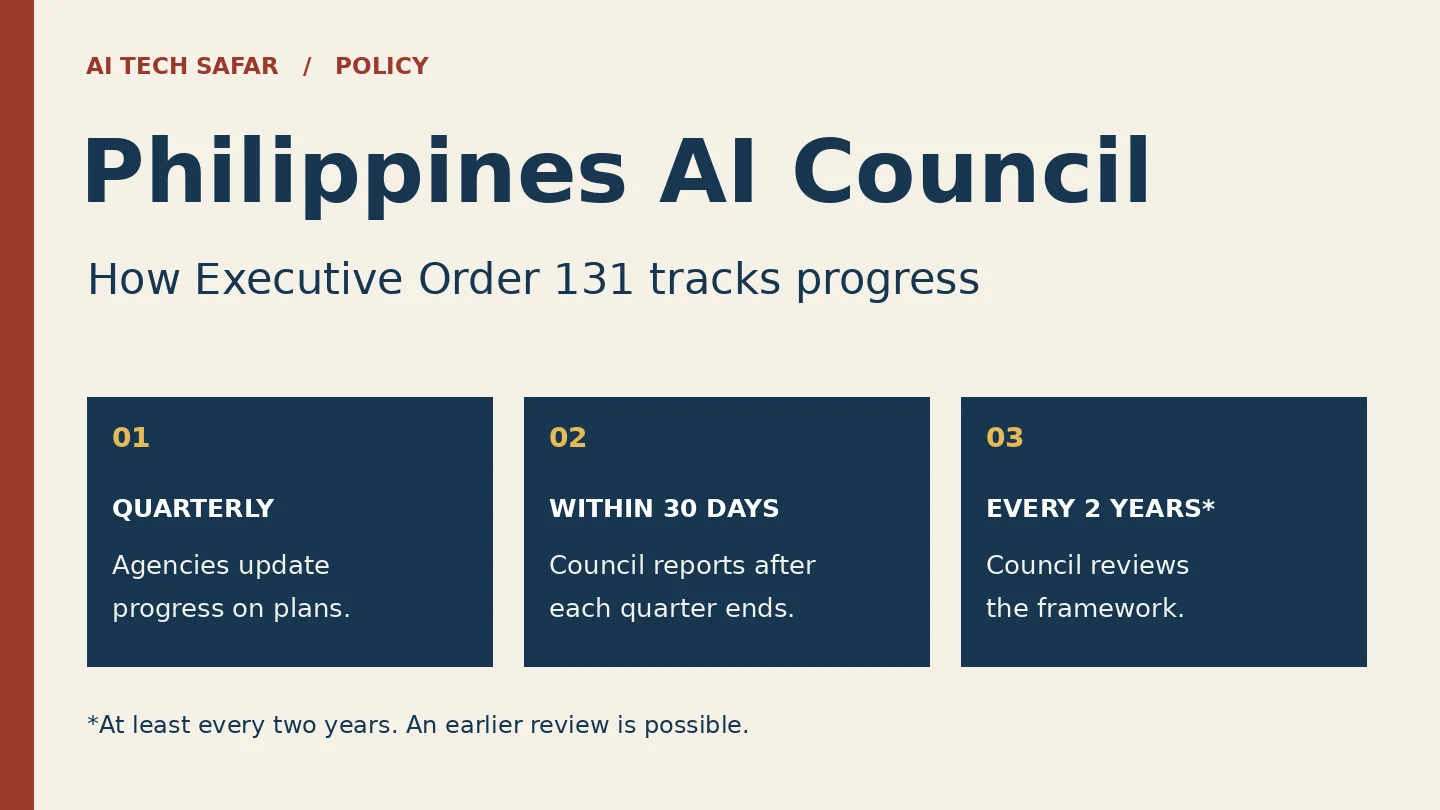
An agency progress update and a report to the President serve different readers. A project manager needs to know which work has stalled and who can restart it. The President might need to know that three projects depend on one unresolved decision. The order creates a path for that information to travel. It leaves an open question for the public: what part of the data, budget or reports will a worker, journalist or business owner be able to see? A tracking platform can help coordination inside government even if outsiders never see what is on it.
What the Philippines AI Council means for MSMEs and small businesses
On the same Saturday, Marcos addressed the ASEAN Business and Investment Summit by video message. As the Inquirer reported, he urged businesses across Southeast Asia to make AI tools more affordable and accessible to MSMEs so entrepreneurs can spend less time on repetitive tasks, use resources better and reach more customers. ASTIG added that the Philippines, as this year’s ASEAN chair, is pushing responsible AI use for MSMEs and the health sector. That was a regional appeal. Executive Order 131 creates a Philippine body. Together they show the government’s priorities, but a summit speech supplies no terms under which a Philippine business can claim help. Inquirer on the summit message · Philstar report
The Presidential Communications Office, as relayed by Tech Pilipinas, says the order is meant to encourage MSMEs and startups to invest in, develop and adopt AI, and to help workers adapt through skills training. The council may also recommend measures to protect the rights and welfare of workers and learners affected by AI-driven changes. Those are intentions.
Illustration, not from the order: a garment seller might adopt a tool that turns customer messages into orders, and then find it reads “replace size M with L” as a second order. The real cost of adoption includes checking exceptions, fixing mistakes and training the next employee. A useful support programme would say whether it covers that work and whether help is available after the first training session. A count of businesses trained answers neither question.
For readers in India, this is a Philippine policy decision. It can still help you read a future vendor announcement or regional partnership: look for the named implementing agency, the service on offer, its geographic scope and any eligibility rules. A firm considering a partnership in the Philippines would need the actual programme or procurement documents before planning a budget around it.
Our Read
The most promising feature of the order is the combination of named agencies, a budget process and repeated reports. Together they could make a stalled project easier to diagnose. Say an agency has the computing capacity it asked for but cannot use a dataset because nobody has agreed who can authorize access. If its report records only the capacity purchased, the project looks healthy. A report that names the missing decision and its owner gives the council a chance to act.
When the first action plans appear, we would look for three things: a baseline that shows how a service performs today, a measure that reflects the experience of the people using it, and an owner who can respond when that measure gets worse. For the letter-sorting example, that could mean tracking how often a letter reaches the right office on the first try and how long staff take to recover a misrouted one. ASTIG makes a related point: the first tests are whether agencies actually file their quarterly reports and whether the two-year review produces binding standards instead of another set of principles.
What remains unknown
The reporting identifies the decision-makers and the reporting intervals. It does not say which projects will be funded first, which indicators each working group will choose, how much of the progress platform will be public, or when an applicant might receive support. It also reports no budget figure for the council. Those are separate milestones worth covering as they happen. For now, the verifiable change is that departments have a common process for planning and reporting their AI work.
Frequently asked questions about EO 131
What is Executive Order 131?
Executive Order 131, titled “Adopting the Artificial Intelligence Governance Framework and Creating the National Artificial Intelligence Council,” adopts the Philippines’ AI Governance Framework and creates the National Artificial Intelligence Council to coordinate and monitor it. Marcos signed it on November 12, 2026.
When was the Philippines AI Council announced?
The Palace announced it on Saturday, November 14, 2026. Marcos had signed the order on Thursday, November 12.
Who leads the National AI Council, and how many members does it have?
The Executive Secretary chairs it, and the secretary of the Department of Economy, Planning, and Development is vice chair. Per GMA, there are twelve seats in total: a chairperson, a vice chairperson and ten members, of whom nine are government officials and one represents the private sector.
Does the order replace the country’s sector regulators?
No. Existing sector regulators keep their mandates, per Tech Pilipinas. The council coordinates agencies, addresses gaps and overlapping efforts, and monitors progress.
Where does the first round of EO 131 funding come from?
From the existing appropriations of member agencies and other available funds identified by the Department of Budget and Management. Later needs enter the annual budget process. The reporting gives no consolidated new spending figure.
Are agencies expected to report every two years?
No. Agencies update progress every quarter. The two-year interval is for the council’s review of the framework itself. The council also owes the President a report within 30 days after each quarter ends.
Is Executive Order 131 already in force?
It takes effect upon publication in the Official Gazette or a newspaper of general circulation. Outlets disagreed on November 14 and 15 about whether the Gazette had posted the text, so check the Gazette for the published version.
Can a small firm apply for AI support under EO 131 now?
Not based on the reporting we found. MSMEs and startups are named as intended beneficiaries of investment and adoption measures, but no application form, subsidy amount or eligibility criteria has been reported. A specific implementing programme would have to supply those.
Does this order apply across ASEAN?
No. It is a Philippine executive order. Marcos separately discussed regional AI adoption at the ASEAN business summit, but a regional speech does not extend the domestic council’s authority to other countries.
Editor’s Note: Earlier drafts of this article cited a source we could not verify and described Marcos’s summit remarks more broadly than the reporting supports. We corrected both and now label our own examples as illustrations.
Related reading on AI Tech Safar
- UN AI Governance: Global Standards and the US Response
- EU AI Act Compliance in 2026: The Complete Guide
- Global AI Policy: How Countries Regulate and Adopt AI
Useful sources
- Philippine News Agency — PBBM creates national council to oversee AI development, governance
- GMA News — Marcos signs EO adopting AI framework, creates national council
- Tech Pilipinas — Marcos signs EO 131 adopting national AI governance framework, creating National AI Council
- ASTIG — Marcos signs EO 131, creating a National AI Council and quarterly AI reports
- Inquirer — Marcos signs EO adopting AI governance framework, creating nat’l council
- Philstar — Marcos creates national AI council, adopts governance framework
- SunStar — Marcos signs EO for AI Governance Framework
- Official Gazette — Executive Order No. 131, s. 2026 (linked by Tech Pilipinas; check for the published text)