Reviewed by Imran Khan Pathan, Editor at AI Tech Safar.
On November 13, OpenAI launched ChatGPT Wallet with a deliberate pause built into checkout. An AI agent can find a product and prepare the order. Before it pays, the buyer sees what is in the basket, the amount and the card, then approves the purchase. Even after that approval, the shop can turn the order down. Those two decisions explain a great deal about what it means to shop through an agent. OpenAI’s launch announcement · Reuters coverage
ChatGPT Wallet overview
The first rollout is through dots, OpenAI’s personal agents, for eligible adult ChatGPT Pro users in the United States. American Express, Mastercard and Visa worked with OpenAI on the wallet. A merchant can receive a payment credential through its checkout while the shopper’s underlying card details stay out of the agent’s hands. For buyers, the immediate question is what they have agreed to buy. For sellers, it is whether their storefront can recognize a legitimate order arriving this way.
TL;DR
- The rollout starts with eligible US Pro subscribers aged 18 or over. OpenAI specifies a US billing address and an eligible US-issued credit card.
- The buyer approves an order before the agent submits it. A change to a material detail triggers a fresh approval under the Wallet terms.
- The payment network supplies a substitute credential linked to the selected card. The issuer can still decline the charge.
- The shop sets the price, accepts the order and handles fulfillment and returns. Its confirmation is the evidence to look for after checkout.
- OpenAI describes advance permission for purchases within spending or time limits as a future direction. The launch flow asks for approval on each purchase.
In this article
- How ChatGPT Wallet works
- Who decides whether an order goes through?
- What ChatGPT Wallet payment tokens protect
- Where a seller can lose the sale
- ChatGPT Wallet availability: US launch and India
- Our Read
- Frequently asked questions
How ChatGPT Wallet works
Picture someone ordering a medium black T-shirt as a gift. The agent finds the right design, selects the size and gets as far as checkout. The buyer now has a short but important job. Is it one shirt or a multipack? Does the total include delivery? Is it going to the recipient or to the address used for the last order? A plausible-looking product photo can answer none of those questions.
In OpenAI’s documented flow, the buyer checks the purchase request and completes a security step, such as a fingerprint check on a supported device. The agent then uses a payment credential linked to the chosen card to continue checkout. Setting up the card was a separate decision. It allowed ChatGPT Wallet to make that card available for a later transaction. OpenAI’s purchase walkthrough
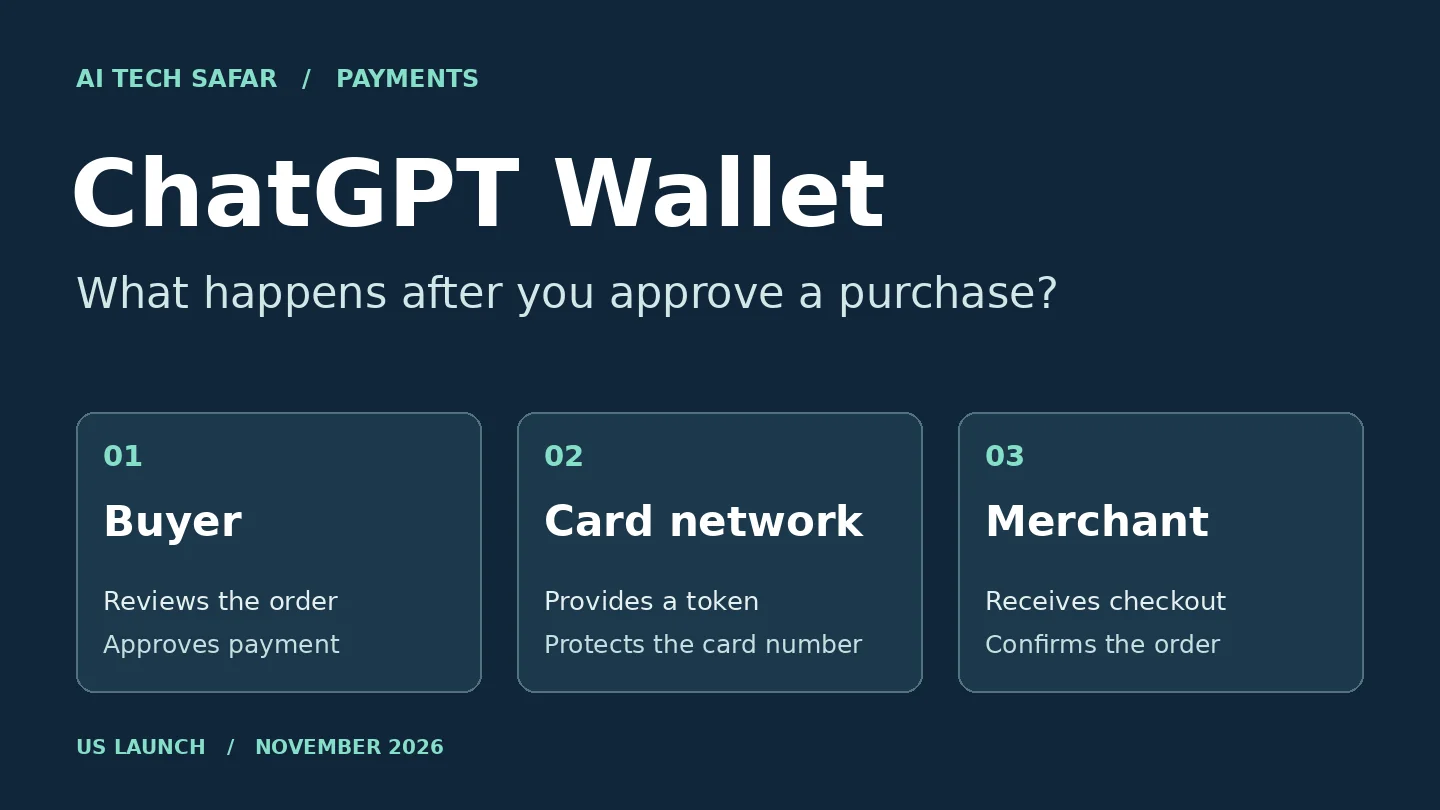
Now suppose the store runs out of medium before submission and offers a large. To the buyer these are different purchases even if they cost exactly the same. The Wallet terms tie approval to the details presented and require another approval when a material detail changes. This matters for agents because a perfectly sensible shopping instruction, such as “find something similar,” can be a poor instruction to follow once a payment is involved. Wallet terms, sections 4–6
Who decides whether an order goes through?
A familiar checkout compresses several decisions into a few seconds. A conversation can make them look like one event. Here is how to read the sequence if the agent says it is ready but no confirmation email has arrived.
| Stage | What has happened | What to look for next |
|---|---|---|
| Buyer approves | The buyer has agreed to the displayed purchase details. | The agent still has to submit checkout. |
| Issuer authorizes | The card issuer has allowed the payment request. A pending charge may appear. | Check whether the store accepted the order. |
| Store confirms | The seller has a record of the order. | Use its order number for delivery questions or a return. |
Suppose the browser closes just after approval. A second attempt might be harmless if the first order never arrived, or it might buy the same shirt twice. The useful evidence is in the merchant’s order history or receipt. OpenAI’s support guide tells buyers to check there before trying again and directs questions about a pending card charge to the issuer. This is a case where asking the agent to repeat its last action can make the problem harder to resolve. Checkout troubleshooting
Recurring purchases deserve a second look at the approval screen. A single order of coffee and a monthly delivery can have the same price today. The Help Center says a merchant can make later charges under a recurring plan the buyer accepted. Removing a card from ChatGPT Wallet does not cancel that agreement. The company sending the coffee is the one to contact about stopping deliveries.
What ChatGPT Wallet payment tokens protect
A payment token lets the agent give the checkout something it can process without handing over the number printed on the shopper’s card. The underlying card account still funds the purchase. Visa described the network’s role months before this launch, when it announced plans with OpenAI to combine tokenized credentials, authorization and fraud monitoring for agent transactions. November’s announcement puts a consumer checkout around that earlier work. Visa’s June 10 announcement
That solves a particular problem: exposure of the original card details. It leaves another question for the buyer. Can the shop deliver the item without knowing where to send it? Usually a physical order needs an address. OpenAI’s Wallet privacy notice identifies contact and delivery information among the data used for checkout, and describes information exchanged with issuers and networks. A buyer may reasonably choose to share an address with a particular retailer and still want to keep the card number private. Wallet treats those as different kinds of information. Wallet privacy notice
There is also a simple limit to what a biometric check can prove. A fingerprint can help confirm who approved the screen. It cannot tell whether that person noticed a misspelled name on a personalized shirt. That is why the accuracy and readability of the approval screen deserve as much scrutiny as the mechanism that unlocks it. For more background on permissions granted to agents, see AI Tech Safar’s analysis of agent security controls.
Where a seller can lose the sale
For an online shop, the interesting part starts before the payment form. A shopper looking at a product page can often puzzle out that the main photo shows navy while the selected option is black. An agent can carry the wrong choice all the way to a correctly authorized payment. For a seller, a useful starting point is to follow one item from the product listing, through variant selection, to the line item on the receipt. Does the same size, colour and quantity survive each step?
OpenAI’s commerce guidance separates three jobs that merchants might otherwise roll into one: maintaining accurate catalogue data, allowing authenticated agent requests to reach the storefront, and working with payment or fraud providers on legitimate declines. A current product feed helps discovery. It cannot repair a checkout page that drops the selected size. Likewise, updating a feed does little for a request that the storefront refuses to serve. Commerce Partner Playbook
| Symptom | First place to investigate |
|---|---|
| The agent finds a discontinued colour. | Compare catalogue availability with the live variant page. |
| Shoppers can browse, but the agent cannot reach checkout. | Review access logs and how the storefront recognizes signed agent traffic. |
| A valid-looking basket reaches payment and is declined. | Trace the decline with the payment or risk provider. |
| A buyer asks where the parcel is. | Use the merchant’s order record and delivery process. |
A seller investigating one failed purchase needs to know which of those stages it reached. A decline at payment calls for a different fix from an unavailable product. Opening a firewall more broadly would do nothing for an expired listing and could weaken a useful control. OpenAI documents signed agent requests as one way businesses can distinguish recognized traffic. Whether that helps any particular shop depends on what its own logs show.
ChatGPT Wallet availability: US launch and India
The November 13 announcement covers the United States. The eligibility terms require US residence, use in the US, a US billing address and an eligible US-issued card. An Indian billing address and a ChatGPT Pro subscription do not meet those launch conditions. OpenAI gave no India release date in the announcement. Eligibility requirements
For an Indian merchant serving overseas buyers, eligibility for a buyer and compatibility of a storefront are separate questions. The US announcement alone cannot tell a seller whether a particular cross-border order will clear its processor or whether its shipping settings will permit delivery. A shop can still audit a listing today. For a made-to-order item, for example, check that the personalization text, dispatch time and return conditions are legible before the shopper is asked to approve. Those improvements also help someone checking out in an ordinary browser.
Our Read
The most revealing moment in this rollout may be the least impressive one to watch: the agent stops and asks the customer to read an order. That pause determines whether delegating a search has also delegated the decision to spend. A good agent can save ten minutes finding the right product. Its value disappears quickly if the buyer has to reconstruct which model, delivery address or renewal terms it selected.
For merchants, the promise is an additional route into a checkout they already operate. The cost is another place where the details of an order can drift. Imagine measuring success by the number of agents that reach the payment page. That figure could rise while confirmed orders stay flat because a fraud filter rejects the traffic. Counting confirmed orders alongside declines, duplicate attempts and post-purchase corrections would give a much more informative picture.
What remains unknown
The launch materials do not give a merchant acceptance rate, a breakdown of failed transactions or a timetable for wider access. They also do not establish whether shoppers catch an incorrect item more reliably on an agent approval screen than at conventional checkout. Those are testable questions. An instructive future disclosure would follow the same set of purchase attempts through approval, merchant confirmation and any later corrections. Until then, the launch establishes a working product design and a limited rollout. Claims about better conversion or fewer shopping mistakes need their own evidence.
Frequently asked questions
Can ChatGPT Wallet buy an item while I am away?
The launch flow requires the buyer to approve each purchase. OpenAI describes delegating future purchases within a budget, category or time window as a direction it wants to explore.
Can I load ChatGPT Wallet with cash?
The ChatGPT Wallet terms describe a credential linked to a card. This purchasing feature does not open a bank account or create a stored cash balance.
Can I add a debit or virtual card to ChatGPT Wallet?
OpenAI’s Help Center excludes both at launch. The substitute number used during an approved checkout is generated within the payment process, which is different from enrolling a virtual card of your own.
Why might the receipt show unfamiliar last digits?
A merchant can receive the substitute card credential during checkout. Match the merchant, amount and order reference to your approved purchase. An unrecognized charge is a matter for your issuer.
Who handles a ChatGPT Wallet refund for the wrong item?
Start with the store and its order number. The seller handles returns under its policy. OpenAI directs Wallet malfunctions or a discrepancy between an approved purchase and what the agent submitted to its own support team.
Does using Face ID give OpenAI a copy of my face scan?
The Wallet terms say that when the device performs the biometric check locally, OpenAI does not receive the underlying face scan or fingerprint. Wallet can retain records of the transaction and approval.
Can buyers in India use ChatGPT Wallet?
The announced rollout is for eligible adults in the US. OpenAI has not announced a date for buyers in India in these launch materials.
Related reading on AI Tech Safar
- How security controls limit what an AI agent can do
- AI agent payments and the evidence behind an earlier refund claim
Useful sources
- OpenAI launch announcement, November 13, 2026
- Reuters reporting on the November 13 launch
- OpenAI Help Center guide to purchases and failed checkouts
- Wallet terms covering approval, eligibility and merchant responsibilities
- Wallet privacy notice
- OpenAI developer guidance for merchants
- Visa’s earlier announcement on agent payments
Cover: Sam Altman at TechCrunch Disrupt, 2019. Photo by Steve Jennings/Getty Images for TechCrunch, via Wikimedia Commons, CC BY 2.0. File photo, cropped and adapted with AI assistance by AI Tech Safar; not a Wallet screenshot.