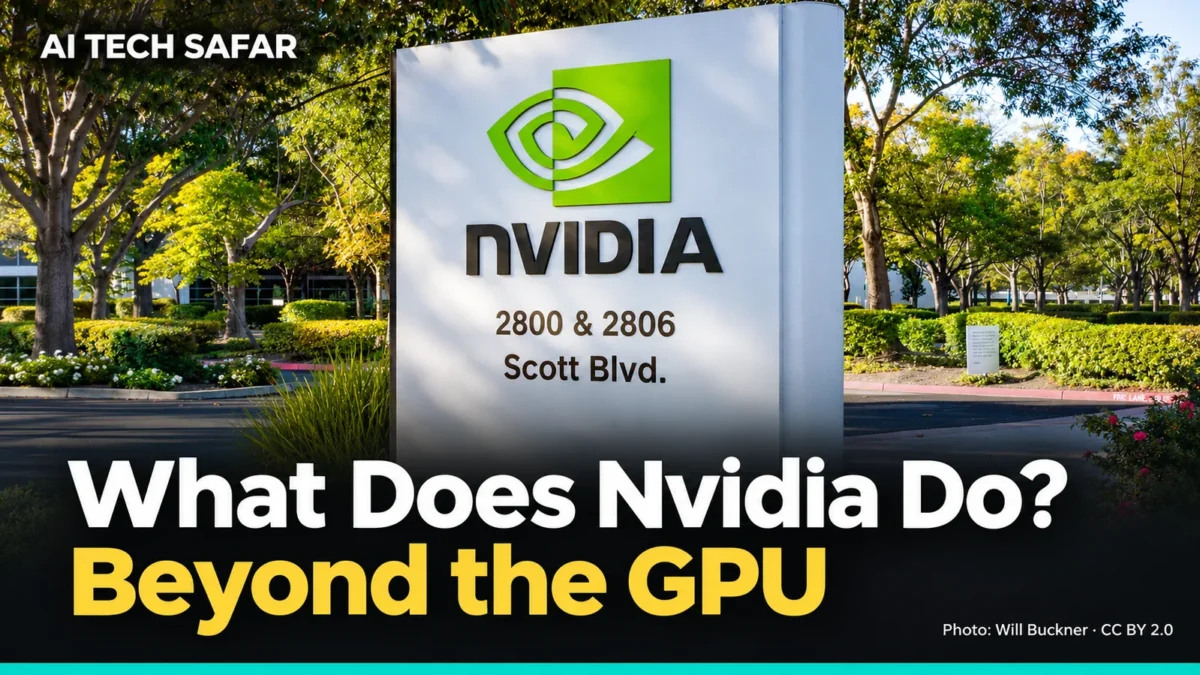
What does Nvidia do in simple terms?
Nvidia designs GPUs: processors that handle many calculations at once. Its technology powers game graphics, AI training and AI responses. The business includes hardware and software such as CUDA, which helps developers run computing tasks on Nvidia GPUs. See Nvidia’s technology overview.
Correction, November 17, 2026: Removed unsourced current market-value rankings, ownership percentages and Apple purchasing claims. The products and CUDA sections remain; this page is a technology explainer, not a current investment assessment.
If you have seen Nvidia on a graphics card or in an AI headline, the connection is parallel computing. A gamer uses a GPU to render a scene; an AI developer uses GPUs for the calculations behind a model. This guide explains what the company sells, how its hardware and software fit together, and how its business differs from competitors.
What products and services does Nvidia sell?
| Part of the business | Simple example | What it does |
|---|---|---|
| Graphics hardware | GeForce graphics cards | Draws game scenes and accelerates compatible creative applications. |
| Data-center computing | GPUs, CPUs and DGX systems | Provides computing hardware for AI and other demanding workloads. |
| Networking | NVLink and data-center networking | Connects processors and systems so they can exchange data. |
| Developer software | CUDA tools and libraries | Helps programmers use GPU computing in applications. |
Nvidia’s business includes hardware and the software around it. Its data-center catalog lists complete systems as well as processors and networking. Buying a gaming card and renting GPU capacity from a cloud provider are different ways to use that technology.
What is CUDA, in plain English?
CUDA is Nvidia’s software platform for GPU computing. For example, a developer can use a GPU-accelerated library instead of writing every calculation from scratch. The CUDA Toolkit includes development tools and libraries. A graphics card is hardware; CUDA is part of the software environment used to program compatible GPUs.
For the software side of this story, see our AI model comparison: a model and the hardware running it are different parts of the system.
Quick Summary & Key Takeaways
- What Nvidia Actually Does: It designs GPUs (graphics processing units)—originally built for gaming, used for graphics and many AI computing workloads.
- Governments Are Now Major Customers: National governments have increasingly turned to Nvidia’s chips to build sovereign AI infrastructure, treating AI compute as a strategic national asset.
Nvidia: Quick Answers to Common Questions
| Question | Quick Answer |
|---|---|
| What does Nvidia actually make? | GPUs (graphics chips), now primarily used for AI training and inference rather than gaming |
| Is Nvidia American or Chinese? | American, headquartered in Santa Clara, California, founded in 1993 |
Do I need Nvidia on my computer?
At its core, Nvidia designs and sells GPUs: specialized processors originally built to render graphics for video games, which turned out to be exceptionally good at a very different job—running the massive parallel calculations required to train and operate AI models. That original gaming use case is also why many people find Nvidia’s name on their own computer: its GeForce graphics cards remain a leading choice for PC gaming, handling the rendering work a computer’s main processor isn’t built to do efficiently.
Who owns Nvidia?
Ownership percentages change with filings and share transactions. Consult dated ownership disclosures on Nvidia’s investor-relations website; this guide does not provide a verified current shareholder ranking.
Why Is the Government Using Nvidia?
Nvidia’s chips have increasingly become viewed as strategic national infrastructure rather than just commercial products. Governments around the world have moved to secure access to Nvidia’s most advanced GPUs to build “sovereign AI” capacity—domestic computing infrastructure that doesn’t depend on foreign cloud providers for critical AI workloads, spanning everything from national security applications to public-sector AI services. This dynamic has also made Nvidia a direct player in geopolitics, since U.S. export restrictions on advanced chips to certain countries have turned Nvidia’s product lineup into a genuine instrument of trade policy, not just a business decision.
💡 AI Tech Safar Insight
What’s notable about Nvidia’s search patterns is how much of the curiosity is really about power and control, not chips—who owns it, why governments want it, whether one company (Apple) can escape depending on it. That’s a fair instinct: Nvidia’s position sits at a genuine chokepoint in the global AI supply chain, and understanding who benefits from that position tells you as much about the AI industry’s power structure as any benchmark or model release does. Whether that concentration of power is a temporary snapshot or a durable, long-term reality will likely be one of the more important storylines in tech for the rest of the decade.
Frequently asked questions
Q1: Who is Nvidia’s biggest competitor?
AMD is Nvidia’s most direct GPU competitor, while custom AI chips from Google (TPUs), Amazon, and Microsoft represent a growing, different kind of competitive threat from major cloud providers building their own silicon.
Q2: Who is Nvidia’s biggest customer?
Major cloud providers and AI labs—including Microsoft, Amazon, Google, Meta, and OpenAI—represent Nvidia’s largest customers, purchasing GPUs at massive scale to build AI data center infrastructure.
Q3: Does Nvidia own any other companies?
Nvidia has made various acquisitions and strategic investments over the years, including networking technology companies, though it operates primarily as a chip designer rather than a broad conglomerate.
Q4: Does Google use Nvidia chips?
Yes, Google uses Nvidia GPUs alongside its own custom-built TPU (Tensor Processing Unit) chips, giving it a hybrid approach that reduces total dependence on any single chip supplier.
What Do You Think?
Is Nvidia’s dominance in AI hardware a durable long-term advantage, or will custom chips from Google, Amazon, and Apple eventually chip away at its position? Share your thoughts in the comments below!
Related Reading:
- AI Models 2026: The Complete Guide to Gemini, GPT, Claude & China’s Challengers
- AI Tools 2026: The Complete Guide — Free Options, Types of AI, and the Big Players Explained
- OpenAI, Google, and Anthropic Absent From Nvidia-Led Open Secure AI Alliance
- SK Group & Nvidia Sign $500 Billion Deal: South Korea’s Big AI Infrastructure Bet