Overview: AI Fake Videos in China
Examine AI fake videos in China, how fabricated disaster footage spreads and what the reported crackdown means for verification, platforms and public trust.
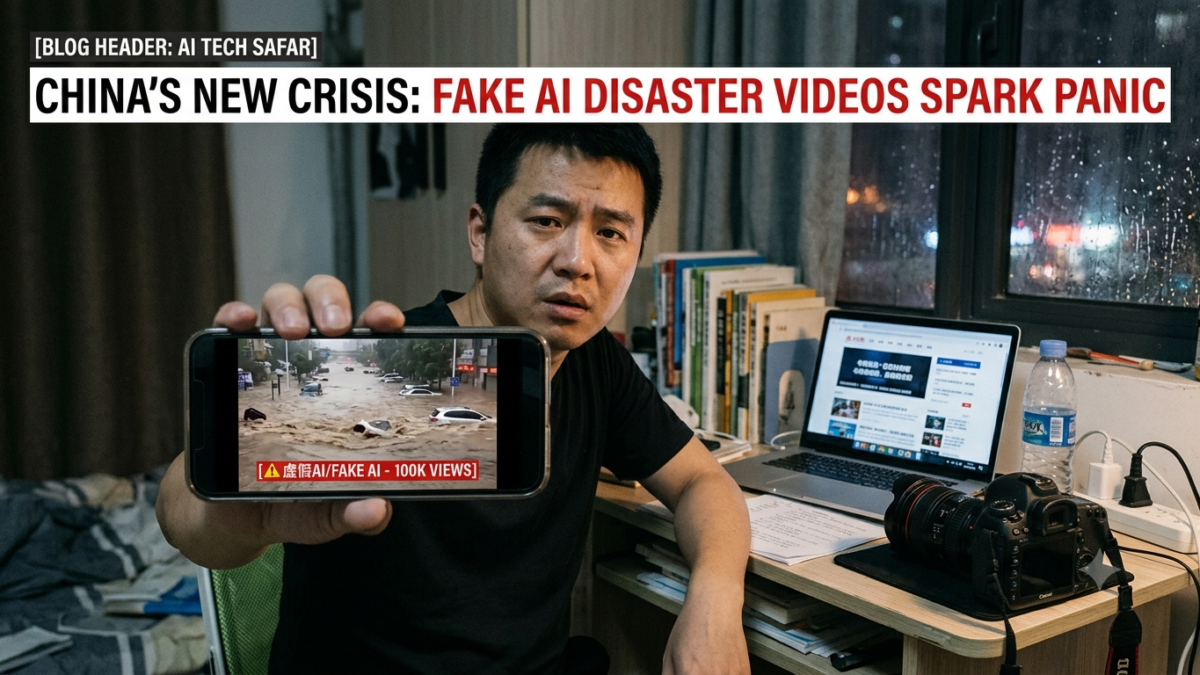
As heavy rains and flooding sweep across parts of China this summer, a new kind of crisis is unfolding alongside the real one—a flood of AI-generated fake disaster content spreading faster than the actual storms. Chinese authorities have now launched a nationwide crackdown to stop fabricated videos, recycled footage, and AI-manipulated images from fueling panic during an already tense flood season.
The Cyberspace Administration of China (CAC) and the Ministry of Emergency Management jointly issued the notice, targeting a growing list of tactics being used to make fake disaster content look convincingly real.

Quick Summary & Key Takeaways
- Joint Crackdown: China’s cyberspace and emergency management authorities have launched a nationwide campaign against fake disaster content.
- AI-Generated Fakes: Authorities specifically flagged AI tools, staged scenes, and edited media used to fabricate disaster footage.
- Recycled Old Footage: Old disaster videos are being stripped of dates and re-shared as if they’re happening right now.
- Fake Casualty Data: Some accounts are exaggerating death tolls, property damage, and disaster severity to drive engagement.
- Scams Included: The crackdown also targets fake donation appeals and fraudulent QR codes exploiting public sympathy during disasters.
Tactics Being Targeted
| Tactic | How It Works | Risk |
|---|---|---|
| AI-Generated Scenes | AI tools and staged footage used to fabricate disaster scenes from scratch | Public panic, false alarm |
| Repackaged Old Footage | Old photos/videos re-shared with dates and watermarks removed | Misleads on current events |
| Exaggerated Data | False casualty figures, property damage, or severity levels | Disrupts rescue operations |
| Fake Official Alerts | Impersonation of government notices about dam breaches, chemical leaks, floods | Mass confusion, false evacuations |
| Donation Scams | Fake donation links and fraudulent QR codes | Financial loss, data theft |
What Happened? Inside China’s Crackdown
According to the joint notice, some accounts have been caught editing footage from overseas or other parts of China, stripping out watermarks, and swapping headlines or subtitles to make it look like a disaster is unfolding locally in real time. Others dig up years-old, even decades-old, disaster footage, remove the original timestamps, and repost it as breaking news—timed deliberately to spread during periods of heavy rain and flooding when public anxiety is already high.
Authorities are also going after posts that inflate or fabricate casualty numbers, property damage, and economic losses, warning that this kind of misinformation can directly interfere with rescue operations and confuse the public about the actual scale of a disaster. Fake government notices claiming dam collapses, chemical leaks, or breaches of flood defences are another major target, since these can trigger unnecessary panic or mass movement of people.
The AI-generated content problem has been building for a while. Earlier this year, a viral clip of a paraglider claiming to have been swept into storm clouds over China’s Qilian Mountains was found to likely contain AI-generated footage, according to a digital security firm’s investigation—prompting several major news outlets to pull the video after it had already been widely shared. A similar case earlier involved a viral image of a baby supposedly surviving an earthquake, which turned out to be entirely AI-generated.
Why It Matters: A Preview of a Global Problem
China’s move highlights a challenge that’s likely to spread well beyond its borders as generative AI tools become easier to use and harder to detect:
- Speed vs. Verification: AI-generated disaster content can go viral within minutes, often faster than authorities or journalists can verify it, giving misinformation a head start during exactly the moments when accurate information matters most.
- Platform Responsibility: Local cyberspace authorities have been instructed to push online platforms to strengthen content review and account management, signaling that regulators increasingly expect platforms—not just users—to catch this content.
- Global Precedent: This isn’t China’s first attempt to regulate AI-generated fake news; the country introduced rules requiring AI and virtual-reality-produced content to carry clear warning labels back in 2019, treating violations as a potential criminal matter.
💡 AI Tech Safar Insight
This story is a preview of a problem every country will eventually have to confront. As AI video generation keeps improving, the gap between “looks real” and “is real” keeps shrinking, and disaster events—chaotic, emotionally charged, and hard to verify in real time—are close to the perfect environment for this kind of content to spread unchecked. China’s response leans heavily on top-down enforcement and platform accountability, but the same underlying challenge exists everywhere: as generative AI gets better, media literacy and verification tools need to improve just as fast, or misinformation will keep winning the race to go viral first.
Frequently Asked Questions (FAQs)
Source: Reporting based on OpenGov Asia and China Daily.
For the broader context and related reading, explore our Global AI Policy: How Countries Regulate and Adopt AI.