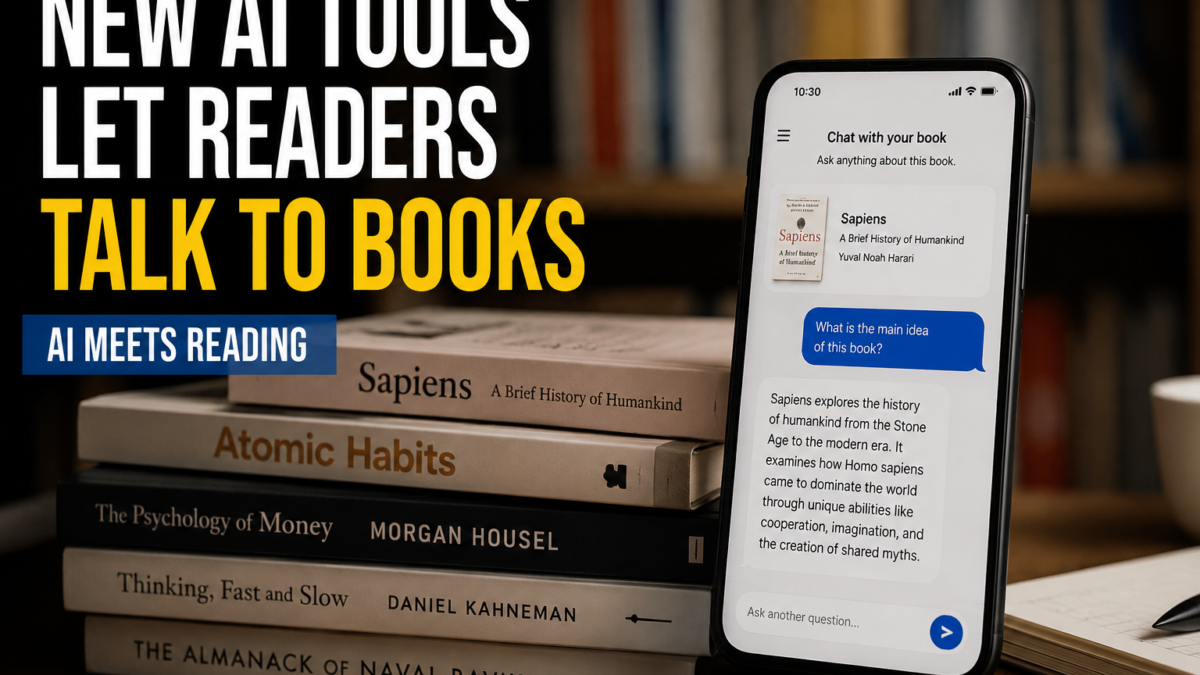
AI book-chat tools can help you ask questions about documents, but a confident answer with a citation can still be wrong. Use them to locate and discuss passages, then return to the text before relying on a quotation, interpretation or factual claim.

What source-grounded chat means
Google’s Gemini Notebook help, covering the product previously known as NotebookLM, explains that answers use selected sources and conversation context. It also notes that citations can behave differently for short sources and that some questions cannot be answered from the material. Source grounding is not an accuracy guarantee.
A practical reading workflow
- Use a document you are entitled to upload and check that the text imported correctly.
- Ask a narrow question, naming the chapter or topic where possible.
- Request the supporting passage and its location.
- Open the reference and read the surrounding paragraphs.
- Record uncertainty if the source is incomplete or does not answer the question.
For example: “Find the passages where the author defines this term. Quote the relevant wording, identify the chapter, and say if the definition changes later.” This is a suggested prompt, not a tested benchmark or a guarantee that a particular product will answer correctly.
Separate retrieval from interpretation
A tool may retrieve a relevant passage while drawing a conclusion the passage does not support. Ask whether the answer is a quotation, a paraphrase or an inference. Check names, dates, negations and page references first. Pagination in an ebook or imported PDF can differ from a printed edition.
When comparing two books, keep their arguments separate before asking for a synthesis. Otherwise the assistant may blend opposing claims into a single neat summary. A useful comparison preserves disagreement and identifies which source supports each statement.
Privacy and rights
Before uploading unpublished work, client material or a purchased ebook, check the service’s terms and the permissions you have for that document. Access to a file does not automatically settle whether a particular upload or redistribution is permitted. This article does not give legal advice or promise that all book formats are supported.
What to compare between tools
- Supported document types and upload limits.
- Whether references open the relevant passage in context.
- How scanned pages, images and complex layouts are handled.
- Deletion, sharing and account controls.
- The amount of human checking needed for your task.
The earlier claims that answers are strictly confined to uploaded text and that named tools are the most accurate were too strong. We have not run a comparative accuracy test. A reading assistant is most useful when it makes verification easier, not when it replaces it.
Sources and scope
Source check: November 17, 2026. Removed guaranteed-accuracy and unsupported tool-ranking claims; clarified source checking and updated the product name. This is source-based reporting and editorial analysis, not a hands-on product or investment test.