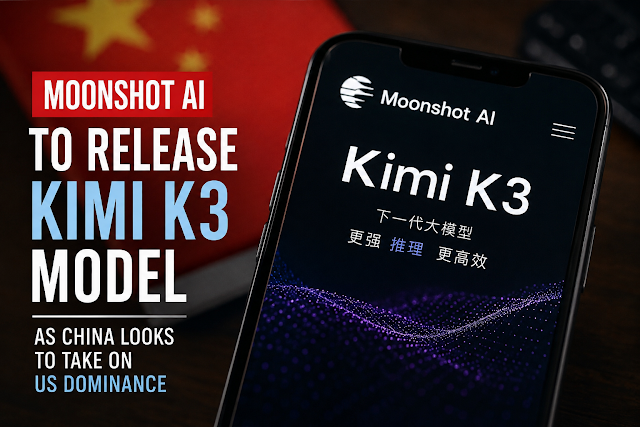
Overview: Moonshot AI Kimi K3
Explore Moonshot AI Kimi K3 through the architecture, benchmark and pricing breakdown, including the trade-offs behind its open-weight model release.
Kimi K3: Inside China’s 2.8-Trillion Parameter Bet to Beat GPT-5 and Claude
TL;DR
- On July 16, 2026, Beijing-based Moonshot AI released Kimi K3 – a 2.8-trillion-parameter open-weight model (104 billion active per token) with a 1-million-token context window and native vision. Full weights shipped July 27 as a native MXFP4 checkpoint – the largest open-weight model released to date.
- On Artificial Analysis’s Intelligence Index, K3 climbed from 57 shortly after launch to 60 by August 20, tying GLM-5.3 and landing within three points of Claude Opus 5 Max (63). It also took #1 on WebDev Arena (1,678 Elo), the first open-weight model ever to top that leaderboard, beating Claude Fable 5 outright.
- Pricing broke from China’s race-to-the-bottom playbook: $3 per million input tokens, $15 per million output tokens ($0.30 on cache hits) – roughly 5x more than Moonshot’s own previous model, K2.6.
- Moonshot’s valuation has been reported climbing sharply through 2026 – from roughly $4 billion in December 2025 toward a $50 billion pre-IPO round, alongside a planned Hong Kong listing.

Reviewed by Imran Khan Pathan, Editor at AI Tech Safar. Benchmark scores for K3 moved noticeably between its launch-week numbers and the figures Artificial Analysis published weeks later, so every score below is dated rather than treated as a single fixed number. I also checked Moonshot’s own technical blog directly for the architecture details (Kimi Delta Attention, active parameter count) rather than repeating an earlier estimate that turned out to be wrong.
Last updated: September 2026
What Kimi K3 Actually Is
Kimi K3 is a Mixture-of-Experts (MoE) model with 2.8 trillion total parameters, of which only 104 billion are active for any given token – the model holds 896 experts and activates just 16 of them (roughly 1.8% of the total) per token. That sparsity is what makes a model this large practical to run at all; the checkpoint itself weighs in at 1.56 TB across 96 shards.
Moonshot calls it “the world’s first open model in the 3-trillion-parameter class,” a claim nobody else could match at launch – the next-largest open model, DeepSeek’s V4 Pro, sits at roughly 1.6 trillion parameters. The full weights shipped July 27, 2026, under a bespoke “Kimi K3 License” – open-weight and freely downloadable, but not an OSI-approved open-source license in the strict sense.
Specs at a glance: a 1,048,576-token (roughly 1 million) context window, native vision built into the same transformer rather than bolted on through a separate model, always-on “thinking mode” reasoning, long-horizon agentic task execution, tool use (APIs, terminal commands, external systems), and automatic context caching to cut costs on repeated queries.
The Architecture Behind the Scale
Building a model this large isn’t just “add more layers” – it requires solving the routing problem: deciding which of 896 experts should handle each token, without training collapsing into inefficiency. Moonshot’s answer across this generation is a new architecture combining two pieces:
- Kimi Delta Attention (KDA) – a hybrid linear attention scheme (69 KDA layers paired with 24 gated MLA layers) that Moonshot says cuts KV-cache memory usage by up to 75%, which is a large part of how the model stays usable at a 1-million-token context length.
- Attention Residuals – a change to how information moves between layers, which Moonshot credits with roughly a 2.5x improvement in scaling efficiency over its previous flagship, Kimi K2.
Native vision means K3 processes images and video through the same architecture as text rather than converting them to text descriptions through a separate model first – which is part of why it can inspect its own visual output (a generated interface or game screen, for instance) and revise based on what it “sees,” rather than working blind after generation.
The Benchmarks – With Dates, Because They Moved
Kimi K3’s scores shifted meaningfully in the weeks after launch as evaluators ran fuller test suites, so treat any single number as a snapshot rather than a fixed fact.
| Benchmark | Kimi K3 | Context |
|---|---|---|
| Artificial Analysis Intelligence Index | 57 (early Aug) → 60 (Aug 20) | Tied with GLM-5.3; ~3 points behind Claude Opus 5 Max (63) |
| AA-Briefcase (agentic knowledge work) Elo | ~1,543-1,547 | Second overall, behind Claude Fable 5 (~1,574), ahead of GPT-5.6 Sol |
| GDPval-AA v2 Elo | 1,686 | Behind Fable 5 (1,747), ahead of Opus 4.8 (1,593) |
| Program Bench | 77.8 | Narrowly ahead of Fable 5 (76.8) and GPT-5.6 Sol (77.6) |
| WebDev Arena | #1 – 1,678-1,679 Elo | First open-weight model ever to top this leaderboard, ahead of Claude Fable 5 |
| FrontierSWE / Terminal-Bench 2.1 | 81.2 / 88.3 | Moonshot’s own reported figures |
The WebDev Arena result deserves its own callout – it’s the clearest, least ambiguous win in K3’s entire benchmark set. Ranking #1 across 99 models in blind developer testing, and specifically finishing first in 6 of 7 domains (brand and marketing, reference-based design, data and analytics, and others), is a genuinely rare outcome for any open-weight model against the best closed Western systems.
The honest caveat: K3 isn’t dominant everywhere. It trails Claude Fable 5 and GPT-5.6 Sol on general intelligence and on presentation-quality scoring specifically – its analytical reasoning is frontier-class, but how it formats and visually structures its output lags the best Western models. For internal tooling that may not matter; for customer-facing products, it likely does.
Pricing: Breaking China’s Race to the Bottom
| Model | Input | Output |
|---|---|---|
| Kimi K3 | $3.00/M ($0.30 cache hit) | $15.00/M |
| DeepSeek V4 Pro | ~$0.86/M | ~$0.86/M |
| Qwen 3.7-Max | ~$5.20/M | ~$5.20/M |
| GPT-5.6 Sol | ~$10/M | ~$30/M |
Against DeepSeek specifically, K3’s output pricing runs roughly 17x higher – a deliberate positioning choice, not an error. Moonshot is pricing K3 as a premium, capability-first model rather than a budget alternative, a roughly 5x jump over its own previous model, K2.6. It’s also genuinely free to use directly on kimi.com, and available via OpenRouter from around $2.60/M, alongside tiered Kimi membership plans (Moderato through Vivace, roughly $15-199/month) for individual and team subscribers who want the full 1-million-token context unlocked.
One Morgan Stanley note framed this as potentially healthy for the broader Chinese AI market – a shift away from destructive price competition and toward business models that can actually sustain frontier-scale training costs.
Moonshot AI: The Company Behind It
Moonshot AI was founded in 2023 by Yang Zhilin, a Carnegie Mellon PhD, and is backed by Alibaba and Tencent – backing that provides both capital and cloud infrastructure access, both of which matter enormously for a company training at the frontier under hardware constraints.
The company’s valuation has been widely reported climbing sharply through 2026 – roughly $4 billion in December 2025, reported to have reached the $20-35 billion range by mid-year, with talks of a Series G pushing toward a $50 billion pre-IPO valuation ahead of a planned Hong Kong listing, potentially before the end of 2026. Reported annualized recurring revenue reached roughly $300 million by June 2026. Treat the exact dollar figures as reported rather than audited – they come from deal-tracking and press coverage rather than a public filing, which won’t exist until the IPO process is further along.
The Enterprise Push: A Palantir-Style Playbook
Rather than competing purely on API access, Moonshot has been building a services-heavy enterprise business – embedding engineers directly at client sites rather than waiting for developers to self-serve through an API. Reported partnerships include a Forward Deployed Engineer arrangement with Chinasoft International (initially focused on energy and power, expanding into financial services), alongside deals with Kingsoft Cloud and AsiaInfo Technologies.
The logic is straightforward: API customers switch models the moment a cheaper or better option appears, while enterprise customers with deeply integrated, customized deployments are far stickier – and that stickiness is what turns impressive benchmark scores into durable, recurring revenue.
The Geopolitical Angle: Building Under Constraints
US export controls on advanced AI chips were explicitly designed to slow Chinese frontier-model progress on the theory that without top-tier Nvidia hardware, matching Western capability would be effectively impossible. K3 complicates that theory – not by disproving it outright, but by showing that architectural efficiency (aggressive MoE sparsity, the KDA attention scheme, and quantization-aware training using MXFP4 weights) can meaningfully close the gap when raw compute access is constrained.
That’s consistent with a broader pattern across Chinese labs this year – DeepSeek, Alibaba’s Qwen team, and now Moonshot have each been pushed toward algorithmic efficiency specifically because brute-force scaling wasn’t fully available to them. Bloomberg’s coverage of the K3 launch framed it directly as the latest evidence that the capability gap between US and Chinese frontier labs is narrowing, not widening.
How Kimi K3 Actually Compares
| Metric | Kimi K3 | GPT-5.6 Sol | Claude Fable 5 |
|---|---|---|---|
| Total / active parameters | 2.8T / 104B (open) | Undisclosed (closed) | Undisclosed (closed) |
| Context window | 1M tokens | Undisclosed | Undisclosed |
| Intelligence Index (Aug 20) | 60 | ~59 | ~60-63 |
| WebDev Arena | #1 (1,678) | Not top-ranked | #2 |
| Input / output pricing per 1M | $3 / $15 | ~$10 / ~$30 | Comparable to Sol |
| Weights | Open | Closed | Closed |
The honest read: K3 isn’t the strongest model in the world, but it’s the strongest open-weight one by a wide margin, it’s roughly a third of GPT-5.6 Sol’s price, and it holds an outright #1 finish on at least one major independent leaderboard. For teams that specifically need self-hostable, inspectable weights at frontier-adjacent capability, there currently isn’t a closer competitor.
FAQ
How many parameters does Kimi K3 have?
2.8 trillion total, with 104 billion active per token – it’s a sparse Mixture-of-Experts model with 896 experts, of which only 16 activate for any given token.
Is Kimi K3 free to use?
Yes, directly on kimi.com. Via the API it’s priced at $3 per million input tokens and $15 per million output tokens ($0.30 on cache hits), and it’s also available through OpenRouter and self-hosting once you have the open weights.
Is Kimi K3 actually open source?
It’s open-weight – the model weights are freely downloadable – but it ships under a bespoke “Kimi K3 License” rather than an OSI-approved open-source license, so it’s not open source in the strict technical sense.
How does Kimi K3 compare to GPT-5.6 Sol and Claude Fable 5?
It trails both on general intelligence benchmarks by a small margin, but it holds the #1 spot on WebDev Arena outright, beats both on price by a wide margin, and is the only one of the three with open weights.
What is Kimi Delta Attention?
A hybrid linear attention architecture Moonshot built for K3, combining 69 KDA layers with 24 gated MLA layers to cut KV-cache memory usage by up to 75% – a major reason the model can handle a 1-million-token context window practically.
Why does this matter for the US-China AI race?
K3 shows that architectural efficiency can meaningfully offset hardware export restrictions – Moonshot trained a frontier-competitive model without the same chip access available to US labs, which is exactly the outcome export controls were designed to prevent.
Related Reading on AI Tech Safar
- Claude Opus 5 vs GPT-5.6 Sol – Full Benchmark Comparison
- Frontier AI Architecture: Mastering the GPT-6 Astra Ecosystem
- The AI Brake Crisis: Why the World’s Biggest AI Labs Just Slammed on the Brakes
Useful Sources
- Tom’s Hardware – Moonshot releases 2.8-trillion-parameter Kimi K3
- Simon Willison – Kimi K3, and what we can still learn from the pelican benchmark
- Northflank – Kimi K3: benchmarks, pricing, hardware requirements, and self-hosting
- CodersEra – Kimi K3: Moonshot AI’s 2.8T Open-Weight Model
- MoClaw – What Is Kimi K3? Moonshot’s 2.8T Model
- Wikipedia – Kimi (chatbot) / Moonshot AI model history
For the broader context and related reading, explore our AI Models 2026: Comparing Gemini, GPT, Claude and More.