Overview: OpenAI Revenue Gap
Explore the OpenAI revenue gap, comparing annualized revenue, partner accounting and the reported investor update behind the market reaction.
Inside OpenAI’s $20 Billion Revenue Gap: What Investors Weren’t Told
TL;DR
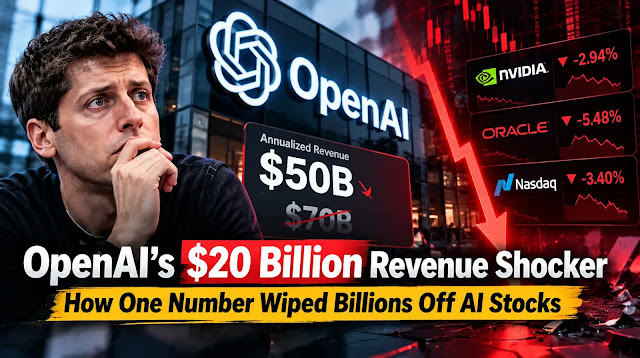
- On October 8, 2026, the Financial Times reported that OpenAI told investors its annualized revenue was approaching $50 billion at the end of September. That’s about $20 billion below the $68-70 billion figure widely reported in late September.
- CNBC confirmed the $50 billion figure. The gap comes from accounting, not a sudden drop in sales: the higher number was an estimate that added partners’ gross revenue, so OpenAI could be compared with Anthropic.
- AI-linked stocks fell that day. Nvidia closed down 2.94%, Oracle 5.48% and the Philadelphia Semiconductor Index 3.4%, and the Nasdaq Composite had its worst day since mid-August. Rising oil prices and Treasury yields were also weighing on the market.
- OpenAI’s growth is still very fast on its own numbers: total run-rate up 77% and enterprise run-rate up 107% in the third quarter, with Bloomberg reporting an expectation of at least $70 billion by year-end.
- This is not investment advice. Single-day moves reflect many factors, and several figures here come from investor documents, not audited filings.

Reviewed by Imran Khan Pathan, Editor at AI Tech Safar. This is a developing business story, so we separated what was reported from what is analysis. The Financial Times report is paywalled, so we checked its key figures against CNBC, which separately confirmed the $50 billion number, and against Bloomberg, CNN, Yahoo Finance and Investing.com. Stock prices come from closing-bell data published on October 8. About our editorial approach and our disclaimer.
Published and last updated: October 9, 2026. If a figure changes, we’ll correct this page and note the change here.
What Happened
OpenAI is making about $20 billion less on an annualized basis than many people believed. That’s the headline from the Financial Times, which reported on Thursday, October 8, that financial documents shared with investors put OpenAI’s annualized revenue at close to $50 billion at the end of September. The number most people had been repeating since late September was $68 billion to $70 billion.
Annualized revenue, or a run rate, takes the current pace of sales and projects it over a full year. It’s a snapshot of momentum and not money already booked, and it has become the headline number for fast-growing AI companies. OpenAI declined to comment to the FT. CNBC then confirmed the $50 billion figure, citing a person familiar with the update.
| Figure | Number | Where it comes from |
|---|---|---|
| OpenAI annualized revenue, end of September (its own basis) | Close to $50 billion | FT; confirmed by CNBC |
| Figure widely reported before | $68-70 billion | Axios on September 29; CNBC notes $68B and $70B versions |
| Gap | About $20 billion | FT |
| Total run-rate growth in Q3 | 77% | OpenAI investor update, via CNBC |
| Enterprise run-rate growth in Q3 | 107% | OpenAI investor update, via CNBC |
| Year-end expectation | At or above $70 billion | Bloomberg, citing people familiar |
The Stock Market Fallout
The report published around midday, and the market’s reaction was swift. The Nasdaq Composite fell 1.25% to 27,193.34, its worst day since mid-August according to CNN. The Nasdaq 100 dropped 1.4%, its worst one-day decline in seven weeks, and the S&P 500 slid 0.5%. The Philadelphia Semiconductor Index fell 3.4%. Here is how the most exposed names closed on October 8:
| Stock | Oct 8 close | Change |
|---|---|---|
| Nvidia | $230.48 | -2.94% |
| Oracle | $135.69 | -5.48% |
| CoreWeave | n/a | Nearly -8% |
| Broadcom | n/a | -4.4% |
| Intel | $107.08 | -5.34% |
| AMD | $620.68 | -3.90% |
| Micron | $1,035.84 | -4.79% |
Prices and percentages are from closing-bell data published by Reuters via Investing.com and Yahoo Finance. CoreWeave’s and Broadcom’s closing prices weren’t in the data we used, so CoreWeave is shown as CNBC’s “nearly 8%” and Broadcom as Investing.com’s -4.4%. Percentages differ by a few tenths between sources.
It wasn’t only OpenAI. The selloff came two days after Nvidia and the Nasdaq hit record highs, and the market was already leaning heavily on a few AI names. Oil prices were rising on the Iran situation, Treasury yields were elevated, and a weak $22 billion 30-year bond auction added pressure. Barron’s linked the decline to the OpenAI report only in part. CNN quoted an analyst describing a “narrower market dependent on the AI names to keep it afloat,” which makes any AI-specific scare hit harder. We can’t separate how much of the day’s drop came from OpenAI and how much from the rest.
Why the $20 Billion Gap Happened
The discrepancy comes from different ways of counting revenue, according to the FT, not from a collapse in demand.
OpenAI and its rival Anthropic calculate annualized revenue differently. Anthropic includes sales made through cloud partners such as Amazon’s AWS and Google Cloud. OpenAI doesn’t include those partner sales in its own figure, so its number is closer to what the company actually keeps.
Investors who wanted a direct comparison tried to “gross up” OpenAI’s numbers to match Anthropic’s method. That adjustment produced a baseline of about $40 billion, which some outlets date to July and others to August. OpenAI’s own figure for July was close to $30 billion. When OpenAI then told investors its revenue had grown more than 70% since July, the market applied that growth rate to the inflated $40 billion base and landed near $70 billion. Applied to OpenAI’s own $30 billion, the same growth gives roughly $50 billion.
| Starting point (July) | Growth applied | Result (end of September) |
|---|---|---|
| About $40 billion (investor-adjusted) | More than 70% | About $70 billion (the widely reported figure) |
| About $30 billion (OpenAI’s own basis) | More than 70% | About $50 billion (the figure OpenAI gave investors) |
The earlier estimate was widely circulated after Axios reported it on September 29, based on sources familiar with the financials. It wasn’t a number OpenAI published, which is a reminder to check where a headline figure comes from.
What OpenAI’s Investor Update Actually Showed
Despite the smaller headline, OpenAI’s underlying growth is still very strong. In the same update, it reported:
- 77% growth in total run-rate during the third quarter
- 107% growth in its enterprise business run-rate over the same period
Bloomberg reported that OpenAI expects to reach or exceed $70 billion in annualized revenue by the end of the year, driven largely by enterprise growth. It’s the same $70 billion number as before, now framed as a year-end goal on OpenAI’s own basis, not a September fact.
The Bigger Picture
The gap matters because OpenAI is under pressure to justify its valuation. It closed a $122 billion funding round on March 31 at an $852 billion valuation, and it submitted a confidential draft S-1 to the SEC on June 8. A listing is widely expected in 2027, after Altman said OpenAI wouldn’t go public this year. OpenAI is also reported to be talking to investors about a new round of $30 billion or more.
Anthropic, which is also preparing to go public, is at the center of the accounting question. We covered how its numbers work, including the prospectus details Reuters reported, in our Anthropic IPO guide.
The stakes stretch well past OpenAI. Suppliers like Nvidia, AMD, Broadcom, Oracle and CoreWeave have all signed large deals tied to OpenAI’s growth. If its revenue is smaller than assumed, investors ask whether the sums being spent on data centers and chips will earn an adequate return. That worry was already in the air: on the same day, Broadcom was reported to be arranging more than $50 billion of financing for chips developed with OpenAI, and Oracle to be in talks with Apollo and Goldman Sachs on financing a major chip purchase.
What We Still Don’t Know
- The exact bridge. No one has published a line-by-line reconciliation of the $20 billion between the two figures.
- Whether the lower number changes OpenAI’s plans. OpenAI hasn’t commented, and no valuation change has been announced.
- How much of the selloff was OpenAI. Oil, yields and an already-stretched AI trade all played a part.
- Audited numbers. Everything here comes from investor presentations and anonymous sources. Neither company has released audited financials.
How We Reported This
We start from the Financial Times report and treat it as the primary source for the $50 billion figure, then check it against reporting that stands on its own. CNBC confirmed it through a separate source. Index and stock moves come from published closing data. Where outlets differ, such as on whether the $40 billion baseline dates to July or August, we say so. We don’t use unnamed analyst quotes we can’t trace. We aren’t financial advisers, and nothing here is a recommendation to buy or sell any security.
FAQ
How far can a run rate be from actual revenue?
Quite far, especially at a fast-growing company. Anthropic’s confidential prospectus, as reported by Reuters, showed about $4.6 billion of actual revenue in 2025, while its run rate was around $9 billion by the end of that year. OpenAI hasn’t published audited 2026 revenue, so its $50 billion is also a pace, not a total of money already booked.
Is Anthropic now bigger than OpenAI?
Nobody can say yet, because the two numbers aren’t built the same way. Anthropic’s run rate was reported at more than $65 billion in late July, and it counts cloud-partner sales gross, while OpenAI’s roughly $50 billion at the end of September is net of those sales and a different date. Audited filings from both companies are the only clean comparison.
Will OpenAI’s $852 billion valuation be cut?
Nothing so far suggests a markdown. The $852 billion figure was set on March 31 after a $122 billion round. Bloomberg, as relayed by HuggingNews, reports that OpenAI is now in talks to raise $30 billion or more at about $1.4 trillion before the new money, with UAE funds including MGX in discussions to anchor it. The FT story is about how revenue is counted, not a change in OpenAI’s valuation.
Why did Oracle and CoreWeave fall more than Nvidia?
They’re more concentrated bets on OpenAI. Oracle signed a multi-year compute deal reported at about $300 billion, and BeInCrypto reports OpenAI accounts for roughly 45% of Oracle’s $664 billion backlog, a figure we couldn’t confirm independently. CoreWeave has contracts worth up to $22.4 billion with OpenAI. Nvidia sells to many customers, and it had also just hit a record high, which can make a pullback larger.
How can I tell whether a company’s revenue figure is gross or net?
Look for who keeps the money. Gross counts the full amount customers pay, including a reseller’s or cloud partner’s cut, and the partner share then shows up as a cost. Net counts only what the company keeps. Check whether a figure says annualized, ARR or contracted, ask what date it applies to, and be wary of round numbers attributed to unnamed sources, which is how the $70 billion estimate spread.
When will OpenAI’s audited numbers become public?
Not before it files publicly. OpenAI submitted a confidential draft S-1 on June 8, 2026, and a public S-1 has to be on file at least 15 days before the roadshow begins. Sam Altman has said OpenAI won’t list in 2026, so audited revenue, losses and cash needs are most likely to appear in 2027.
Related Reading on AI Tech Safar
- Anthropic IPO 2026: Inside the $2 Trillion Nasdaq Listing That Could Beat SpaceX’s Record
- OpenAI Is Spending $500,000 a Day to Find Out What Its Own AI Agents Did
- Did OpenAI’s AI Agents Make 10,000 Unauthorized Payments? What’s Confirmed and What Isn’t
- Claude vs ChatGPT in 2026: Which AI Is Actually Better?
Useful Sources
- Financial Times – OpenAI annualized revenue about $20 billion below earlier signals (October 8, 2026; paywalled)
- CNBC – Nvidia, Oracle, CoreWeave and other AI stocks sink on OpenAI revenue report
- CNN – Tech stocks drop after report that OpenAI’s revenue is lower than expected
- Bloomberg – Nasdaq 100 drops 1.4% as OpenAI warning deepens bubble fears
- Investing.com – U.S. stock futures steady after Nasdaq slides on OpenAI revenue concerns
- Reuters via Investing.com – Tech stocks struggle on AI spending worries, elevated yields
- Yahoo Finance – Stock market today, Thursday October 8, 2026
- Axios – Scoop: OpenAI’s annual recurring revenue nears $70B (September 29)
- SiliconANGLE – AI stocks crumble on report that OpenAI’s annualized revenue is much lower than believed
- TradingKey – Why is OpenAI’s annualized revenue $20 billion below expectations?
- HuggingNews – OpenAI expects $70B revenue run rate by end of 2026 (citing Bloomberg)
- Sacra – OpenAI revenue, valuation and funding
- Yahoo Finance – OpenAI confidentially files for IPO with SEC
For the broader context and related reading, explore our AI Business Guide: Stocks, Infrastructure and Layoffs.