Last updated: November 21, 2026. Market figures checked against contemporary reporting; prices are historical, not live quotes.
What happened after Anthropic’s first trading day?
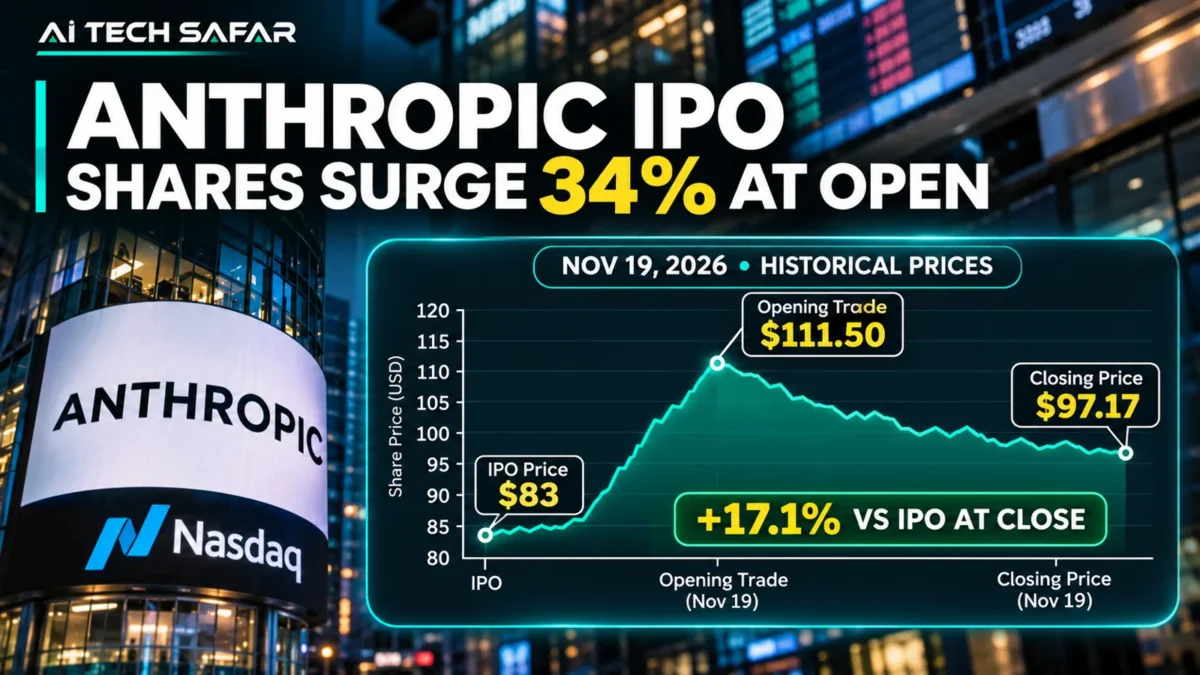
Anthropic priced its IPO at $83 a share. On November 19, ANT opened at $111.50, reached an intraday high of $115.10 and closed at $97.17, according to contemporary market coverage. On November 20, shares briefly approached the IPO price, reaching about $83.05 intraday before recovering. The company confirmed the IPO closed on November 20, with 1.127 billion Class A shares sold at the offering price. An IPO closing is not the same as the closing share price on the exchange.
Sources: Anthropic closing announcement; Fortune market report.
Reviewed by Imran Khan Pathan, Editor at AI Tech Safar. Updated November 20, 2026. This is a follow-up to our earlier Anthropic IPO coverage. It focuses on the first trading session and on the difference between the offer price, the opening trade and the close. Anthropic is the company behind Claude. We report from its own filings and announcements and from independent coverage, and we label which is which. We have not independently audited any figure, and this is not investment advice.
Anthropic IPO first day in perspective
Anthropic’s first day as a public company produced two very different headlines. When shares first traded on November 19, they changed hands far above the offering price and briefly gave the Claude developer a fully diluted valuation of about $2 trillion. By the closing bell, the stock had given back much of that gain. It still finished well above the IPO price. A retreat from the opening trade is not the same as a first-day loss for investors who received shares at the offering price.
Anthropic priced its Class A shares at $83 on the evening of November 18, according to its official announcement. That was above the $70 to $78 range it had set a week earlier. Market reports put the first trade at $111.50 and the close at $97.17. The gap between those two prices is the heart of this story. Demand was strong enough to lift the first quote sharply, but the market did not hold the highest implied valuation through the session, and a broad market selloff the same day did not help.
For AI Tech Safar readers, the significance goes beyond one stock chart. Anthropic is a frontier-model developer whose products are closely tied to enterprise AI adoption, coding assistants and expensive computing infrastructure. Its listing gives investors a new, highly visible way to price those opportunities and risks. The first session is also a useful reminder that enthusiasm for a technology and agreement on what its future cash flows are worth are two different things.
Key takeaways
- The offering was priced at $83 per share, confirmed by Anthropic and above the $70 to $78 range. It sold 980 million shares, up from 825 million in the range filing.
- ANT first traded at $111.50 at about 11:48 a.m. ET on November 19 and closed at $97.17. That is roughly 17.1% above the IPO price and 12.9% below the first trade.
- The fully diluted value at the close was reported at about $1.75 to $1.76 trillion. On shares actually outstanding it was about $1.27 trillion, according to one report. Outlets round these figures differently.
- The Nasdaq and S&P 500 both fell about 2% that day, so the first-day move happened in a falling market.
- The $81.34 billion offering is described as the largest IPO on record, though how you compare it with SpaceX depends on whether you count that company’s over-allotment option.
- One day of trading says little about growth, profitability or safety. Those need filings and results, not a price chart.
The IPO week at a glance
| Date (2026) | What happened |
|---|---|
| October 26 | Anthropic files its S-1 publicly |
| November 10 | Amended S-1 and roadshow launch; range of $70 to $78 for 825 million shares |
| November 18 | SEC declares the registration effective; IPO priced at $83 for 980 million shares |
| November 19 | First trade on Nasdaq under ANT at about 11:48 a.m. ET; close at $97.17 |
| November 20 | Offering expected to close, subject to customary conditions |
| Within 30 days | Underwriters’ option to buy up to 147 million additional shares |
What actually happened on November 19
Anthropic’s pricing announcement specified 980,000,000 shares, of which 956,351,354 were sold by the company and 23,648,646 by selling stockholders. The split matters for proceeds. Money paid to existing shareholders for their shares is not new cash on Anthropic’s balance sheet, and the company said it would not receive proceeds from the selling stockholders’ shares. The company also granted the underwriters a 30-day option to buy up to 147 million additional shares and said the offering was expected to close on November 20. Anthropic’s pricing announcement
The $83 offer price was the reference point. Trading did not begin at the 9:30 a.m. opening bell. Most reports place the first trade at about 11:48 a.m. ET, at $111.50, a premium of roughly 34% that reflected orders and expectations built up before ordinary trading began. One live blog reported a $110.00 opening-auction print, but the $111.50 figure is the one carried by CNN, CNBC and other outlets citing Nasdaq data. The intraday high was reported at $115.10. By the close, the price had fallen to $97.17. CNN’s first-day report · CNBC’s debut takeaways
That is why a description such as “Anthropic shares crashed on day one” would mislead. A person who got shares at the IPO price and held to the close had a positive paper return before fees and taxes. A person who bought at the first trade and held to the close had a negative return. Both statements are true because the entry prices differ.
The first-day numbers
The table separates confirmed offering terms from secondary-market trading reports. Prices are historical snapshots from November 19, not live quotes.
| Metric | Reported figure | Interpretation |
|---|---|---|
| IPO price | $83 | Official offering price, set November 18 |
| First trade | $111.50 | First public trade, November 19, about 11:48 a.m. ET |
| Intraday high | $115.10 | Reported session high |
| Closing price | $97.17 | November 19 close, per Nasdaq data |
| Close vs IPO price | +17.07% | Return measured from the offering price |
| Close vs first trade | -12.85% | Change from the first trade |
| Close vs intraday high | -15.6% (our arithmetic) | Distance from the reported peak |
| Trading volume | About 839.6 million shares | Reported by one outlet; CNBC says volume passed SpaceX’s debut |
To see why the entry price matters, here is an illustration with a hypothetical $1,000 stake, before fees and taxes. Shares bought at the $83 IPO price would be worth about $1,171 at the close. Shares bought at the $111.50 first trade would be worth about $871. Shares bought at the $115.10 high would be worth about $844. These are our arithmetic from the reported prices, not what any investor actually earned.
Three different prices, three different interpretations
The offering price is negotiated before trading and matters to investors who were allocated shares and to the amount raised. The first trade is the first public-market price and can reflect a backlog of orders, media attention and thin early liquidity. The closing price shows where buyers and sellers matched after a full session of shifting expectations.
These are not interchangeable. Treating the opening price as though every investor could buy at $83 exaggerates the return available to ordinary buyers. Describing a decline from the opening high without mentioning the IPO price can make a positive debut look like an outright loss. A more useful question asks what each figure measures, who could transact at that price, and whether a valuation refers to basic shares, fully diluted equity value or enterprise value.
How the deal grew after the range was set
The final terms were larger than the ones Anthropic filed on November 10. Morningstar described the offering as upsized, and the price came in 12% above the midpoint of the range. The sizes differ enough that older articles with the range figures can be misleading.
| Term | November 10 filing | Final pricing, November 18 |
|---|---|---|
| Price per share | $70 to $78 | $83 (about 6.4% above the top of the range) |
| Shares offered | 825 million | 980 million (155 million more) |
| Gross public offering | $57.75 billion to $64.35 billion | About $81.34 billion |
| Private placement | $26 billion to seven tech companies | Still $26 billion, at the IPO price |
Which valuation figure is right?
All of them, depending on how shares are counted, which is exactly why headlines disagree. Reports on the close ranged from “more than $1.6 trillion” (Morningstar) through $1.75 trillion (The National), $1.76 trillion (CNN) and $1.77 trillion (a Reuters-based account) to “roughly $1.8 trillion” (CNBC). The National also reports about $1.27 trillion on the shares now outstanding, which is consistent with our earlier arithmetic using the 13.09 billion shares in the S-1/A. At the $83 offer price, the fully diluted value was about $1.5 trillion.
| Measure | What it counts | Reported at the $97.17 close |
|---|---|---|
| Shares outstanding | Shares that exist now | About $1.27 trillion |
| Fully diluted | Existing shares plus options, awards and convertible instruments | About $1.75 to $1.77 trillion |
| Enterprise value | Equity value adjusted for cash and debt | Not reported in the sources we read |
One outlet put the fully diluted closing valuation at about 49.6 times trailing 12-month revenue. We have not verified that multiple, and a multiple of revenue says nothing by itself about whether a price is high or low. It does show how much of the value rests on future growth. CNBC reports that Amazon and Google together own roughly 28% of Anthropic’s outstanding capital stock after the offering.
The market around the debut
Anthropic’s first day happened in a falling market. CNN reported the S&P 500 down 1.6% and the Nasdaq down 1.75% while it updated its report, and other outlets gave slightly different final numbers, around 2% for each. NBC News attributed part of the slide to investor worries that Nvidia’s China export problems could spread across the AI ecosystem. The Nasdaq rose as much as 1.9% at the start, as investors treated the debut as a relief for the AI trade, and then lost those gains.
That context limits what the share price can tell us. A weaker close than the opening partly reflects how new listings behave and partly reflects a broad risk-off day. It cannot separate how much of the decline was about Anthropic and how much was about the market.
Supply also affected trading. NBC reported that employees were allowed to sell 10% of their shares on the first day, and it said early signs pointed to those sales contributing to the heavy volume. A third-party estimate puts the number of shares non-founder insiders could sell on day one at about 315 million. Lock-up terms staggered later releases, so supply can change again.
What the IPO proceeds do and do not mean
At $83 each, the 980 million shares have a gross value of about $81.34 billion. That is not the net amount Anthropic receives. Some shares were sold by existing holders, who keep those proceeds, and underwriting discounts and offering expenses reduce what the company keeps. The arithmetic below uses Anthropic’s published share counts and is not an audited net-proceeds figure.
| Share component | Shares | Gross at $83 |
|---|---|---|
| Company-issued shares | 956,351,354 | About $79.38 billion |
| Selling-stockholder shares | 23,648,646 | About $1.96 billion |
| Total offering | 980,000,000 | About $81.34 billion |
The $26 billion private placement is separate. Seven companies, including Google, Nvidia, AMD and Microsoft, agreed to buy non-voting stock at the same $83 price, subject to closing conditions. Counting it, the National reports a combined raise of about $107.3 billion, and TechRepublic reports that Anthropic estimated roughly $104.8 billion in combined net proceeds after underwriting costs, assuming the underwriters do not use their option. We have not checked the final prospectus for that net figure, so treat it as reported. The option for 147 million more shares could add to the total, but it is an option, not money received.
Is it really the largest IPO ever?
Most coverage says yes, and The Associated Press called it the largest public stock offering on record. The comparison depends on what you count. CNBC and Morningstar put SpaceX’s June offering at $75 billion, which Anthropic’s $81.34 billion exceeds. The National and Wikipedia describe SpaceX’s raise as $86 billion, a figure that appears to include its over-allotment option. On that basis the public offering alone would be smaller than SpaceX’s, and Anthropic’s total passes it only when the private placement is included. Whichever method you prefer, the “largest ever” label should come with a note on what is being counted.
Why the IPO matters for AI
The listing creates a public reference point for a capital-intensive part of the technology sector. Many investors already had indirect AI exposure through cloud providers, chipmakers and diversified tech firms. Anthropic offers a more direct, though still complex, way to hold a company that builds and sells frontier models.
That does not make the stock price a benchmark score. Model performance, enterprise revenue, inference costs, data-center contracts, safety processes and customer retention affect the business in different ways. A new model release might improve a benchmark without improving margins, and a larger customer base might add revenue while raising the cost of serving requests. The financial question is whether Anthropic can turn rapid demand into durable operating economics when training runs, inference, talent and infrastructure commitments can absorb enormous amounts of capital. In its S-1/A the company listed about $900 billion in compute and infrastructure commitments, which are payments due over many years and not money already spent.
The company also operates in a competitive market. Enterprises can choose among proprietary models, open-weight alternatives, cloud-hosted services and in-house systems. Switching costs can be meaningful in integrated workflows, but they do not remove competition, and one company’s first-day performance is no guarantee that other AI vendors will enjoy similar economics.
What could justify the valuation?
A very large valuation is a claim about the future, not a reward for past accomplishments. To justify it, investors would need to see sustained revenue growth, competitive differentiation, improving economics and manageable financing needs. Anthropic’s own filing says it does not expect its extraordinary growth rate to continue, which is why the later quarters matter more than the first day.
Enterprise adoption is a promising source of demand because businesses pay for productivity, software development, research and automation. But customers must see a return. If they cannot measure meaningful value, expansion may slow, and if model prices fall faster than costs, revenue growth alone may not produce the margins investors expect. Compute is the other central variable. Better hardware, caching, routing and efficient architectures can cut the cost per useful output, yet lower prices can also stimulate more usage, so total infrastructure spending may keep rising. A sound forecast needs both unit economics and usage assumptions.
Governance and safety also matter. Anthropic describes itself as a public benefit corporation focused on the responsible development of advanced AI. Public investors may weigh how that mission interacts with competitive product timelines, disclosure duties and demands for financial performance. Neither a mission statement nor a stock listing proves the safety of any model.
What the numbers cannot tell us
One trading day cannot establish a sustainable valuation, predict the next earnings report or show that the AI industry is in a bubble. It also cannot reveal customer churn, profit margins or model market share. Those need operational disclosures and independent evidence. An opening-day return does not show whether any individual investor will profit later, and historical prices are observations, not recommendations.
Reports also differ in how they describe the offering and the company. Some count gross shares sold and others emphasize primary proceeds. Some use fully diluted equity value and others use shares outstanding. This article uses Anthropic’s own release for offering mechanics and attributes trading data to reporting published after the session.
Our Read: a milestone, not a final score
The debut matters because the public market now puts a daily price on one of the companies most associated with frontier AI. That visibility should increase scrutiny of revenue quality, infrastructure costs and competitive durability, and it may shape expectations for other private AI companies considering a listing.
The first-day pattern is familiar: investors paid far above the offer price at the first trade, and the clearing price fell as trading went on, in a weak market and with insiders free to sell. The meaningful question is whether future disclosures validate the expectations built into even the lower closing valuation. We suggest following three separate tracks. The product track asks whether Claude remains useful and competitive. The business track asks whether that usefulness produces durable revenue and better economics. The capital-markets track asks how much investors will pay for those outcomes. Mixing the three can turn a news story into an unsupported investment thesis.
| Question | What evidence is needed | Why it matters |
|---|---|---|
| Revenue durability | Reported financial results and retention | Demand may not equal long-term margins |
| Compute efficiency | Cost per useful output and utilization | Infrastructure spending affects economics |
| Competition | Product adoption and pricing trends | Switching and price pressure affect growth |
| Safety and governance | Disclosures, audits and incidents | Trust and regulation affect operations |
What to watch next
- The close and the option. Confirmation that the offering closed on November 20 and whether the underwriters use their 30-day option for up to 147 million more shares.
- Disclosures. Revenue, margins, cash flow and capital commitments in the first quarterly filings.
- Lock-up releases. Scheduled sales by insiders and early investors, which add supply to the market.
- Demand evidence. Enterprise retention, usage and pricing trends.
- The landscape. Changes in competition and regulation.
Investors should also separate company statements, audited filings, analyst projections and third-party reporting, because each carries a different weight as evidence. A later filing may revise assumptions that looked plausible on IPO day, which is normal in a young market and a reason to revisit forecasts instead of repeating them.
What we could not verify
- The exact first-trade print: most outlets say $111.50, while one live blog reported a $110.00 opening-auction figure.
- The $115.10 intraday high and the 839.6 million share volume, each reported by a single secondary source.
- The combined net proceeds of about $104.8 billion, which we have not checked against the final prospectus.
- The 49.6 times revenue multiple and the 315 million day-one lock-up figure, both from secondary sources.
- Final index closes for the Nasdaq and S&P 500, which outlets reported slightly differently.
Frequently asked questions
Did Anthropic stock rise on its first day?
Yes, relative to the $83 IPO price: it closed at $97.17, about 17.1% higher. It fell about 12.9% from the $111.50 first trade.
What is Anthropic’s ticker?
ANT, on the Nasdaq Global Select Market, as stated in the official announcement.
Was Anthropic worth $2 trillion?
Briefly, on a fully diluted basis at the first trade, according to CNN and others. The reported closing value was about $1.75 to $1.76 trillion fully diluted, or about $1.27 trillion on shares outstanding.
How much did the IPO raise?
The gross value of the 980 million shares offered at $83 is about $81.34 billion. Not all of it went to Anthropic, because some shares were sold by existing stockholders. A separate $26 billion private placement was also planned.
Why did the price differ from the earlier $70 to $78 range?
Demand was strong, so Anthropic raised the price to $83 and upsized the deal from 825 million to 980 million shares. The range was a preliminary estimate, not a commitment.
Is the IPO price the same as the opening price?
No. The offering was priced at $83. The first public trade, at about 11:48 a.m. ET, was reported at $111.50.
Did the stock fall because of something Anthropic did?
Nothing in the coverage we read points to company news. The broader market fell about 2% that day, and insiders were allowed to sell some shares, so the decline from the first trade has several possible causes.
Does a strong IPO prove Claude is the best AI model?
No. Market pricing reflects business expectations and many other factors. Model quality requires separate evaluation.
Can investors in India buy ANT shares?
India was not among the jurisdictions for the public offering in the IPO documents we reviewed earlier. After listing, investors can generally buy US-listed shares through brokers that offer international access, but availability depends on the broker, India’s remittance rules, costs and tax treatment. Check those independently.
Does this article recommend buying the stock?
No. It is an analysis of historical news and financial mechanics, not individualized investment advice.
Editor’s Note: An earlier draft cited three articles we could not verify and did not mention that the IPO priced above its range, that the offering was upsized, that the broader market fell on debut day or that the first trade came at about 11:48 a.m. ET. We replaced those sources with ones we checked and added that context.
Related reading on AI Tech Safar
- Anthropic Sets Its IPO Range at $70 to $78: A $1.4 Trillion Valuation and $26 Billion From Big Tech
- Anthropic Officially Files for Nasdaq IPO: Inside the $2 Trillion S-1
- OpenAI’s $20 Billion Revenue Shocker: How One Number Wiped Billions Off AI Stocks
Sources and further reading
- Anthropic — Anthropic prices initial public offering (November 18, 2026)
- CNN — Anthropic valued at $1.76 trillion after first day of trading
- CNBC — Anthropic IPO takeaways: ANT debuts with $1.8 trillion market cap
- Morningstar — Anthropic stock jumps 17% in record-breaking IPO
- The National — Anthropic shares close 17% above IPO price after volatile Nasdaq debut
- NBC News — Anthropic’s record-setting IPO can’t halt broader market slide
- TechRepublic — Anthropic IPO: Claude maker opens at $111.50 in record Nasdaq debut
- StockTitan — Anthropic IPO live: ANT’s first day of trading