Overview: Q-CTRL Funding
Q-CTRL funding has reached a new milestone: the quantum infrastructure company announced a US$290 million Series C on November 12, 2026, led by Salesforce Ventures. The money backs an unusual AI story—software intended to make quantum computers and sensors useful outside carefully controlled experiments.
The stakes are practical. Can a research result become a service that scientists can repeatedly use? Can a navigation system move from trials into dependable equipment? Those questions make this more interesting than the size of the cheque.
Editorial review: Imran Khan Pathan, Editor at AI Tech Safar.
Prepared November 13, 2026 (IST). The funding is new; technical demonstrations discussed below predate it. This article examines published evidence and reporting, not hands-on testing.
TL;DR
- Q-CTRL announced a US$290 million Series C, with Salesforce Ventures leading the round.
- Forbes Australia reports a valuation above US$1 billion; the precise figure was not disclosed.
- Quantum computing and quantum navigation are separate applications. Success in one does not establish performance in the other.
- IBM documents an accessible Dynamics Simulator workflow, but it supports a defined class of physics problems and has plan requirements.
- The most useful next milestones are reproducible results, production delivery and repeat customers—not a larger headline multiplier.
Q-CTRL Funding: What the Announcement Confirms
The company announcement gives the round as US$290 million, or A$415 million, and names a mix of new and returning investors. These are the announcement’s currency figures, not a conversion at today’s exchange rate. Q-CTRL says it will expand its software work and international operations.
| Item | Verified position | How to read it |
|---|---|---|
| Announcement | November 12, 2026 | New funding news; not the date of every technical result |
| Lead investor | Salesforce Ventures | A financing relationship, not proof of technical performance |
| Valuation | Above US$1 billion, reported by Forbes Australia | No precise valuation disclosed in that report |
| Business focus | Quantum infrastructure software and navigation | Two product paths with different customers and deployment demands |
Quartz’s November 12 coverage independently reports the financing and, citing Bloomberg, the billion-dollar-plus valuation. Its account also identifies aerospace and government customers. Those relationships help explain the commercial interest, but a customer name alone does not reveal contract size, recurring revenue or profitability.
Australia’s National Reconstruction Fund Corporation separately confirms an equity investment and says its capital will support Australian research, development and workforce expansion. That is direct evidence from a participating investor. Its performance descriptions still need to be read as statements from a backer, rather than an independent product assessment.
Two Applications, Different Tests of Success
The easiest way to lose the thread is to treat every mention of quantum technology as the same claim. In this story, the computer processes a scientific model; the sensor helps establish position. Each needs its own evidence.
| Application | Useful question | Evidence to request |
|---|---|---|
| Quantum simulation | Can this physical model be simulated accurately and efficiently? | Matched accuracy, classical baseline, complete runtime and cost |
| Quantum navigation | Can position be estimated reliably without GPS? | Route conditions, reference position, error distribution and availability |
| Commercial deployment | Can customers depend on the product repeatedly? | Delivery milestones, support obligations and repeat orders |
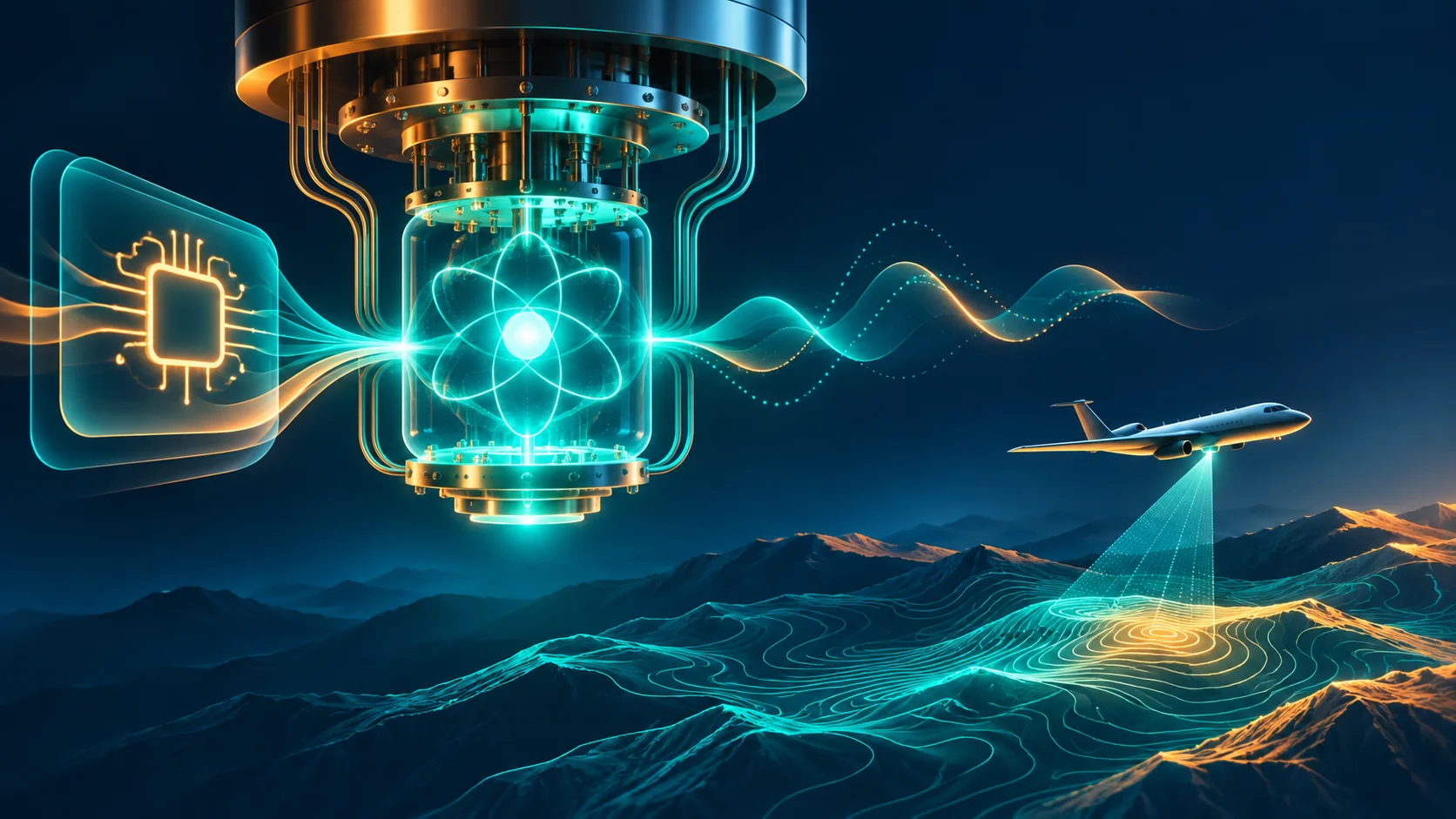
Q-CTRL’s earlier navigation explanation describes magnetic measurements matched to a map, with software handling interference. By contrast, IBM’s Dynamics Simulator documentation describes a function that constructs quantum circuits from a specified physical model and returns measured quantities over time. Neither is a general-purpose chatbot.
For an AI reader, the connection is the role of software in making hardware usable. It is tempting to ask whether quantum will replace today’s AI infrastructure. The more immediate question is narrower: where can control software remove a bottleneck that prevents a particular machine from doing useful work?
The Navigation Claim Needs Its Baseline
In its April 14, 2025 field-trial announcement, Q-CTRL reported improvements of up to 50 times against a conventional GPS backup. The system used measurements of the Earth’s magnetic field and compared them with map information to estimate position. The trials included moving vehicles, rather than only a stationary laboratory setup.
Forbes Australia’s latest interview reports a later claim of a hundredfold improvement, and makes an important distinction: the comparison was with alternatives used when GPS is unavailable, not with GPS itself. The interview also says detailed information about some subsequent trials was not disclosed.
Those numbers should not be joined into a simple performance trend. Different trials, conditions or baselines can change a ratio. Without matched test definitions, a larger number does not establish that the same product doubled its performance.
Consider an illustrative procurement decision. An aircraft operator needs to know how errors behave across an entire route, including difficult sections, rather than just the best observed result. An average improvement may be valuable while still hiding a small number of unacceptable failures. A purchasing decision therefore needs the distribution of errors and the conditions under which the system remains available.
That is an evaluation principle, not a claim that Q-CTRL failed such a test. It explains why a promising field demonstration and an operational guarantee are different things.
What the Computing Evidence Actually Shows
The computing milestone has its own timeline. In May 2026, Q-CTRL reported a materials-science simulation on IBM hardware taking about two minutes compared with more than 100 hours for its chosen classical comparison. The company presented this as evidence of practical quantum advantage. The claimed speedup belongs to that workload and comparison, not to all computing.
On November 5, Q-CTRL announced its Dynamics Simulator function, packaging circuit design, mapping to hardware and error suppression into a workflow for materials research. This gives the funding story a concrete product to examine: a callable service rather than only a laboratory result.
IBM’s documentation confirms that the function supports a one-dimensional Fermi-Hubbard chain with open boundaries. Users define the model, initial state, simulation settings and observables. Quantum Functions are described as beta and available to specified Premium, Flex and On-Prem users. This is not unrestricted access for every developer.
A defined problem class is a useful boundary, not a weakness to hide. It lets a research team decide whether its work fits. A simulation specialist can compare the supported model with the question they actually need answered; someone looking for a faster language-model server cannot infer relevance from the word quantum.
IBM also distinguishes cumulative quantum-processor execution time from additional execution used for error handling. That makes the measurement boundary important. A reader should avoid turning a quoted processor time into a promise about the full experience from submitting a job to receiving a usable result.
From a Demonstration to a Repeatable Business
Forbes Australia reports that Q-CTRL has been selling navigation evaluation kits, with a production variant planned for early 2027. That distinction matters more than the broad phrase “being deployed”: customers can be evaluating technology before a production version is generally delivered.
Forbes contributor John Koetsier notes that revenue figures were not disclosed with the funding announcement. The commercial picture is therefore incomplete. Financing can support development and deployment, but it does not tell readers how much customers pay, how long integration takes or whether each installation earns an attractive return.
The next phase should be assessed in stages. A successful trial establishes that something works under the tested conditions. A production delivery adds manufacturing and integration. A renewal or repeat order supplies evidence that the customer continues to find value after the excitement of the first demonstration.
This distinction is useful across AI infrastructure. A product can be technically impressive while still demanding expensive installation, specialist support or a long customer approval process. Conversely, a narrowly targeted product can be commercially important without becoming a universal computing platform.
Our Read: The Software Opportunity
Our analysis: the strongest part of this story is the attempt to turn difficult hardware into a repeatable workflow. Software that handles specialist decisions can expand the number of people able to use a system. But the value comes from reliable outcomes, not from adding an AI label.
For a research group, the relevant unit of value may be a validated simulation completed within a project deadline. For an operator evaluating navigation, it may be dependable positioning during a loss of the primary signal. These are concrete purchasing problems, and they need separate demonstrations.
The investment can give Q-CTRL more room to work through that transition. It does not remove the need for customers to compare alternatives. Our preferred next story would follow one deployment from evaluation through routine use: what the customer required, what changed, and what it cost to maintain.
For readers following the wider funding cycle, our Anthropic IPO explainer covers a different financing model. The useful connection is the habit of separating the amount raised from the evidence of business performance. Neither financing structure answers the product question by itself.
For Indian developers and business owners, this is primarily a signal about specialised industrial AI. There is no basis here to promise a cheaper chatbot subscription or an immediate improvement to an ordinary website. The practical opportunity is most relevant when a team already has a scientific or sensing problem that matches the technology.
What Remains Unknown
- The precise valuation and detailed financing terms.
- Revenue, profitability and the split between research engagements, evaluation kits and recurring product use.
- Complete conditions and comparable data behind the latest navigation-performance claims.
- Whether the planned production timeline will translate into deliveries at the scale customers need.
- How much benefit a new user obtains on a different scientific workload after accounting for accuracy, access and total cost.
These gaps define the next reporting questions. They should not be filled with assumptions drawn from an investor list or a promotional performance figure.
Frequently Asked Questions
How much did Q-CTRL raise?
The announced Series C is US$290 million. The amount raised is financing; it should not be read as annual sales.
Is the company valued at exactly US$1 billion?
No. The reporting says above that threshold, with the precise valuation undisclosed. Rounding the threshold into an exact valuation would change the meaning.
Does quantum navigation require a quantum computer on an aircraft?
The navigation approach described here uses quantum sensors and processing of their measurements. It is a different application from running materials simulations on a quantum computer.
Does the hundredfold claim mean it beats GPS?
That is not the comparison described in the reporting. The cited comparison concerns alternatives used without GPS, and the conditions of each test matter.
Can anyone immediately use the Dynamics Simulator?
Access depends on IBM’s eligible plans and the supported workflow. A team should check the current documentation before assuming it can run a particular problem.
Does this prove quantum machines are faster at every task?
No. A result on one scientific problem cannot establish a universal speed advantage. The problem, accuracy target and competing method must remain part of the claim.
What should readers watch next?
Production deliveries, independently reproducible comparisons and evidence of repeat use. Those would help establish how much of the technical promise is becoming a durable business.
Related Reading on AI Tech Safar
- Multiverse Computing: Funding and AI Compression
- Anthropic IPO: Price Range, Valuation and Big Tech Backing
Sources and Reporting Notes
Company and investor announcements establish what was announced. Independent reporting supplies commercial context. Technical documentation defines product scope; the sections marked Our Read and the evaluation examples are analysis. Historical demonstrations are included as background, not presented as fresh results.
- Q-CTRL — Series C announcement, November 12, 2026
- Quartz — Funding coverage, November 12, 2026
- Forbes Australia — Interview and commercial timeline, November 13, 2026
- NRFC — Investment announcement
- Q-CTRL — Navigation field trials, April 14, 2025
- Q-CTRL — Computing demonstration, May 6, 2026
- Q-CTRL — Dynamics Simulator launch, November 5, 2026
- IBM Quantum — Dynamics Simulator documentation
- Forbes — Funding analysis, November 12, 2026
Investors and stakeholders should closely monitor the forthcoming production deliveries and any independently reproducible comparisons that emerge in the wake of Q-CTRL’s substantial funding round. The ability to demonstrate consistent and repeatable applications of their technology will be critical in validating the company’s claims and assessing the durability of its business model. Furthermore, continued engagement with technical documentation will provide insights into the scope and potential impact of Q-CTRL’s offerings. Historical demonstrations serve as a foundation, yet the emphasis should remain on new evidence that supports the company’s trajectory within the competitive landscape of AI and quantum technologies.