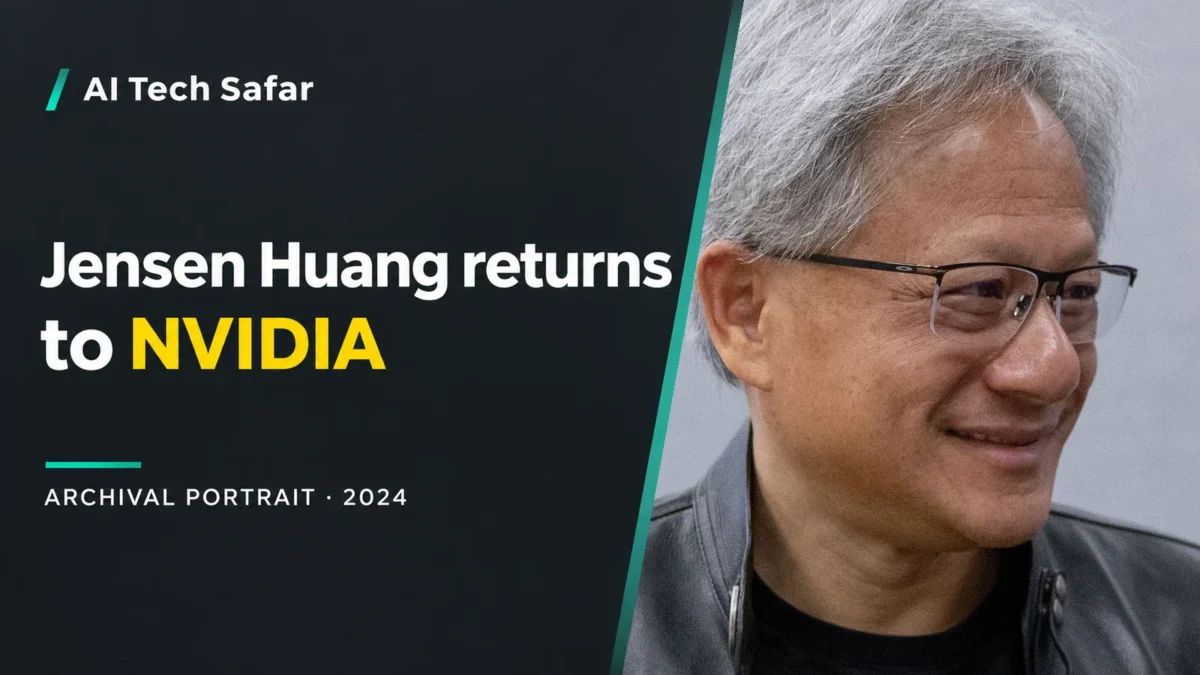
Jensen Huang returns as NVIDIA CEO after a remarkably short leadership interruption. The company announced his reinstatement on November 23; its SEC filing puts the effective date one day earlier, November 22. For the AI industry, this restores a familiar decision-maker at a major computing supplier. It does not settle every question surrounding his departure.
Editorial Reviewed Imran Khan Pathan, Editor at AI Tech Safar.
Reporting checked November 24, 2026, at 8:30 a.m. IST. This article distinguishes official corporate actions, attributed independent reporting and our analysis.
Overview: A leadership reversal with unfinished business
The practical story is about three different things: who runs NVIDIA, how its oversight arrangements work, and whether customers receive the computing capacity they expect. These questions overlap, but they require different evidence. A leadership announcement answers the first directly. It cannot, by itself, answer the other two.
NVIDIA’s reinstatement announcement says the independent-director investigation will continue to its conclusion. That distinction should shape how readers interpret the return: the board has made a management decision while a separate process remains open. The useful question now is what changes in accountability and execution, beyond the name on the CEO’s office.
TL;DR
- The formal return is documented: Huang is president, CEO and a director again, effective November 22, according to the Form 8-K.
- The earlier exit was real: NVIDIA’s November 12 announcement named Colette Kress interim CEO while retaining her finance responsibilities.
- Oversight has a separate structure: a standing board committee announced November 17 covers national security and export controls.
- The operating scale is substantial: NVIDIA reported $115.8 billion in quarterly revenue in its November 17 results. These are company-reported financial figures, not a forecast of what the leadership change will deliver.
- Our Read: buyers should track delivery commitments and governance disclosures separately. Neither a familiar executive nor a dramatic headline is a substitute for evidence on a particular project.
In this article
- What changed and when
- Oversight and independent reporting
- The business behind the headline
- Our Read: Three tests for the return
- Practical implications for AI teams
- What remains unknown
- FAQs
- Related reading
- Useful sources
Jensen Huang returns: What changed and when
NVIDIA’s original transition release confirmed Huang’s resignation as president, chief executive and director on November 12. Kress took the interim chief executive role, Harvey C. Jones became board chair, and the company described a search considering internal and external candidates. This was an announced leadership transition, not simply speculation about a possible departure.
The new filing records a reversal: Huang’s three roles were restored on November 22, and Kress continues as executive vice president and chief financial officer. The filing is dated November 23 and attaches the public announcement. Keeping those dates separate avoids turning the publication date into the date the decision took effect.
| Date in 2026 | Documented development |
|---|---|
| November 12 | Huang resigns; Kress becomes interim CEO. |
| November 17 | NVIDIA announces a standing national-security and export-control committee. |
| November 22 | Huang’s reinstatement takes effect, according to the SEC filing. |
| November 23 | The public reinstatement release and Form 8-K are dated. |
Readers who followed our earlier resignation coverage should treat this as a material follow-up. That article describes the departure phase; the current management position is established by the newer filing. An archive can accurately record what happened at the time while no longer describing who holds the job today.
There is also a difference between restoring someone to an office and demonstrating how decisions will be made after that restoration. The former can be established with a filing. The latter will become visible through subsequent disclosures, appointments and operating decisions. That is why the next stage of coverage should follow the resulting arrangements rather than repeatedly replaying the reversal.
What NVIDIA says about oversight—and what Reuters reports
In its November 23 statement, NVIDIA says the board voted unanimously after discussions with Huang. It expresses confidence in his leadership and says senior government input informed its national-security assessment. These are the board’s stated judgments. The same release says Jones remains chair, an independent investigation continues, and the company is searching for a chief compliance officer reporting to the Nominating and Corporate Governance Committee.
Reuters reported on November 24 that President Donald Trump and Vice President JD Vance pressed for Huang’s return, citing people familiar with the matter. That account adds a reported political dimension to the decision; it is not an independently published finding resolving the underlying inquiry. We do not interpret a reinstatement announcement or a news headline as legal exoneration.
The November 17 committee announcement gives more detail about the oversight structure. Suzanne Nora Johnson chairs the committee, with Stephen C. Neal and John O. Dabiri as members. NVIDIA described a remit covering national-security policies, export compliance and global trade risks, supported by independent outside experts. It also described reporting lines to then-interim CEO Kress. That dated description should not be casually republished as proof that she remains interim CEO after Huang’s return.
A reader can reasonably want more information without assuming the answer. The strength of an oversight arrangement depends on access to information, authority to raise uncomfortable questions and what happens when commercial and compliance judgments conflict. A committee’s existence is an observable step. Its effectiveness requires a record of how it operates, especially when the decision is difficult.
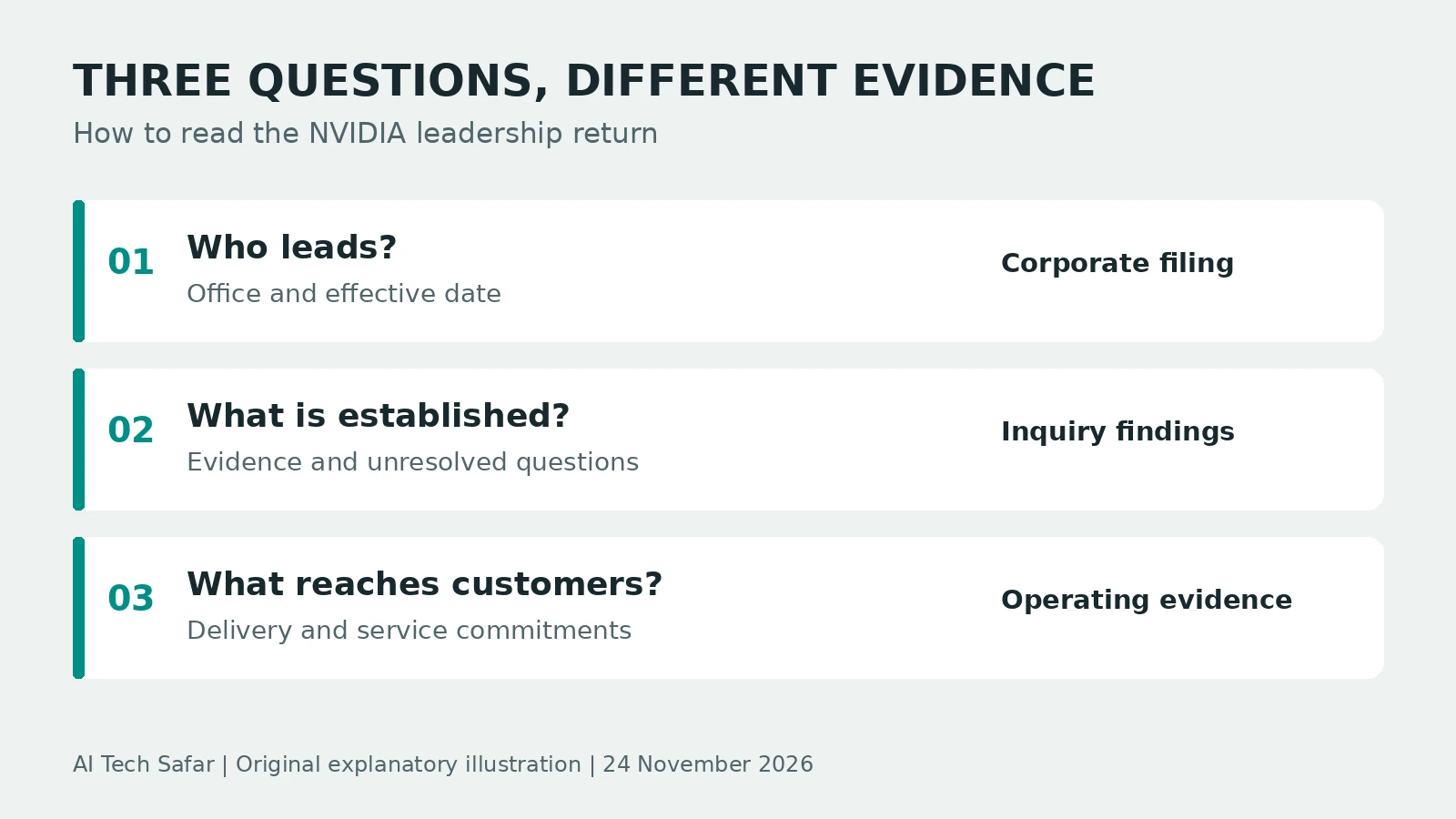
This distinction is also useful when interpreting the language of corporate releases. Confidence, cooperation and oversight describe different things. Confidence expresses a judgment; cooperation describes participation in a process; oversight identifies a responsibility. None of those words alone tells readers the final findings of an inquiry. The most informative future update would explain what was established, what remains unresolved and what corrective action, if any, follows.
The business behind the leadership headline
NVIDIA’s Q3 fiscal 2027 release provides a separate view of the business. The quarter ended October 25, before the November leadership changes. It therefore offers a baseline for operating scale, not a measurement of the effects of Huang’s departure or return. This timing matters: results published during a management crisis can still describe a period before that crisis.
| Measure | Company-reported figure |
|---|---|
| Q3 FY2027 revenue | $115.8 billion; up 103% year over year |
| Data Center revenue | $107.6 billion; up 110% year over year |
| GAAP gross margin | 74.8% |
| Q4 revenue outlook | $130 billion, plus or minus 3% |
| Outlook caveats | Extra week in Q4; no China Data Center compute revenue assumed |
Using those reported figures, Data Center contributed approximately 92.9% of quarterly revenue: 107.6 divided by 115.8. The outlook’s arithmetic range is $126.1 billion to $133.9 billion. These are our calculations, not additional company forecasts. Neither calculation establishes how much revenue depends on any one customer, executive or geography.
The distinction between a reported result and guidance is especially important here. A result describes an accounting period that has ended; guidance describes management’s expectations for a later period. A leadership change might influence confidence in those expectations, but it does not convert them into completed sales. Readers should resist treating an outlook as cash already collected or computing capacity already installed.
For AI builders, the useful financial question is whether the supplier can support a credible delivery and service plan. A large revenue total supplies context, but it does not identify the queue position of a smaller buyer, the availability of a particular configuration or the terms offered by a cloud reseller. Those details come from a customer’s actual supplier relationship. They cannot be reconstructed from the group revenue line.
Our Read: Three tests for the return
The following is AI Tech Safar’s analysis. The return can reduce uncertainty about leadership while leaving uncertainty about governance and execution. The strongest interpretation is therefore conditional: continuity is useful if the organization can show that its controls and commitments remain credible. We would assess that through three tests rather than through the emotional appeal of a comeback story.
1. Does responsibility become easier to trace?
The first test is whether readers can follow who is responsible for which decision. A chief executive manages the business; a board oversees management; a compliance function needs a clear path for escalating concerns. In practice, readers need enough disclosure to understand how these responsibilities connect. If every issue is described only as something “the company” is handling, accountability becomes difficult to evaluate.
A useful future disclosure would explain how a significant concern reaches independent directors and who can ask for additional examination before a commercial decision proceeds. That does not require exposing confidential customer details or investigation material. It requires making the decision process understandable. An organizational chart can help, but the important question is whether a concern can move through it without being lost or diluted.
The chief compliance officer search is therefore worth following as a governance development, not as an automatic solution. A job title alone tells outsiders little about resources, access or escalation authority. The evidence to watch would be the eventual mandate and reporting arrangements. Our assessment should change when those details become public, rather than assuming that announcing a search has already accomplished the intended reform.
2. Can commercial continuity be demonstrated at project level?
The second test is whether customers can verify the promises that matter to their projects. A leadership announcement may make a buyer more comfortable, but a deployment still depends on concrete deliverables. For a team buying infrastructure, those might include the agreed configuration, acceptance criteria, support arrangements and the point at which capacity becomes usable. A positive corporate story does not answer those contractual questions.
Consider an illustrative AI service preparing to expand a customer-support product. Its immediate concern is not whether an executive’s return sounds reassuring. It is whether the planned capacity is available in the required location and whether the application can handle interruptions. This is an example for analysis, not a report of a customer we interviewed or a deployment we tested. It shows why operational evidence should be collected where the dependency actually sits.
The same principle applies to a research team choosing between a reserved cluster and a shorter commitment. The useful comparison concerns workload fit, switching effort and the cost of unused capacity. A boardroom reversal can be a reason to revisit assumptions, but it should not become a substitute for that comparison. Teams should change a plan when the evidence affecting the plan changes.
3. Do later disclosures narrow uncertainty?
The third test is whether each subsequent update makes the remaining questions more precise. An informative disclosure could explain the status of a process, identify a completed appointment or document a specific operating result. A less informative update might repeat confidence without adding anything readers can evaluate. The volume of reassuring language matters less than the amount of new, usable information.
This also gives readers a disciplined way to avoid overreacting in either direction. They do not need to assume that the return proves every concern was unfounded. They also do not need to assume that an open inquiry predetermines an adverse conclusion. Both shortcuts replace evidence with a preferred story. The better approach is to record what each document establishes and leave the unanswered questions visibly unanswered.
Our central judgment is that continuity and scrutiny can coexist. A company can decide that a particular leader should run the business while maintaining a process for examining concerns. The credibility of that combination depends on the independence and usefulness of the process. Readers should evaluate those two decisions together, without collapsing them into a single verdict about either success or failure.
There is a practical way to make that evaluation less subjective: decide in advance what would change your mind. If the concern is an unclear reporting line, a documented mandate could answer it. If the concern is a delayed delivery, a governance statement would not be enough; the relevant evidence would concern that delivery. Naming the question prevents an impressive but unrelated announcement from being mistaken for a solution.
The converse matters too. A disappointing commercial outcome would not, by itself, prove a failure of the inquiry or establish misconduct. Businesses can miss expectations for many reasons, and an article should identify the evidence connecting a cause to an outcome before asserting that connection. Separating the questions protects readers from both excessive reassurance and unsupported accusation.
We would also distinguish an appointment from a transition that has become durable. An appointment is an event. Durability becomes visible over time as responsibilities are exercised and commitments are met. The return gives readers a new starting point for observation; it does not supply that future record in advance. This is a reason to keep a dated assessment rather than trying to issue a permanent verdict immediately.
For an editorial team, that means maintaining a short list of propositions instead of a single optimistic or pessimistic label. Who holds the office can be checked against a filing. What a board says it believes can be attributed to its statement. What independent reporting alleges should retain that attribution. What has actually been established by an inquiry needs the relevant findings. This approach makes later corrections more precise because a new fact changes the proposition it addresses.
Finally, transparency should be evaluated in context. An ongoing process may legitimately leave some details undisclosed, but that does not make every broad assurance equally informative. Readers can ask whether the company has identified the scope of the open question and the next meaningful reporting milestone. The answer may remain incomplete. Recording that limitation clearly is more useful than inventing either a deadline or a promised outcome that the source has not supplied.
Practical implications for AI teams and Indian readers
For readers in India, the most useful response is to map the actual dependency before taking action. Some teams buy hardware directly; others rent compute; many use an AI application without choosing its underlying hardware at all. These are different relationships. The appropriate evidence and the person who can supply it will differ accordingly. A supplier-level headline should be translated into a question relevant to the layer a team actually controls.
| Reader or team | Useful next check | What it establishes |
|---|---|---|
| Direct hardware buyer | Confirm written configuration, delivery and support commitments. | Project-specific obligations, not an industry-wide promise. |
| Cloud customer | Check contracted capacity, region and service terms. | The provider’s commitment to that account. |
| AI application developer | Review workload portability and recovery assumptions. | The team’s own exposure to a dependency. |
| News reader | Compare newer filings with earlier coverage. | Which facts have changed since the original report. |
A small team need not start an expensive migration merely because the news is dramatic. A proportionate first step is to identify its most important dependency and ask whether anything about that dependency has actually changed. If the answer is unclear, request the relevant written terms or status update. The objective is to reduce uncertainty efficiently, not to manufacture an emergency from a headline.
Where a team does have concentrated exposure, a modest contingency exercise can be useful. It might identify the data needed to restart a workload, the software components that would need adjustment and the person authorized to make a change. These are suggested planning questions, not tested instructions. Their value is in revealing whether the team has a usable alternative or merely assumes one exists.
For procurement discussions, separate the reasons for a decision. Technical suitability, commercial terms and confidence in a supplier’s governance are related but distinct. Recording each reason makes it easier to revisit the decision later. If a delivery estimate changes, the team can assess that change directly instead of reopening every assumption about the supplier at once.
For general readers, the equivalent discipline is simpler: check the date and purpose of the source. A historical article may explain why a controversy began; a newer filing may establish who now holds an office. A financial statement may quantify the business without resolving a governance question. Reading each for what it can actually establish produces a more accurate picture than treating the newest headline as a replacement for every earlier fact.
What remains unknown—and what would answer it
The reviewed material does not provide the completed findings of the independent inquiry or a final public outcome for every government-related question. It also does not provide a customer-by-customer account of whether the leadership interruption affected commercial decisions. We cannot fill those gaps with an inference from the reinstatement itself. The relevant evidence would have to come from the process or the affected business relationship.
Three types of future evidence would materially improve the picture: a substantive update on the inquiry, clearer information about the compliance leadership appointment, and subsequent operating disclosures that can be compared with stated expectations. Each answers a different question. Combining them too early would obscure the difference between a governance improvement, an investigation outcome and ordinary business performance.
There is no fresh hands-on hardware test in this report, and we have not interviewed customers or reproduced company financial reporting. Our contribution is to connect the dated documents, distinguish their evidentiary roles and explain the implications. We have also avoided using a moving share price as a shorthand verdict on the situation. A market reaction would describe investor behavior at a particular moment, not settle the outstanding facts.
Frequently asked questions
Is Jensen Huang officially back as NVIDIA CEO?
Yes. The SEC filing documents his reinstatement as president, CEO and director, effective November 22, 2026. The public announcement followed on November 23.
Why are there two dates for his return?
One is the effective date of the corporate action; the other is the date of the public announcement and filing. They describe different points in the sequence. Treating them as interchangeable would create an avoidable chronology error.
Does reinstatement mean the investigation is complete?
No. NVIDIA’s announcement explicitly says the independent investigation continues. A decision to restore an executive is not the same document or process as a completed investigative finding.
What happens to Colette Kress?
The filing says she continues as executive vice president and chief financial officer. Earlier descriptions of her as interim CEO belong to the transition period and should be read with their dates in mind.
Do the quarterly results show the impact of the return?
No. The reported quarter ended before the leadership events discussed here. The figures provide context for the business’s scale; attributing them to a later management decision would reverse the order of cause and effect.
Should AI teams change suppliers because of this news?
This article does not establish a project-specific reason to do so. A useful decision would examine actual commitments, workload requirements and switching costs. The checklist above is editorial guidance for that assessment, not a finding that a particular service has become unavailable.
What is the most important next development to watch?
Look for information that closes a specific gap: an inquiry update, a defined compliance appointment or measurable delivery and financial results. A new statement matters most when it adds evidence that changes an assessment, rather than merely repeating a position.
Related reading on AI Tech Safar
- The earlier NVIDIA leadership transition: historical context
- AI agent security: separating incidents, evidence and controls
Useful sources and reporting notes
- SEC Form 8-K, filed November 23: reinstatement effective November 22
- NVIDIA, November 23: board reinstatement announcement
- Reuters, November 24: independent reporting on the return and political pressure
- NVIDIA, November 12: original leadership transition
- NVIDIA, November 17: national-security and export-control committee
- NVIDIA, November 17: Q3 fiscal 2027 results and outlook
Sources were opened and read for this report. Corporate statements establish announced company actions and claims; Reuters is identified where independent reporting is used. Calculations are labeled, and Our Read and the practical checklist are editorial analysis. The featured portrait is archival, not a photograph of the reinstatement; the supporting diagram is an original explanatory illustration.
Featured-image credit: Archival portrait by Peter Dasilva / European Union, May 13, 2024, via Wikimedia Commons, CC BY 4.0. Resized, cropped and incorporated into an original AI Tech Safar card; not a photograph of the reinstatement. No endorsement implied.