OpenAI perplexity limits entered the AI policy debate on November 22, 2026, when chief scientist Jakub Pachocki proposed shared development boundaries tied to measurable capabilities and stronger oversight. Reuters reported that CEO Sam Altman backed the proposal. The immediate question is practical: what evidence should a laboratory need before it builds something more powerful?
Editorial Reviewed Imran Khan Pathan, Editor at AI Tech Safar.
Research checked: November 23, 2026. This is a reported news explainer with clearly labeled editorial analysis. We have not reproduced OpenAI’s experiments or tested an industry-wide measurement system.
Overview
The November 22 essay calls for limits based on perplexity alongside other measurements, with further development conditional on concrete progress in understanding and monitoring AI. It does not announce an agreed numerical boundary, an industry pact or an effective date. That distinction matters for everyone reading this as a prediction about the next model release.
For AI Tech Safar readers, the consequential issue is how to connect a research score to a decision that other people can inspect. A score might help signal when closer scrutiny is needed. Whether it can justify delaying development depends on the test behind it, the risk being addressed and who is empowered to challenge the result. Those are separate questions, and this article works through them separately.
TL;DR
- Reuters’ independent report records Altman’s support. Support from one company’s leadership does not establish a cross-industry agreement.
- Pachocki’s published figures use a fixed snapshot of OpenAI’s internal codebase and report log-perplexity. They are not a ready-made comparison chart for competing labs. Primary source.
- Tokenization and evaluation context affect perplexity comparisons, according to Hugging Face’s technical documentation. A bare score is missing essential context.
- OpenAI’s November 10 monitoring research describes imperfect indicators of monitoring difficulty. It does not demonstrate that every current monitoring system fails.
- A separate November 18 OpenAI account distinguishes research, internal use and public deployment. The company describes different safeguards for different access conditions.
- Our Read: the strongest next step would be a reproducible evaluation and review protocol. A dramatic threshold headline without that protocol would be difficult to audit.
In this article
- What was proposed
- What perplexity measures
- Why monitoring matters
- Comparing measurements
- Our Read: designing a credible agreement
- Practical implications
- What to watch next
- FAQs
- Related reading
- Useful sources
What the OpenAI perplexity limits proposal actually says
Pachocki argues that progress in pretraining could provide a common signal of emerging capabilities. His proposed limit would be conditional: developers would wait for a specified oversight milestone before moving beyond it. He also acknowledges differences between laboratories’ datasets, the gap between prediction scores and practical tasks, and improvements outside pretraining that the metric misses. Read the full proposal and its limitations.
Those qualifications belong in the story’s centre. Treating an internal research indicator as a universal intelligence scale would skip the work necessary to establish that scale. Treating a suggested boundary as an enforced pause would skip the work necessary to establish an agreement. Neither shortcut helps readers understand what has changed.
The background is broader than one essay. In its September 21 standards proposal, OpenAI argued for shared definitions, evaluation practices and incident-reporting protocols. It identified fragmentation, collective-action problems and uneven technical capacity as obstacles. That earlier document framed international technical standards as distinct from licensing or mandatory prerelease approval, leaving governments to decide how standards might enter their legal systems.
This background explains the company’s position, rather than proving that its preferred approach is the right one. A developer has relevant technical knowledge, but it also has commercial interests in the rules that shape its own work. Independent researchers, customers and public institutions would need enough access to evaluate the evidence, including evidence that challenges a laboratory’s preferred interpretation.
Perplexity: a useful measurement with a specific job
Hugging Face’s documentation defines perplexity through the probabilities a language model assigns to tokens in a sequence. Lower values indicate better prediction on the evaluated material. The documentation also explains why tokenization matters: different ways of splitting text change the units being scored. Context handling matters too. Evaluating isolated chunks can produce a different result from evaluating overlapping windows that give the model more preceding context.
An analogy may help. Imagine asking two students to predict the next word in a document. One receives the previous paragraph; the other sees only the previous sentence. Even if both answers are scored honestly, the comparison mixes ability with the amount of information supplied. This is an illustration of evaluation design, not a claim that language models learn or reason like students.
The same caution applies when a score moves from a research report into a purchasing decision. A company choosing a customer-support assistant needs evidence about its own support work. Prediction quality alone does not tell the buyer whether the assistant will escalate a refund dispute appropriately, follow the company’s data-handling rules or cope with incomplete order information.
That is why a measurement’s scope is as important as its precision. A tightly defined number can be useful without answering every question. Trouble begins when readers silently expand “better on this measurement” into “better for every use” or “safe under every form of access.” An article, product page or procurement memo should state which of those claims the evidence actually supports.
Why monitoring sits at the centre of the debate
OpenAI’s November 10 research examines two signals: what models can accomplish without an explicit chain of thought, and how much they can control that chain of thought. It reports changes across pretraining, reinforcement learning and model-generated training data. The authors describe these measures as imperfect proxies for monitorability and acknowledge that controllability does not always correspond to more monitor evasion.
In this context, a chain of thought is model-generated reasoning text. Reading that text may offer useful evidence, but it should not be casually described as direct access to every computation inside a model. The research question is whether the available observations are sufficient for the monitoring task. That is narrower, and more testable, than claiming that an AI’s “mind” has become visible.
Our interpretation is that oversight should be evaluated as a system. Consider an illustrative coding agent that proposes a database change. A reviewer might inspect the explanation, examine the actual query, check the account’s permissions and require approval before execution. These checks answer different questions. A persuasive explanation cannot compensate for an account that already has excessive authority, and a restrictive account does not prove the explanation is reliable.
OpenAI’s November 18 risk-management description similarly separates research environments, employee use and wider deployment. The company says it combines protections rather than depending on one safeguard, and that changing access changes which protections matter most. This is a description of the company’s approach, not an independent audit of how consistently every control operates.
The practical lesson we draw is to ask what a monitor can observe, what it can miss and what happens after an alert. “We monitor the system” leaves all three unanswered. A useful oversight claim should name the behaviour being detected, the intervention available and the conditions under which the evidence was collected.
Different measurements answer different questions
An external research example helps put the proposal in perspective. METR’s task-horizon methodology measures performance using tasks whose length is expressed in the time human professionals take to complete them, at a specified success probability. It is an approach to measuring task completion, rather than a prediction score. METR also notes that estimates depend on methodological choices, including the tasks and human baselines.
We are using that methodology as background, not quoting its historical model rankings as current November 2026 performance. The distinction is useful because the question “How well does this model predict?” differs from “How reliably does this system finish a sustained task?” A governance discussion could need both kinds of evidence without pretending they are interchangeable.
| Evidence type | What to ask | What it cannot settle alone |
|---|---|---|
| Prediction score | What corpus, tokenizer and context method were used? | Suitability for a particular business workflow. |
| Task-completion evaluation | Which tasks, human baselines and success level define the result? | Performance across every occupation or operating environment. |
| Monitoring evaluation | What behaviour can be observed and interrupted? | Safety after tools, permissions or deployment conditions change. |
The table suggests a useful reading habit: look for the noun after the number. Accuracy on what? Reliability at which task length? Detection of which behaviour? A headline can remove those qualifiers without changing the digits, yet materially change what a reader thinks was established. Better reporting preserves the qualifiers instead of relying on a single impressive number.
Our Read: what a credible agreement would need
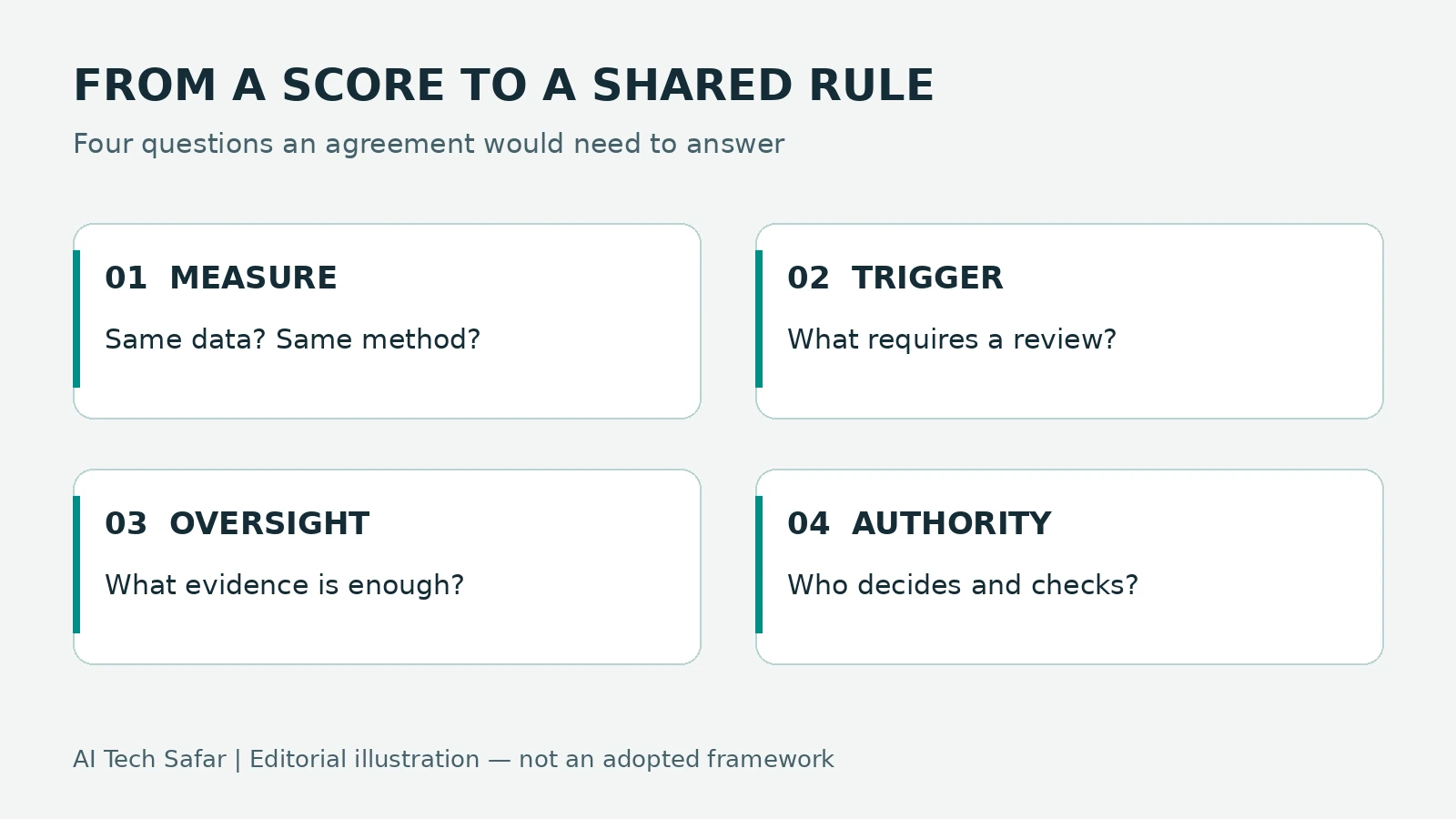
The following is AI Tech Safar’s analysis, not an announced implementation plan. The proposal becomes useful if it turns into a process that produces decisions people can examine. We would evaluate a future agreement against five requirements: comparability, a meaningful trigger, evidence of oversight, independent challenge and a workable procedure for changing the rules.
1. Publish the comparison protocol before the leaderboard
A shared score needs a shared explanation of how it is produced. Participants should know which test version applies, how access to test material is controlled, how results are checked and which changes require a new comparison. Without that information, a lower reported value could become a public-relations claim that outsiders have little ability to examine.
Full public release of every test item is not the only possible design. An independent evaluator could hold confidential material and publish the procedure, limitations and conclusions. That would introduce its own accountability questions: who selects the evaluator, who pays, who can challenge the result, and how competing laboratories receive equivalent treatment. Confidentiality should narrow access for a reason, rather than eliminate scrutiny altogether.
2. Define the decision that a trigger activates
A threshold can trigger different actions: more testing, tighter internal access, a delay in a particular training activity or a restriction on deployment. These choices should not be blurred. A system available only inside an isolated research environment presents a different decision from one that can initiate actions across customers’ accounts. The agreement would need to specify its scope before anyone could judge compliance.
We would also want a documented process for borderline results. Measurement uncertainty creates awkward cases around any boundary. A rule that ignores uncertainty could alternate between permissive and restrictive decisions because of small methodological changes. A credible process would explain how to handle retests, disputed results and changes to the evaluation itself, rather than leaving these questions to private negotiation after a controversy.
3. Make the permission to proceed evidence-based
The condition for moving forward deserves as much attention as the stopping condition. “Monitoring improved” is too vague to evaluate. A stronger submission would identify the failure being addressed, show the evidence that the mitigation works in the relevant environment and disclose remaining gaps. The decision should be tied to the capability and access being authorised, not merely to the existence of a new safety document.
For example, an imagined evaluation might demonstrate that a review system catches a particular class of unauthorised tool action. That would be useful evidence for that class of action under the tested conditions. It would not automatically justify giving the agent unrelated permissions or removing the review system. This is a hypothetical example of how evidence should constrain a decision; we did not run such an evaluation.
4. Give independent challenge a practical route
A standard is weaker if only its signatories can see enough information to dispute it. External reviewers should have a defined route to request clarification, reproduce an assessment where feasible and publish disagreements without having to imply that every uncertainty is misconduct. Technical disagreement is often valuable evidence about the limits of a measurement.
The process should also guard against incumbents designing requirements that only incumbents can afford. An evaluation can be demanding while still explaining its costs, access rules and proportionality. Smaller developers should not receive a free pass on serious risks, but neither should company size become an unexplained substitute for demonstrated capability or exposure.
5. Explain how the rule can change
Any long-lived agreement needs a revision procedure. New kinds of systems may expose weaknesses in an old test, and new oversight techniques may change the evidence needed to proceed. If revision is too easy, the boundary could move whenever it becomes inconvenient. If revision is impossible, the agreement could preserve a poor measurement indefinitely.
A sensible balance would publish the reason for a change, the evidence considered, who participated and how the new version affects earlier decisions. That creates a history that readers can inspect. It also gives developers something more predictable than an undefined promise that the rules will evolve responsibly.
| Agreement element | Evidence we would look for | Reason it matters |
|---|---|---|
| Comparable testing | Versioned method and independent verification route. | Separates a reproducible result from a private assertion. |
| Defined trigger | Specific action, scope and dispute process. | Makes compliance understandable. |
| Permission to proceed | Relevant mitigation evidence and remaining gaps. | Connects oversight progress to the actual decision. |
| Accountability | Named decision authority and challenge mechanism. | Shows who can correct a mistaken decision. |
| Revision | Public explanation of changes and affected decisions. | Prevents silent movement of the standard. |
Practical implications for developers, buyers and readers
For a small business, the immediate task is not to invent a private perplexity threshold. It is to avoid purchasing certainty that a vendor has not supplied. If an assistant is being added to a support desk, bookkeeping workflow or content operation, the business still needs a clear description of the assistant’s job, access and escalation process.
For a developer, we would keep model evaluation and application evaluation in separate sections of a release review. The first describes the underlying model evidence. The second describes the specific tools, permissions and operating conditions of the application. This makes it harder for a strong general benchmark to conceal a weak integration decision.
For example, a shop’s assistant might be allowed to draft a reply but require approval before changing a refund. A content assistant might draft an article but require an editor before publication. These are illustrative design choices, not claims that we tested a particular product. They make the consequence of an error easier to understand and connect the approval to an actual action.
For teams seeking an established starting point, NIST’s AI Risk Management Framework is described by NIST as voluntary and intended to incorporate trustworthiness considerations into AI design, development, use and evaluation. NIST also provides a generative AI profile. These are background resources, not evidence that NIST has endorsed this new OpenAI proposal or adopted its measurement approach.
| Reader | Useful next question | Concrete follow-up |
|---|---|---|
| Application developer | Does the evaluation cover our actual tools and permissions? | Record deployment assumptions alongside the model version. |
| Business buyer | Who approves consequential actions? | Ask for a demonstration of approval and escalation behaviour. |
| Research reader | Can the comparison be checked? | Look for method, scope, access conditions and limitations. |
| Policy observer | Who has agreed to what? | Separate a proposal, a voluntary commitment and a binding rule. |
Readers interested in the application layer can also explore our AI agent security coverage. The connection is the decision to grant an agent authority. This article does not rely on that earlier post as verification of today’s announcement.
A useful procurement record could be a short decision note attached to each consequential integration. In an illustrative support workflow, it would identify the account the assistant uses, whether it can read customer records or change them, which actions need approval, and who receives an escalation. It would also record the model version and the evidence used to approve that configuration. The purpose is to make the decision reviewable when something changes, rather than turn a vendor’s general safety statement into a permanent permission slip.
If the team later adds a payment tool, broadens access to customer data or removes an approval step, that note gives reviewers a clear reason to revisit the decision. This is our suggested operating practice, not a requirement announced by OpenAI. It brings the discussion back to something a small team can control: the relationship between an assistant’s authority, the evidence available and the person accountable for granting access.
What to watch next
The next meaningful development would be evidence that parties outside OpenAI are willing to work with a specified protocol. A statement of general support would be newsworthy, but a published testing method, named participants and a decision process would make the proposal much easier to assess. We would report those as distinct developments rather than bundle them into a claim of universal agreement.
Other signals deserve attention: whether independent evaluators can examine relevant systems, whether results include uncertainty, and whether the proposed rules apply consistently to different forms of development. A framework that covers only the most visible public releases could miss consequential activity elsewhere. Conversely, a framework with an undefined scope could be too broad to implement fairly.
The question for readers is therefore concrete: what new evidence or authority has appeared since the proposal? Keeping that question in view helps separate a genuine institutional change from another round of commentary. It also gives future coverage a clear standard for updating this article without pretending that a suggested solution has already been delivered.
Frequently asked questions
Has OpenAI announced an industry-wide development pause?
No. The essay proposes limits; it does not announce an industry-wide agreement. Source.
Is this about the Perplexity search product?
No. Here, perplexity refers to a language-model evaluation metric. The article is discussing prediction quality and governance, not announcing a change to a search subscription or app. Technical definition.
Can I compare two models using whichever perplexity figures I find?
Check the tokenizer, dataset and context method first. Without comparable conditions, the figures may not support your conclusion. Documentation.
Would a stronger prediction score prove that an assistant is safe?
Our assessment is no: safety in a workflow needs evidence about that workflow and its consequences. A score about prediction cannot by itself establish that an assistant should receive permission to modify accounts, approve payments or publish material.
Are monitoring concerns proof that all reasoning traces are useless?
No. OpenAI’s research describes imperfect proxies and limitations in their relationship to monitor evasion. A useful conclusion is to examine what a particular monitor can detect, not to dismiss every monitoring approach. Research and caveats.
Does this announcement change my ChatGPT plan or API access?
This is not a product-availability notice. Check product documentation separately before making an account-specific decision.
What would make a future agreement convincing?
In our view: comparable measurements, a clear action at the boundary, evidence for proceeding, a challenge mechanism and transparent revisions. The practical test is whether someone outside the developer can understand why a decision was made and what would change it.
Related reading
- AI Agent Security Incidents: WorkOS, Binance and Controls — related application-security coverage.
- Global AI Policy: How Countries Regulate and Adopt AI — broader policy background.
Useful sources
- Jakub Pachocki: Perplexity and intelligence — November 22, 2026; primary proposal and stated limitations.
- Reuters: OpenAI scientist proposes industry AI limits — November 22, 2026; independent reporting and attribution of Altman’s support.
- Hugging Face: Perplexity of fixed-length models — technical documentation, checked November 23, 2026.
- OpenAI: What affects chain-of-thought monitorability across the model lifecycle? — November 10, 2026; research and caveats.
- OpenAI: Managing frontier AI risk — November 18, 2026; company-described operational safeguards.
- OpenAI: Building standards for the next phase of AI — September 21, 2026; earlier policy position.
- METR: Measuring AI ability to complete long software tasks — March 19, 2025; methodology background, not a current model ranking.
- NIST: AI Risk Management Framework — voluntary risk-management background, checked November 23, 2026.
Image credit: Featured archival portrait (2012): Izabela Majewska, Wikimedia Commons, CC BY 2.0. Resized into an AI-assisted news-card layout; original photographic content retained. The body diagram is an original AI Tech Safar editorial illustration. Neither depicts an event or test from this announcement.