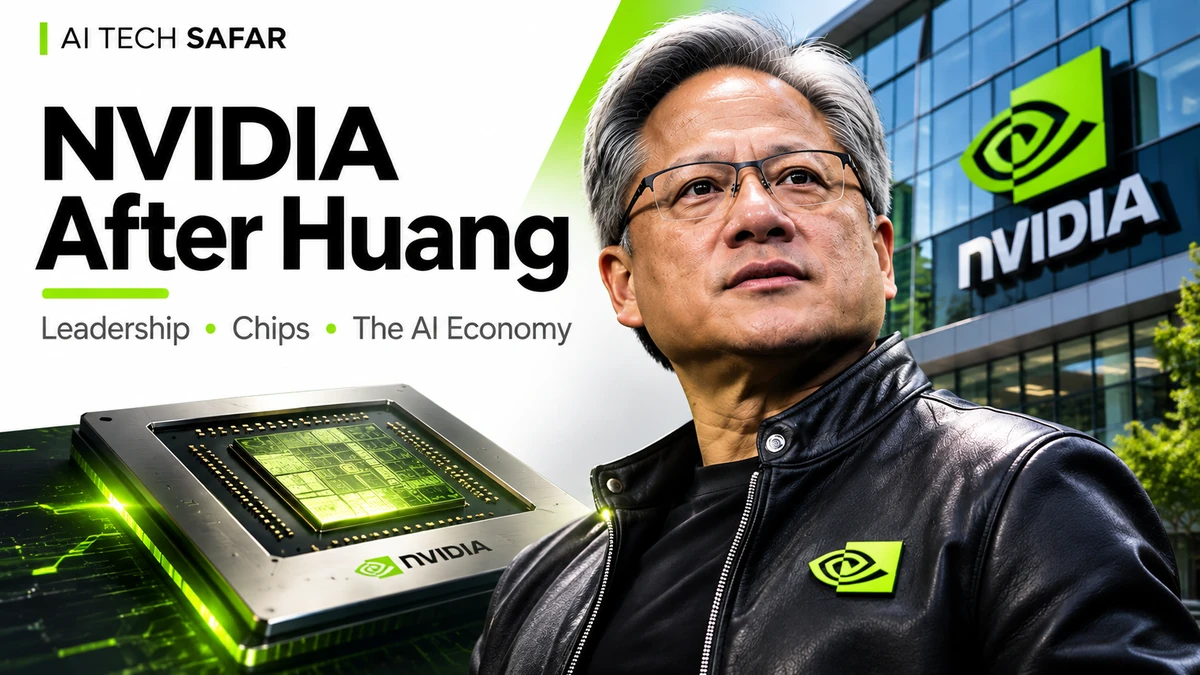
Overview: Jensen Huang Resigns as Nvidia CEO
Jensen Huang resigns as Nvidia CEO, putting the company’s leadership, customer relationships and role in financing AI infrastructure under fresh scrutiny. Here is what has changed, what the company has actually confirmed, and which developments matter next.
Editorial review: Imran Khan Pathan, Editor at AI Tech Safar.
Prepared November 13, 2026 (IST), using announcements and reporting dated November 12. This is a developing story; market figures below are identified as intraday snapshots.
Jensen Huang resigns after decades at Nvidia’s helm, and the company must now show how much of its extraordinary influence can carry on without its founder in charge. The company’s November 12 announcement confirms his immediate departure as president, chief executive and board member, with finance chief Colette Kress taking over as interim CEO.
For anyone building on AI, the important question reaches beyond the next person on a keynote stage. Who keeps customer commitments moving, who decides where the company puts its capital, and how will a new leadership team handle the political pressure around advanced chips? Those questions connect a boardroom change to the infrastructure behind AI products.
TL;DR
- Nvidia has confirmed the leadership transition. Kress will retain her CFO responsibilities while the board considers internal and external candidates for the permanent role.
- Harvey C. Jones becomes the company’s first board chair. Nvidia says it expects customer commitments, operations and its product roadmap to continue without interruption.
- The investigation and the succession are separate issues. A resignation does not establish that the allegations surrounding the company have been proven.
- Watch operating decisions: deliveries, partnerships, financing and regulatory developments will say more about the consequences than speculation about a successor.
- The next scheduled results call is November 17 in the US, which falls early on November 18 in India.
In This Article
- Jensen Huang Resigns: What Has Changed at Nvidia
- How the Crisis Reached This Point
- Who Is Colette Kress—and Why Her Background Matters
- Why This Matters Beyond Nvidia’s Own Chips
- The Stock Reaction: A Snapshot Is Not the Whole Story
- What to Watch at the November 17 Results
- What We Still Do Not Know
- Our Read
- FAQ
Jensen Huang Resigns: What Has Changed at Nvidia
The initial ABC News report independently corroborates the central event: Huang resigned, and the company began a permanent CEO search while appointing an interim leader. This is a completed leadership change, not a report that the board is merely considering one.
| Role or decision | Position after the announcement | What remains open |
|---|---|---|
| Chief executive | Colette Kress serves on an interim basis | Permanent appointment |
| Finance leadership | Kress also retains the CFO role | Longer-term allocation of responsibilities |
| Board leadership | Harvey C. Jones becomes chair | How oversight develops during the transition |
| Successor search | Internal and external candidates will be considered | Names and timetable have not been confirmed |
These details are also set out in NDTV Profit’s account of the transition. The distinction between an interim appointment and a permanent succession matters: customers have an executive in charge now, but they do not yet have a settled answer about who will shape the company’s next chapter.
How the Crisis Reached This Point
The public record includes a November 8 message from Huang to employees, in which he acknowledged infidelity, apologised and said he would cooperate with an independent investigation into national-security concerns raised by reporting. The message did not establish the outcome of that investigation.
On November 10, the independent directors named Joon H. Kim and Wachtell, Lipton, Rosen & Katz to conduct the inquiry. That announcement identifies who is doing the work; it does not publish findings. By November 12, the company had announced a new leadership arrangement.
The chronology explains why this story requires careful wording. The existence of an inquiry, the subject of that inquiry and a conclusion from it are three different things. Readers should not have to untangle those distinctions from a sensational headline.
Reporting has linked the crisis to allegations involving a Chinese businesswoman and possible intelligence connections. Reuters explicitly says it could not independently verify the intelligence allegation and notes China’s denial. This article focuses on the documented business transition rather than treating that allegation as a finding.
Who Is Colette Kress—and Why Her Background Matters
Nvidia’s official biography of Kress says she joined in September 2013. Before that, she led finance for Cisco’s Business Technology and Operations Finance organisation, spent 13 years at Microsoft—including four as CFO of its Server and Tools division—and held finance roles at Texas Instruments.
That history gives readers a more useful starting point than describing her simply as the person replacing Huang. Her background spans enterprise technology, planning, reporting and financial strategy. Our interpretation is that those skills are particularly relevant when customers and partners want clarity about commitments, and employees need decisions to keep moving.
It still leaves a leadership question. Financial familiarity does not, on its own, tell us how technical priorities, product decisions and major relationships will be distributed across the executive team. Watch the people given responsibility for those decisions, rather than assuming one executive must personally reproduce every part of the founder’s role.
Analysts quoted in Reuters’ initial reaction roundup make a similar distinction: Kress is familiar to investors, while replacing a founder who concentrated decision-making creates an organisational challenge. That is an assessment of transition risk, not evidence that a product programme has already failed.
Why This Matters Beyond Nvidia’s Own Chips
There are three different business questions inside this story: the ability to supply technology, the willingness to finance expansion and the freedom to serve particular markets. A leadership change can affect each through a different route. Combining all three into a claim that the AI boom is over would hide the details readers need.
1. Product execution and customer commitments
A customer cares about whether a delivery arrives, whether software support continues and whether the next product fits the systems already being built. An executive departure alone does not answer those questions. The useful evidence will be changes to schedules, customer communications and operating guidance.
For a team planning an AI deployment, the practical response is to review its actual exposure. Does it own hardware, rent cloud capacity, or buy an application powered by someone else’s infrastructure? Each position has a different dependency. A business using an AI application may be several commercial relationships away from the chip supplier.
2. The financing behind new capacity
Nvidia’s July infrastructure-financing announcement, co-authored by Kress, describes a model combining revenue sharing and credit support for AI cloud partners. Nvidia would receive product revenue and a portion of cloud revenue on supported capacity. The company presented this as a way to make large-scale compute accessible to more customers.
That provides concrete context for the financing question. Selling equipment and helping make a project financeable are different relationships. When a supplier participates in both, decisions about capital and risk can influence how quickly customers expand. A new leadership team could reaffirm, refine or eventually alter that approach; the resignation announcement does not tell us which.
The next useful disclosure would therefore be specific: existing commitments, new agreements, the terms offered to partners, and the conditions attached to support. A broad promise of confidence is less informative than a clear account of what is funded and what is still being negotiated.
3. Access to computing across borders
Separately, Reuters reported on November 12 that Chinese AI companies were seeking overseas Nvidia-based computing capacity amid fears of tighter restrictions on remote access. The report describes concern and preparations, not an announcement that a new cloud-access ban has taken effect.
This distinction matters commercially. Buying chips and renting access to chips are different transactions. For a reader assessing the consequences, the evidence to watch is an actual rule or supplier notice describing what changes, for whom and when. Political pressure may be relevant background, but it is not a substitute for the text of a policy.
The Stock Reaction: A Snapshot Is Not the Whole Story
An ANI report carried by The Tribune recorded a sharp early drop followed by a partial recovery, quoting $160.36, down 7.69%, at its reporting point. Those numbers are a dated intraday observation, not a closing price or a live quote. Different reports can legitimately show different percentages when the market is moving quickly.
The more useful question is what investors are trying to price. Leadership uncertainty may change expectations about execution, while financing concerns may change expectations about customers’ expansion. A share-price move bundles those judgments together; it cannot tell us which individual contract or product will be affected.
We are not drawing a buy-or-sell conclusion from the reaction. To assess the business story, compare subsequent operating disclosures with what the company previously promised. A fall in market value and a reduction in operating capacity are different developments.
What to Watch at the November 17 Results
Nvidia’s published earnings schedule sets the fiscal third-quarter results release for approximately 1:20 p.m. Pacific Time on November 17, followed by the call at 2 p.m. Pacific. In India, those times are approximately 2:50 a.m. and 3:30 a.m. IST on November 18. The quarter ended October 25.
Our reporting checklist for that update is straightforward. The point is to look for measurable commitments and clear ownership of decisions, rather than grade the tone of a prepared statement.
| Question | Evidence worth watching | Why it matters |
|---|---|---|
| Are deliveries on track? | Specific guidance on schedules and supply | Tests operating continuity |
| Are customers changing plans? | Disclosed changes in demand or commitments | Separates customer behaviour from market sentiment |
| Will financing support continue? | Terms and scope of partner commitments | Clarifies expansion assumptions |
| Who makes key technical decisions? | Named responsibilities across the leadership team | Shows how execution is organised |
| What has changed in market access? | Actual rules and compliance disclosures | Distinguishes policy from speculation |
What We Still Do Not Know
- The permanent CEO’s identity and the date of appointment.
- The findings and completion timetable of the independent investigation.
- Whether the transition will eventually change investment priorities or partner-financing terms.
- Whether concerns over cross-border cloud access will produce a new restriction.
- Whether any customer or supplier will change a material commitment because of the transition.
These are open questions, not predictions. Keeping them separate also makes the next update easier to assess: a confirmed appointment resolves succession, while a regulatory announcement answers a different part of the story.
Our Read
Nvidia’s immediate challenge is to make decision-making visible and dependable at a moment when its leadership has changed abruptly. Customers need delivery clarity. Partners need to know whether commitments still hold. Employees need to know who can settle the decisions that keep work moving.
The strongest evidence of continuity will be ordinary execution: commitments met, responsibilities explained and plans supported by disclosed resources. The strongest evidence of disruption would be concrete changes in those same areas. That is the distinction worth following over the next few weeks.
For AI Tech Safar readers, this story belongs alongside the larger question of how AI infrastructure is funded and governed. The person at the top matters, but the useful analysis follows the decisions—and then checks what happened.
FAQ
Has Jensen Huang actually resigned?
Yes. The company’s statement confirms an immediate departure. Earlier reporting about deliberations should not be confused with the later announcement.
Is Colette Kress the permanent CEO?
No. The appointment is interim, and the successor search remains open. Reporting a candidate as the next CEO before an appointment would be premature.
Does the resignation prove the allegations?
No. A personnel decision is not an investigative finding. The publicly announced inquiry must be assessed on its own evidence and conclusions.
Does this mean Nvidia’s chips or services will stop working?
That conclusion does not follow from a leadership change. Users should rely on notices from their actual hardware, cloud or application provider for service information.
Why discuss finance in a chip-industry story?
Infrastructure needs both equipment and funding. How a project obtains financing can affect when it is built, even when the underlying technology is available.
Has a new ban on overseas cloud access been announced here?
No. The reporting cited describes companies’ concerns about possible tightening. It should not be presented as an enacted ban.
What should Indian readers watch next?
The scheduled results and call fall in the early hours of November 18 IST. Focus on operating guidance, customer commitments and answers about leadership responsibilities.
Related Reading on AI Tech Safar
- What Does Nvidia Do? Chips, Business Model and Rivals
- Crux AI: Google’s TPU Cloud and Blackstone’s Bet
- Anthropic IPO: Price Range, Valuation and Big Tech Backing
Sources and Reporting Notes
Primary company material establishes the leadership announcement, inquiry appointments, executive background and scheduled results. Independent reporting supplies context and market observations. Sections headed “Our Read” and the reporting checklist are AI Tech Safar’s analysis.
- Nvidia — CEO transition, November 12
- Nvidia — Message to employees, November 8
- Nvidia — Independent directors’ statement, November 10
- Nvidia — Colette Kress biography
- Nvidia — AI infrastructure financing model, July 1
- Nvidia — Third-quarter results schedule
- ABC News — Initial resignation report
- NDTV Profit — Leadership arrangements and succession
- Reuters via Investing.com — Analyst reactions
- Reuters — Overseas computing-capacity concerns
- ANI via The Tribune — Intraday market report
For the broader context and related reading, explore our AI Models 2026: Comparing Gemini, GPT, Claude and More.