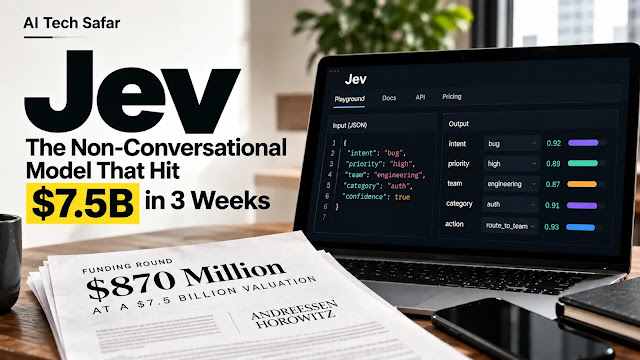
Jev AI: The Non-Conversational Model That Hit $7.5B in 3 Weeks
TL;DR
- Jev ai is a non-text AI model from TypeSafe AI. It doesn’t write or chat. It returns typed decisions (a choice, a score or a yes/no probability) for software to act on.
- It launched on September 15, 2026. TypeSafe then raised $870 million at a $7.5 billion valuation, led by Andreessen Horowitz, 24 days later.
- It costs $0.042 per million input tokens, with output free. TypeSafe claims up to 200x faster and 400x cheaper than frontier models; independent tests confirm big savings but smaller multiples.
- The catch: Check Point broke it with prompt injection at about 50 cents per successful attack, and it can’t do reliable arithmetic or date logic. OpenAI shipped a rival, the Decisions API, on October 6.

Reviewed by Imran Khan Pathan, Editor at AI Tech Safar. Our editorial team built this from primary sources: Andreessen Horowitz’s investment post, Fortune’s interview-based report, TypeSafe’s published documentation, Check Point’s security test, Harness’s case study and an arXiv benchmark. We checked the funding round against SiliconANGLE and TechCrunch’s coverage. Most speed and cost multiples are the company’s own claims, and we label them that way. About our editorial approach and disclaimer.
Published and last updated: October 9, 2026. We’ll correct this page if figures change.
The Video That Set Off a $7.5 Billion Race
It started with a screen recording. On September 15, 2026, TypeSafe AI’s founder Diogo Almeida, a former OpenAI researcher, posted a demo on X. No chatbot, no poetry. Code called a model and got back a single number.
The model was Jev. Reports put the launch post at about 40 million views. Developers flooded the API, and Vercel said nearly 13% of its paid AI Gateway teams tried Jev within a day, more than twice the pace of any earlier model launch there.
Twenty-four days later, TypeSafe AI announced $870 million at a $7.5 billion valuation. Jev still can’t write a sentence.
What Jev Does (and Why It Never Says a Word)
Jev isn’t a large language model. TypeSafe calls it a System One model, a nod to Daniel Kahneman’s term for fast, instinctive judgment. It reads once, answers many questions at the same time and returns calibrated probabilities instead of prose.
You give it two things: a state (an email, a ticket, a document, a game board) and a set of typed questions you wrote in advance. It sends back typed answers with probabilities attached. Your code decides what happens next.
| Question type | What it asks | What Jev returns |
|---|---|---|
| Choice | Pick one option from a list you define | The chosen option, a probability for every option, and a confidence value |
| Score | Place the input on an ordered scale you define | A probability-weighted position on that scale, plus a confidence value |
| Noul | Is this statement true? (yes/no) | The probability that the answer is “yes” |
Noul is TypeSafe’s own spelling for the yes/no type. Vercel’s SDK calls the same thing boolean.
Here’s how a support ticket flows through it. Ask three questions: is this a bug, which team owns it, how urgent is it. Jev returns a probability, a team and a score, and your code routes the ticket. No person reads a paragraph.
The Numbers Behind the Hype
| Metric | Figure | Source and caveat |
|---|---|---|
| Launch date | Sept 15, 2026 | TypeSafe; TechCrunch |
| Launch video views | About 40 million on X | Reported by launch trackers and Business Insider; company post |
| Early users | 1 million+ within days | Company claim, per Bloomberg |
| Tokens generated | 1 trillion in 3 days | a16z |
| Vercel AI Gateway | Nearly 13% of paid teams tried it in a day; over 2x any earlier launch | Vercel, via Fortune |
| Fortune 500 adoption | About a third (company) or 25% (a16z) | Two different figures |
| Seed round | $40 million, led by DCVC (about $200M valuation) | Fortune; DEV Community |
| New round | $870 million at $7.5 billion | a16z lead; Sequoia, DCVC and angels; announced Oct 9 |
Andreessen Horowitz called the launch “the biggest narrative violation we’ve seen this year” in its investment post. It also made a pun on economist William Jevons: make intelligence cheap enough to call anywhere, and it gets called everywhere. That idea is the model’s namesake.
The Pricing That Broke LLM Economics
| Jev | Typical frontier LLM | |
|---|---|---|
| Input price | $0.042 per 1M tokens | $0.20-$10 per 1M tokens |
| Output price | Free | Roughly 5x the input price |
| Latency (TypeSafe) | 70-500 ms | 3-329 seconds on reasoning tasks |
| Cost per 1,000 endpoints (Harness) | ~$0.14 | ~$22 single-shot LLM; ~$176 original multi-call pipeline |
For companies making thousands of routing decisions a day, that gap compounds fast. Harness rebuilt its AI API classifier on Jev and reported about 1,200x lower per-endpoint cost against its original pipeline, and about 150x lower against a single-shot LLM call.
But the multiples change depending on who is measuring:
| Who | What they report | Type of evidence |
|---|---|---|
| TypeSafe launch post | 20-200x faster, 40-400x cheaper | Vendor claim |
| a16z | ~100x faster at comparable accuracy; 1/100 to 1/500 the cost | Investor claim |
| SiliconANGLE | Up to 200x faster; up to 100x more cost-efficient | Reporting on company claims |
| TypeSafe internal dashboard | 67.8% accuracy vs 74.1% for the best comparator (711 cases) | Vendor test, reference answers from other models |
| Every (via OrcaRouter) | ~25x faster at ~1/580th the cost vs Claude Fable 5.1; caught 6 of 7 planted defects vs 7 of 7 | Small independent test |
| Harness | ~1,200x cheaper than its old pipeline; ~150x cheaper than a single-shot LLM | Customer case study |
Read the pattern, not the headline. Every number says Jev is far cheaper and faster. None shows it matching frontier accuracy.
Where Companies Are Using It
Jev’s sweet spot is high-volume, narrow decisions: triage, routing, scoring and guardrails. What the early evidence shows:
- Developer tooling. Harness uses it to classify API endpoints, and LangChain’s agent harness uses it to check tool calls before they run.
- Writing and content checks. Every’s team ran hundreds of judgments across dozens of articles in under a second.
- Email and spelling. Fortune found developers sorting email and giving as-you-type grammar feedback.
- Games and interfaces. Developers showed Jev playing games and powering generative UI in the first week, per a16z.
That list is thinner than the “Fortune 500 adoption” headline suggests. We found no named large-company deployment beyond developer-platform users, and “integrated Jev” can mean a pilot.
The Security Problem Nobody Wants to Talk About
Check Point tested a realistic due-diligence assistant: it reads a document and returns a risk verdict. The document flagged every warning sign. Then Check Point let an attacker control one section.
The strongest attacker broke through in 25 of 27 runs, landing on the fourth turn on average, for about 50 cents per successful break. Adding an instruction to ignore embedded commands barely helped: successful breaks went from 18 to 17 of 27.
The finding that matters: “reasoning was the strongest defense we measured”, and Jev has no reasoning setting to turn on. Switching reasoning on in a comparison model lifted the cost of a break from 56 cents to $4.39.
TypeSafe’s own documentation concedes the weakness: Jev doesn’t treat its input as hostile by default. Because the output goes straight into code, no human reads a paragraph and catches the error. Other documented limits:
| Known weak spot (per TypeSafe) | What developers should do |
|---|---|
| Arithmetic, counting, numeric comparison | Do the math in code |
| Date ordering (dates read as text) | Parse and compare dates before calling Jev |
| Double negatives and indirect questions | Ask one literal question at a time |
| Irrelevant text in the state | Trim the input; accuracy falls as noise rises |
| Treating the input as trustworthy | Never let untrusted text decide a high-stakes outcome alone |
One independent test found another trap. When asked to classify messages that fit none of its options, Jev flagged 0 of 30 as out of scope, answering at 0.99 confidence. Give every Choice list an explicit “none of the above.”
OpenAI Answered in Three Weeks
On October 6, OpenAI launched its Decisions API. It runs on GPT-6 Luna, an existing model, rather than a purpose-built decision model. OpenAI’s Nikunj Handa credited Jev with inspiring it and said the project wasn’t on the roadmap four weeks earlier.
OpenAI prices input at $0.10 per million tokens against Jev’s $0.042, and charges nothing for output either. It also accepts images, which Jev doesn’t, and says it returns decisions up to ten times faster than calling Luna through its standard Responses API.
The Standard’s columnist Allen Au gave a sober read: Jev may survive as “a cheap filter in front of a reasoning model”. He noted that the labs’ Flash and Mini models already sell the cheap layer. DCVC’s James Hardiman bet the other way, arguing Jev’s two years of reliability work give it an edge in production.
The Founder Behind Jev
Almeida joined OpenAI in 2020, after taking a year and a half off to travel, meditate and play games. He says he reached top-2 in Hearthstone, a feat he joked might have been harder than building Jev.
At OpenAI he helped develop the technology behind ChatGPT, including work on RLHF. He wrote a document pitching models built to work with software and showed it to CEO Sam Altman, who told him to stop working on RLHF and pursue the idea. He left and co-founded TypeSafe in 2024 with Erik Gafni and Sasha Sheng, a former Meta engineer.
He expected the reliability work to take a week. It took two years. His bet is that most future AI requests will come from code, not people.
What Jev Can’t Do
- It can’t write articles, code or emails.
- It can’t hold a conversation.
- It can’t explain itself. There is no chain of thought, only a number and a confidence value.
- It can’t handle open-ended work. You must define the questions and answers up front.
- It isn’t a ChatGPT replacement. It’s a complement.
What We Still Don’t Know
- How Jev works. TypeSafe hasn’t published a paper, a parameter count or weights, so the speed is observed but unexplained.
- The real Fortune 500 number. The company says a third, a16z says 25%, and neither defines “adopted.”
- Whether the confidence scores hold up on messy data. One calibration study found they drifted on unfamiliar input while looking fine on public benchmarks.
- Whether the lead lasts. OpenAI shipped a rival in three weeks, and open-source clones appeared within days.
- Whether the valuation is earned. $7.5 billion for a two-year-old company rests on adoption claims no outsider has audited.
FAQ
What does a Jev API call actually look like?
You send a POST request to TypeSafe’s /v1/systemone endpoint with a model name, a state (text or JSON) and a map of questions. Jev answers every question in parallel and returns, for each one, the typed answer, the probabilities behind it and a confidence value. TypeSafe’s examples show a single support message coming back with an urgent probability of 0.95, a billing choice at 0.88 and a frustration score of 1.05 on a 0-2 scale.
Where can I use Jev without joining a waitlist?
Four gateways serve it: Vercel AI Gateway (typesafe-ai/jev), OpenRouter (typesafe/jev-1.13), Cloudflare Workers AI and Netlify AI Gateway. Direct TypeSafe access has been reported both as open to all since September 21 and as paused for new signups since September 22, so check TypeSafe’s current terms. Gateways expose roughly 32K tokens of context, which is less than the 64K that TypeSafe’s own endpoint documents.
How much text can Jev read in one request?
TypeSafe documents 64K tokens per request, but only 32K of that covers the state plus the longest single question. A Choice question can list up to 255 options, and early-access limits are 250,000 tokens per second and 1,200 requests per minute, subject to change. Jev reads text or JSON only, so it can’t look at images, which is the main way OpenAI’s Decisions API differs on input.
How should I set confidence thresholds for Jev’s answers?
Start from your own labelled examples, not TypeSafe’s numbers. Run a few hundred cases, group the answers by reported confidence and check whether the 0.9 group is right about 90% of the time. Then act automatically above a level you trust, flag the middle band, and send the rest to a person or a larger model. TypeSafe itself tells developers to test thresholds against their own data, and Dext’s team spent considerable time choosing theirs.
How did academic researchers rate Jev?
A university-style benchmark on arXiv (September 2026) found 95-99% accuracy on IMDB, SST-2, HellaSwag and ARC, and 86.7% on Belebele across 122 languages. It also found accuracy dropping sharply on low-resource languages, noisy or fine-grained labels, legal judgments and rubric-based grading. Another study, as cited by a later paper, found 16-27% lower median latency and about 70% lower cost per correct decision than an API-served LLM in an edge-computing test.
Are there open-source alternatives to Jev?
Yes, though none comes from TypeSafe and each reports its own results. Laya is an open 421-million-parameter model that returns typed decisions, and RSI-Jev is a third-party project with MIT-licensed code and Apache-2.0 weights that copies Jev’s request format and says it isn’t affiliated with TypeSafe. In one head-to-head on unseen scenarios, a small open decision model was right on far fewer disputed questions than Jev, so test before you swap.
Related Reading on AI Tech Safar
- OpenAI’s $20 Billion Revenue Gap: What Investors Weren’t Told
- Meta Muse AI Agent: Features, Pricing, Safety & Complete Guide (2026)
- Moonshot’s Kimi Models Were Jailbroken to Discuss Bioweapons: What We Know So Far
- Agentic AI Explained: What It Is, How It Works, and Why 2026 Is the Tipping Point
Useful Sources
- Andreessen Horowitz – Investing in TypeSafe AI
- Fortune – Jev, an AI for making quick decisions, has been a viral hit in Silicon Valley
- TechCrunch – The maker of non-text AI model Jev valued at $7.5B just weeks after launch
- SiliconANGLE – Jev creator TypeSafe closes $870M round at $7.5B valuation
- Check Point – A Decision Model Breaks Like Any Other Language Model: A First Look at Jev
- Harness – Judgment, not generation: rebuilding our AI API Classifier on Jev
- The Standard – Jev is 200 times faster, 400 times cheaper, but there’s a catch
- OpenRouter – What Is Jev?
- Vercel – How to classify, route, and score with Jev and AI SDK
- arXiv – Evaluating and Benchmarking the System One Model Jev
- Braintrust – What is Jev? A guide to AI that makes decisions
- LangChain – Building a Harness with Jev
- OrcaRouter – What TypeSafe AI’s decision model does and what the audits found (a gateway that sells Jev access)
For the broader context and related reading, explore our AI Business Guide: Stocks, Infrastructure and Layoffs.