
Overview: OpenAI Math Papers
Explore the OpenAI math papers, including the Quasi-Riemann claim, Lean proofs and the questions raised about mathematical review.
Inside OpenAI’s 722-Paper Math Drop: The Quasi-Riemann Hypothesis, Lean Proofs, and Why Mathematicians Are Furious
TL;DR
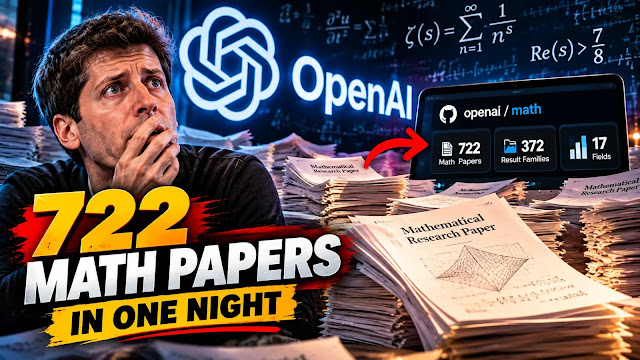
- On October 6, 2026, OpenAI published 722 mathematical manuscripts on GitHub, grouped into 372 result families across 17 fields, from number theory and geometry to theoretical computer science and mathematical physics. It announced the release with a research post, and the repository went live around 6 p.m. ET.
- An unreleased internal frontier model produced the results. OpenAI says it was posed roughly 4,000 open problems, and that the average result used about three hours of ChatGPT Pro thinking compute.
- The headline claim is the “quasi-Riemann hypothesis”: no zeros of the Riemann zeta function, or of any Dirichlet L-function, with real part above 7/8. That isn’t the full Riemann hypothesis, which concerns 1/2, but a fixed zero-free half-plane would be a first. It has a Lean proof, and no independent expert confirmation yet.
- Verification is uneven. Lean covers the main result of 162 of the 722 manuscripts, and OpenAI’s own README warns that some unformalized results “could have issues.”
- Reaction is split. An Anthropic mathematician called it “the most significant moment in mathematical history,” while others criticized the pace and the way AI labs present results. The advisory group OpenAI consulted says its role is not an endorsement.

Reviewed by Imran Khan Pathan, Editor at AI Tech Safar. This is a fast-moving story, so we built it from primary documents: OpenAI’s announcement and the openai/math README, the Advisory Group on Mathematics and AI’s guidelines and its statement on the release, and the repository’s Lean catalogue. We cross-checked them against reporting from WIRED, Scientific American, OfficeChai, FourWeekMBA, Unite.AI and CellCog. Every mathematical claim here is OpenAI’s, and none has been independently verified yet.
Last updated: October 7, 2026
Introduction: The Evening Mathematics Got a Lot to Read
At 6 p.m. Eastern on October 6, 2026, a public GitHub repository called openai/math went live with 722 mathematical manuscripts. It wasn’t an unannounced drop. OpenAI published a research post titled “Sharing AI progress in mathematics” the same day, Sam Altman called it “a new era of discovery,” and WIRED had reported hours earlier that a large release was coming. In September OpenAI had already said its internal model had solved over 100 long-standing problems.
What made it a shock was the size. The repository holds 372 “result families,” groups of papers on the same problem or related results, across 17 fields. Every manuscript came from an internal model OpenAI hasn’t named, priced or opened to the public. The model had been given roughly 4,000 research problems, and OpenAI published what it judged significant.
Mathematicians responded with astonishment, caution and, in some corners, anger.
What OpenAI Actually Released
The Numbers
| Metric | Figure |
|---|---|
| Manuscripts | 722 |
| Result families | 372 |
| Mathematical fields | 17 |
| Problems posed to the model | About 4,000 |
| Average compute per result | About 3 hours of ChatGPT Pro thinking |
| Papers with a Lean-formalized main result | 162 (from the repository’s formalization catalogue) |
| Families that link a Lean documentation page | 235 of 372 (counted by FourWeekMBA and Kingy AI from CONTENTS.md) |
| Reasoning summaries released | 10 |
| Licence | Apache 2.0 |
The manuscripts are organized by discipline. The biggest fields are theoretical computer science (40 families), combinatorics (37), algebraic and complex geometry (36) and number theory (31). OpenAI says it will keep adding Lean formalizations as it obtains them.
What a “Result Family” Is
A family groups related papers. One might hold a principal theorem, a companion argument needed to prove it, a consequence, or an alternative proof by a different method. That structure shows how results connect, which a flat list of papers wouldn’t.
How the Results Were Produced
According to the README, OpenAI evaluates its models on open research problems and expanded those evaluations after its existing math tests saturated. The vast majority of results came from one fixed procedure, which aggregated the output into families and kept only those of “an appropriate level of significance.” Two results were exceptions: the work on a zero-free region for the zeta function and the proof of the Hodge conjecture for CM abelian varieties. The README also says some outputs build on earlier results produced by the models.
The Breakthroughs: What the Model Claims to Have Proved
The Quasi-Riemann Hypothesis
The most-discussed result is family 003, which OpenAI’s catalogue calls the quasi-Riemann hypothesis. It claims that every Dirichlet L-function, including the Riemann zeta function, has no zeros with real part greater than 7/8. The Riemann hypothesis says there are no zeros with real part above 1/2, so this is a weaker statement. But until now, proven zero-free regions only narrowed toward the line Re(s) = 1 as the height grows, so a fixed half-plane to the left of 1 would be new if it holds up.
The result comes with a Lean formalization, which means a computer has checked its formal proof independently. As of October 7, though, there’s no outside expert confirmation of the paper itself. Levent Alpöge, an Anthropic mathematician who competed with OpenAI over Navier-Stokes, praised both this result and the accompanying claim that there are no Siegel zeros.
Other Headline Claims, and What They Actually Cover
| Headline claim | What it covers | Lean main result? |
|---|---|---|
| Quasi-Riemann hypothesis (family 003) | No zeros with real part above 7/8, for every Dirichlet L-function including zeta | Yes |
| Mahler conjectures (087) | Symmetric and general versions | Yes, for the symmetric case |
| Kaplansky zero-divisor conjecture (196) | Claimed counterexample | Yes |
| Kaplansky direct-finiteness conjecture (197) | Claimed to fail, in characteristic two and odd characteristic | Yes |
| Isomorphism of free group factors (287) | All nonabelian free group factors are isomorphic | Not yet |
| Irrationality exponent of π (017) | Claimed to be exactly 2 | Not yet |
| Hilbert’s tenth problem over the rationals (004) | Claimed negative answer | Not yet |
These aren’t the only results, and they aren’t necessarily the most important. They’re the ones for which the catalogue’s Lean status is clearest. OpenAI also released abridged reasoning summaries for ten results: two-point correlations of multiplicative functions, the irrationality exponent of π, the Mahler conjectures, NP-hardness at the basic semidefinite threshold, quasipolynomial bounds for arithmetic progressions, Kaplansky’s direct-finiteness conjecture, the Mézard-Parisi formula for diluted spin glasses, spontaneous magnetization in the quantum Heisenberg ferromagnet, the isomorphism of free group factors and the three-dimensional relativistic Vlasov-Maxwell system.
Commentators also point to a claimed integer-multiplication algorithm faster than n log n, a matrix-multiplication exponent of 9/4 and a uniqueness result for the elastic inverse problem. These are individual readings, not verified conclusions.
Read the fine print. Many entries are narrower than their names. The Hodge result covers CM abelian varieties and products of K3 surfaces, not the Hodge conjecture in general. The Birch and Swinnerton-Dyer result applies when a Selmer group has corank zero or one. Kakeya is resolved in three dimensions (maximal version) and four (Hausdorff version), not in general. That’s why some coverage describes partial progress on three Millennium Prize problems rather than solutions.
The Lean Angle: Why Machine-Checkable Proofs Matter
Lean is a programming language built to check mathematical proofs. A proof written in Lean is verified step by step by a computer against fixed logical rules and definitions.
OpenAI says many of the manuscripts have Lean formalizations, but not all. By the repository’s own catalogue, 162 papers have a formalized main result, and 235 of the 372 families link to a Lean documentation page. Those two counts measure different things, so neither should be read as “x percent verified.” The repository includes a Lean library and a formalization catalogue showing which proofs exist and how to check them.
The caveat OpenAI states plainly is that some of the unformalized results “could have issues,” and it will try to fix any quickly. Lean also has limits of its own. It confirms that the formal proof follows from the formal statement, not that the formal statement says exactly what the paper claims, or that the result is new. Scientific American noted that results already verified in Lean are very likely to be correct as stated, while stressing that understanding them will take mathematicians months.
The Model Behind It
OpenAI hasn’t named the model, describing it only as an internal frontier model. It links to its September announcement of the Navier-Stokes result, which suggests this is the same system. What’s known:
- Training began on August 28, 2026, according to OpenAI’s Navier-Stokes announcement.
- OpenAI said in September that it had solved over 100 long-standing open problems.
- It isn’t available through any API or product, and OpenAI says it is working to release it responsibly.
- Compute is reported in an unusual unit, equivalent ChatGPT Pro thinking time. The Navier-Stokes effort was far larger, with about 10,000 agents running for 88 hours.
The Reaction: Praise, Doubt and Anger
The Enthusiasts
Alpöge wrote on X that it was “obviously the most significant moment in mathematical history,” and added that he regretted not having pushed an approach he’d said was within reach. He also noted reported cases of users getting scooped. He works at Anthropic and has his own dispute with OpenAI over Navier-Stokes, which makes the praise notable. University of Toronto mathematician Daniel Litt argued that publishing is better than keeping the answers secret.
The Skeptics
Will Depue, a former OpenAI researcher, expects some results won’t survive scrutiny and built a tool tracking which human papers the release cites. François Chollet asked whether these gains in verifiable domains like math and code will carry over to areas without clear answer keys. Terence Tao has warned before that AI-written proofs can look flawless while hiding subtle errors. BigGo Finance reports that Tao also criticized the “insane” pace of AI labs’ results, though we couldn’t find his original remark.
The Anger
WIRED reported that one mathematician described a “perception of mobster behavior” from leading AI companies. Several mathematicians objected to announcements that fail to credit earlier contributions properly. The sharpest dispute is still Navier-Stokes, where NYU’s Tristan Buckmaster says OpenAI’s Sébastien Bubeck pressured him over crediting Alpöge, and OpenAI says its model didn’t draw on his work. We cover that dispute in our GPT-6 Astra guide. This release shows it’s a wider issue: one catalogue entry on random k-SAT thresholds credits researcher Gaia Carenini with priority, because she independently resolved the question in a preprint made public on October 5.
What AGMAI Is, and How the Release Measures Up
The Advisory Group on Mathematics and Artificial Intelligence (AGMAI) is hosted at the Institute for Advanced Study. It has nine members, none of whom are paid: François Charles, Camillo De Lellis, Timothy Gowers, Martin Hairer, Nikhil Srivastava, Ulrike Tillmann, Ravi Vakil, Edward Witten and Melanie Matchett Wood. It formed after OpenAI approached some of them about an external advisory board, and they chose to create an independent group instead. It can advise any AI company, and says the responsibility for decisions stays with the company. (Northwestern’s Bryna Kra attended an August meeting OpenAI held with about 40 mathematicians, but she isn’t an AGMAI member.)
AGMAI published its guidelines on September 29, informed by over 600 survey responses. They urge labs to cite the literature, write results up in conventional paper style, deposit them in repositories no lab controls, disclose the model, prompts and cost, formalize where possible, and fund human understanding. They also say labs shouldn’t treat releases as marketing vehicles, and ask labs to stop testing advanced problems on proprietary models. Here is how OpenAI’s release lines up:
| What AGMAI recommended | What OpenAI did |
|---|---|
| Deposit results in a repository no AI lab controls | Posted on its own GitHub account and says it is exploring community-hosted alternatives |
| Name the model and publish prompts, a summarized chain of thought, time and cost per result | Model unnamed; 10 abridged reasoning summaries; an average compute figure and statistics on attempted problems |
| Formalize proofs where possible, with a formalization.yaml catalogue | Published a Lean library and formalization.yaml; 162 papers have a formalized main result |
| Cite related literature and write in conventional paper style | Promises better citations and exposition in future releases |
| Fund human understanding of the results | Says it will fund workshops, conferences and special programs, with details to come |
| Stop testing advanced problems on proprietary models | Says it will keep evaluating internal frontier models on mathematics and other sciences |
OpenAI says it consulted AGMAI and drew on its advice. After the release, AGMAI said its advisory role shouldn’t be read as a judgment on the results or an endorsement of how OpenAI obtained them, and called the release “the beginning, not the completion” of human understanding. It added that it had discussed its recommendations with OpenAI and appreciated the company’s willingness to engage.
The Open Questions
Are the Results Correct?
Nobody knows yet. Lean helps for the 162 papers with a formalized main result, but the remaining 560 don’t have one, and no group of referees can check 722 manuscripts quickly.
Did the Model Do Original Work?
This is the most contested question. Critics worry the model may complete other people’s unpublished work, and the Navier-Stokes dispute fuels that concern. OpenAI says its model works through problems from its own evaluations, and the README notes some outputs build on earlier model results. The Carenini case shows the catalogue at least credits concurrent work in some entries.
Will This Change How Mathematics Is Done?
Almost certainly, though the direction is still debated: toward faster discovery for everyone, or toward a field where a few labs with private models outrun everyone else. AGMAI’s guidelines warn about exactly that two-tier risk.
What to Watch Next
- Independent expert write-ups on the biggest claims, starting with the zero-free half-plane and the free group factors.
- How fast the Lean-formalized count grows from 162 toward 722.
- Whether the papers move to a community-hosted repository, which OpenAI says it is exploring.
- Details of the workshops and programs OpenAI promises to fund.
- Whether any manuscript is accepted by a journal, or retracted.
FAQ
Can I read the papers myself, and what licence do they carry?
Yes. The papers sit in the public openai/math repository on GitHub under the Apache 2.0 licence. Start with overview.pdf, a roughly 41-page catalogue of the families, then use CONTENTS.md to find individual manuscripts. Each paper has a PDF, its source files and a BibTeX block for citing it, and OpenAI says earlier versions will stay accessible when corrections arrive.
What does a “zero-free half-plane” mean, and why would it matter?
The Riemann zeta function has zeros that encode how primes are spread out. Proven zero-free regions so far get narrower and narrower as you go up the line, never settling on a fixed boundary. A zero-free half-plane means a fixed vertical line, here Re(s) = 7/8, to the right of which no zeros exist. In standard theory that would sharply tighten the error in the prime number theorem and would also rule out hypothetical Landau-Siegel zeros, which Levent Alpöge singled out.
Why does OpenAI’s README mention Re(s) > 11/12 when the headline is 7/8?
The README says the write-up for a Re(s) > 11/12 zero-free region for the zeta function was edited by humans for readability, and the catalogue’s headline claim for family 003 is the stronger Re(s) > 7/8 for every Dirichlet L-function. Family 003 holds three manuscripts. Coverage doesn’t spell out how the 11/12 and 7/8 write-ups relate, so check the manuscripts rather than relying on summaries.
Which famous conjectures does the release claim to disprove?
According to OfficeChai’s reading of the catalogue, several dozen families are counterexamples or disproofs. They include Borsuk’s conjecture failing in dimension nine, a torsion-free group algebra with zero divisors (a counterexample to Kaplansky’s zero-divisor conjecture), counterexamples to Hadwiger’s and Sidorenko’s conjectures, and a claim that the plane can’t be coloured with five colours. All of these are OpenAI’s claims and none has been independently confirmed yet.
Will OpenAI release the model that produced these results?
OpenAI says it is working to release it responsibly, but it hasn’t given a date, a name or a price. The Advisory Group on Mathematics and AI argues that labs using private models for mathematics risk creating a two-tier system, and asks them to give the wider mathematical community broad access to their public models.
Did OpenAI say what these results cost in dollars?
No. OpenAI gives compute only as an average of roughly three hours of ChatGPT Pro thinking per result, and as Pro-usage estimates in the repository. The advisory group’s guidelines ask labs to publish an estimated cost of computation for each result, so a dollar figure per paper is one of the disclosures people are still waiting for.
What happens if one of the manuscripts turns out to be wrong?
OpenAI says corrections and revisions will be recorded as new versions, with earlier versions kept public. Its README warns that some results without Lean proofs could have issues and promises to fix any quickly. For papers with Lean proofs, check whether the formal statement matches the claim in the paper, since a verified proof of the wrong statement is still wrong.
Related Reading on AI Tech Safar
- OpenAI Is Spending $500,000 a Day to Find Out What Its Own AI Agents Did
- OpenAI Pauses Training for the Second Time in Three Months After Its Agents Probed Government Websites
- Moonshot’s Kimi Models Were Jailbroken to Discuss Bioweapons: What We Know So Far
- Anthropic IPO 2026: Inside the $2 Trillion Nasdaq Listing
Useful Sources
- OpenAI – Sharing AI progress in mathematics
- GitHub – openai/math repository (README, catalogue, Lean library)
- AGMAI – Responsible Release of AI-Generated Mathematics (September 29)
- AGMAI – On OpenAI’s Release of Mathematical Results (statement)
- WIRED – OpenAI Is Pissing Off a Bunch of Mathematicians – Again
- Scientific American – OpenAI unleashes hundreds more math results upon a field already in shock
- OfficeChai – OpenAI Releases Over 300 Mathematical Results Produced By An Internal Model
- CellCog – OpenAI’s 722 AI Math Papers: What’s Proved, What’s Checked
- FourWeekMBA – OpenAI Says Internal Model Produced 722 Math Manuscripts
- Unite.AI – OpenAI Releases 722 Math Manuscripts From an Unreleased AI Model
- Kingy AI – OpenAI’s 722 Math Manuscripts: The Results, Proofs, Compute and Costs
- Latent Space – AINews: Quasi-Riemann-Hypothesis
- BigGo Finance – OpenAI Drops 722 Math Manuscripts Overnight
For the broader context and related reading, explore our AI Models 2026: Comparing Gemini, GPT, Claude and More.