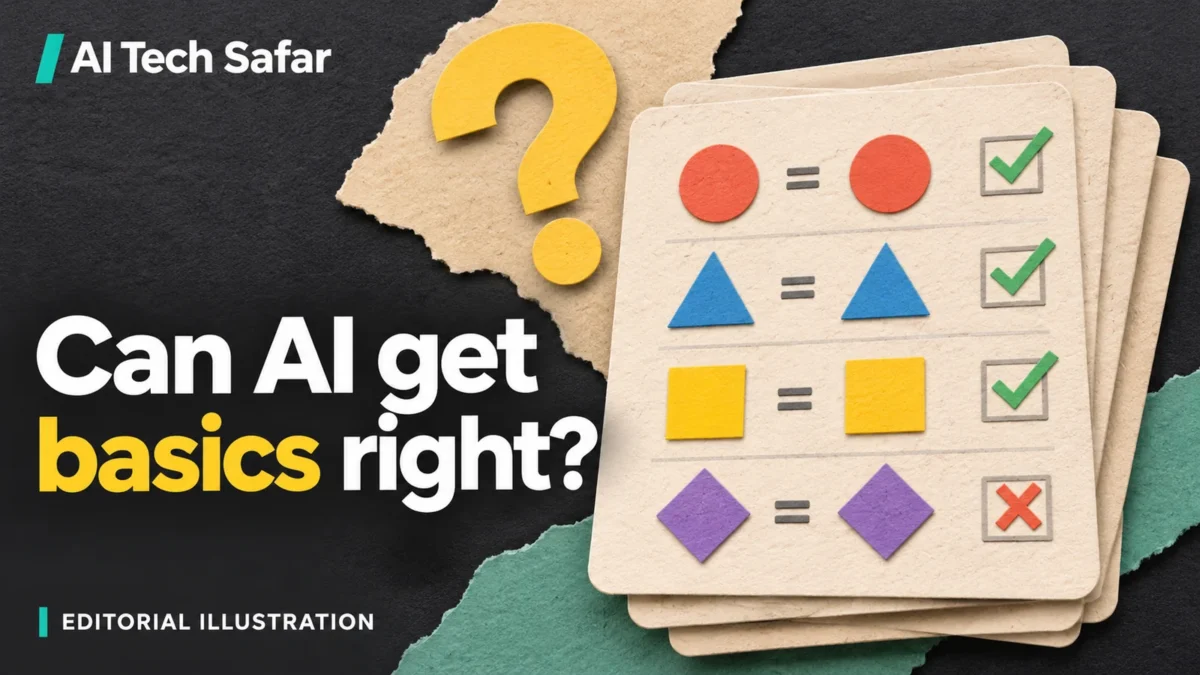
Google DeepMind launched Humanity’s First Exam on November 24, 2026, asking a practical question about AI: can a model handle an ordinary task dependably, rather than produce one impressive answer? The official announcement describes a benchmark of 544 text and image prompts across 20 foundational capabilities, paired with a Kaggle competition.
Editorial Reviewed Imran Khan Pathan, Editor at AI Tech Safar.
Reporting checked November 25, 2026 (IST). Research results below are attributed to their authors; this is not an independent reproduction.
Overview: Why an exam of the basics matters
A model can solve a difficult problem and still mishandle an everyday instruction. Humanity’s First Exam tests that gap through repeated, task-specific questions. It adds one useful signal for model selection, not a universal ranking of AI quality.
TL;DR
- The benchmark: Google says HFE covers everyday questions and small variations. Its announcement invites community submissions through December 15, 2026; check the official rules before entering.
- The scores: the paper reports results for 18 models. A separate leaderboard snapshot gives different figures for three models, so the two records stay clearly labelled.
- The takeaway: treat HFE as one useful signal. Test the workflow you plan to use and decide how errors will be caught.
What Humanity’s First Exam measures
The paper’s methodology uses 136 four-prompt families and six sampled responses per prompt. Its primary family pass4 statistic estimates all 16 draws succeeding (four per prompt) rather than merely one success somewhere in the family. Evaluation is single-turn and tool-free. The researchers selected failure-revealing tasks, and a Gemini model grades answers.
That design makes the distinction between “can do” and “does reliably” concrete. Those phrases can sound interchangeable in a product demonstration. They become very different when a team has to decide whether the next answer can be used without another person checking it.
A successful demonstration is valuable evidence that a capability exists. It is not automatically evidence about the frequency of success, the circumstances of failure or whether the same result survives small changes to the input. These are separate questions that a buyer should be able to ask without dismissing the demonstration itself.
| Evidence sought | Question being asked |
|---|---|
| One successful example | Can the system produce the desired result at all? |
| Repeated trials | How often does it produce that result under the specified conditions? |
| Input variations | Does a change in wording or presentation alter the result? |
| Workflow acceptance | Is the observed behavior adequate for this particular use? |
Takeaway: one success shows that a model can do the task; repeated trials show how consistently it does it. A workflow check tells you whether that performance is good enough for the job.
The paper’s scores and a separate leaderboard snapshot
| Provider / model and effort | Paper family pass⁴ |
|---|---|
| ChatGPT / OpenAI GPT-6.2 Astra (xhigh) | 92.4% ±4.3 |
| ChatGPT / OpenAI GPT-6.2 Sol (xhigh) | 86.9% ±5.2 |
| Gemini 4 Neon (high) | 85.8% ±5.8 |
| Claude Fable 5.2 (max) | 73.7% ±7.3 |
| Claude Sonnet 5.5 (max) | 67.6% ±7.7 |
| Claude Opus 5.5 (max) | 63.0% ±7.6 |
| Grok | Not evaluated in this report |
iClarified’s November 25 article instead reports a launch leaderboard snapshot of 90.7% for Astra, 87.5% for Sol and 85.6% for Neon. We could read the paper, but the live Kaggle page did not expose its data to our research reader. We therefore cannot establish why the numbers differ or verify today’s live ordering. The discrepancy is specific: these three reported percentages do not match Table 4.
An unexplained difference is not a reason to choose whichever figure makes the stronger headline. It is a reason to preserve the source, date and metric beside the number. Possible explanations should remain questions until documented; we have not attributed the difference to an update, a different subset or a mistake.
The confidence intervals also deserve space beside the point estimates. A list containing only three precise-looking percentages can encourage more certainty than the underlying evaluation warrants. We would not convert their numerical ordering into a claim that one model is conclusively better for every user. Nor would we interpret the percentages as promises about a subscription product, which may involve different settings or surrounding software.
Why repetition changes the question
Consider a deliberately simplified mathematical example, separate from HFE’s actual estimator. Suppose a hypothetical system has a 95% chance of success on each attempt, and all attempts are independent with the same success probability. Its chance of four consecutive successes is 0.95 × 0.95 × 0.95 × 0.95, or about 81.5%. For 16 consecutive successes, the same calculation gives about 44.0%.
Those figures are arithmetic illustrations, not measured model performance. Real errors may be correlated, and real tasks may have different difficulty. The example simply shows why a strong single-attempt rate cannot be substituted for an all-attempts-success rate. The requirement has changed, so the number answering it changes too.
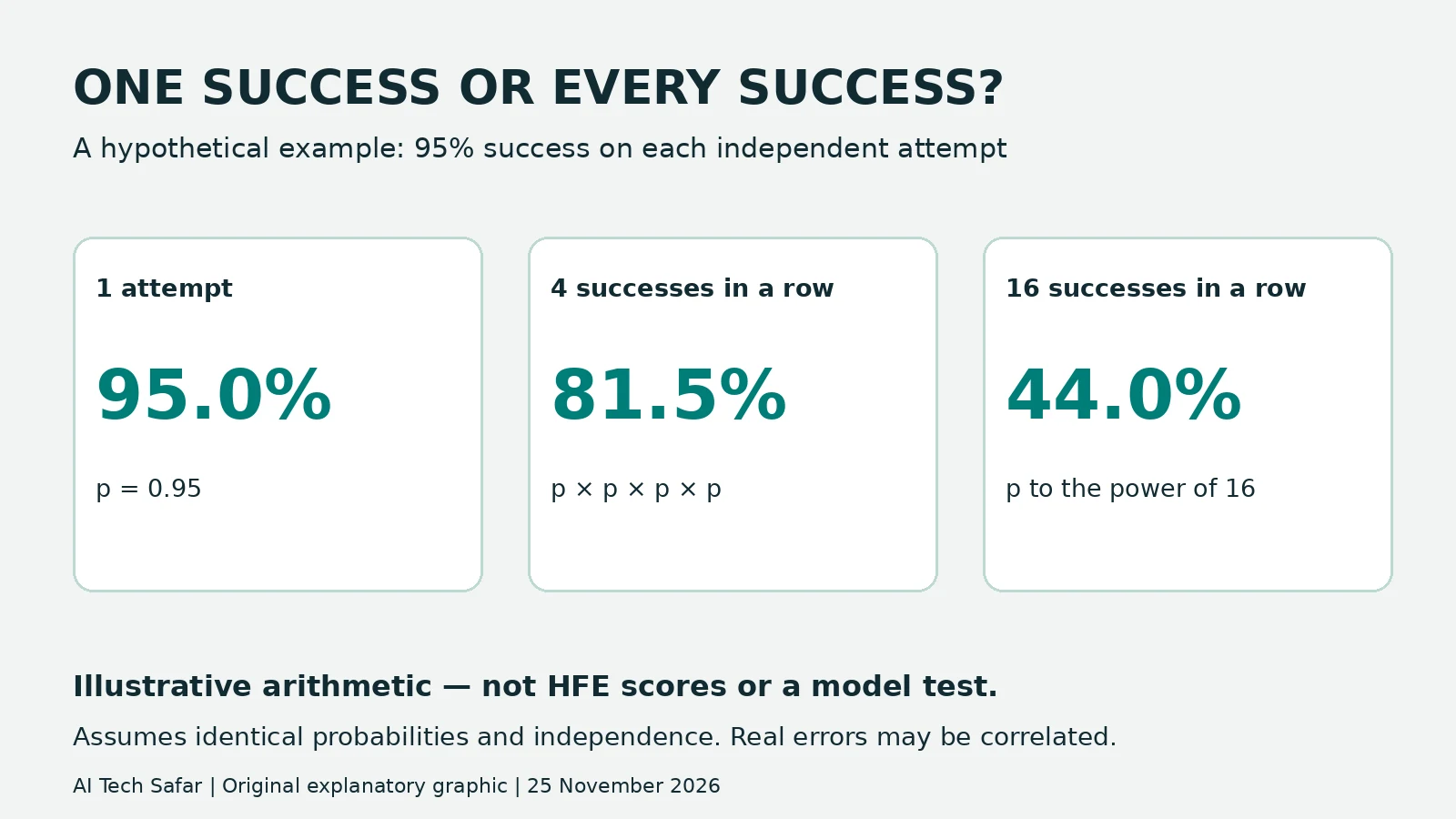
Now consider the opposite question: did at least one of four attempts succeed? Under the same hypothetical assumptions, the chance that all four fail is 0.05 to the fourth power. Subtracting that from one gives 99.999375% for at least one success. This does not mean a user automatically receives the right answer. Someone or something must still recognize which attempt succeeded.
That recognition step is often missing from casual discussions of retries. If the correct answer is already known, selecting a correct result can be straightforward. If it is not known, asking again may produce another persuasive answer without establishing which one is right. A retry policy therefore needs a verification method, not merely a larger number of attempts.
There is a practical cost distinction as well. A workflow can tolerate experimentation during drafting and still require a much stricter standard before sending an instruction to a customer. The useful threshold depends on what the output will do next. It should be chosen before looking at an attractive model score, rather than adjusted afterward to justify a preferred purchase.
Our Read: The important change is the decision being tested
AI Tech Safar analysis: the useful question is not only which model has the highest score. It is which errors could reach your users, and how your workflow would catch them.
A small online seller could compare ChatGPT, Claude, Gemini and Grok on the same product-listing task. Use one photo, one specification sheet and one prompt for each model, then check:
- Do the dimensions and materials match the specification sheet?
- Does the description stick to details visible in the photo?
- Are missing facts marked as unknown?
- Do the results hold up when the wording changes slightly?
Keep every result. This is a suggested reader test; AI Tech Safar has not run it.
Classify failures before deciding how to fix them. A visual misread may call for a clearer image or a human check. An ignored instruction points to a different problem. When the source material lacks a fact, the right response may be to leave that field unresolved. A single pass or fail score cannot show which change would help.
The same idea applies to code. Passing tests only shows that the tested conditions passed; it does not prove every requirement was met unless the tests cover them. Record what was checked mechanically and what still needs review.
When comparing AI services over time, save the input, expected result, actual result and reason for your judgment. That record makes model updates easier to compare and helps reveal when the original instruction was ambiguous.
A practical evaluation plan without pretending to reproduce HFE
The following is an editorial evaluation plan, not Google’s documentation and not a hands-on tutorial. It borrows the general idea of checking repeatability while leaving the benchmark’s official methodology intact. A private workflow test should be described as that, not branded as an HFE reproduction.
| Decision | Evidence to keep |
|---|---|
| Define the task | A written input specification and acceptable output. |
| Define failure | Examples of omissions, wrong facts and unacceptable actions. |
| Control the comparison | Model identifier, settings, tools and test date. |
| Repeat and vary | Every result, including failures; document what changed. |
| Choose the next action | Accept, revise, require review or stop the workflow. |
Start with one task that matters enough to justify the effort. A broad instruction such as “help our business” is difficult to score. A narrower task, such as extracting specified fields from an approved document, allows a team to define the answer and the circumstances in which uncertainty is acceptable. A useful test is one whose failure can lead to a concrete improvement.
Keep the baseline stable while investigating a problem. If the model, instructions, input format and tool access all change at once, a better result will not reveal which change helped. That may be acceptable for casual experimentation, but it is weak evidence for a deployment decision. Change one relevant factor, retain the old cases, and compare the outcome against the same acceptance rule.
Do not quietly delete awkward inputs after seeing the answers. Some may turn out to be ambiguous or outside the intended scope; if so, record that reason and revise the specification. Others may expose exactly the weakness the evaluation was meant to find. The distinction is whether the exclusion follows the task definition or simply makes the results look better.
Record the cost of correction as well as the presence of a mistake. An obvious formatting error may take seconds to repair. A plausible but incorrect fact may require checking the entire output. Both can count as failures, but they do not impose the same operational burden. This is why the economic value of a workflow cannot be inferred from a benchmark percentage alone.
A sensible pilot also defines what happens when the check fails. Does the output go to a reviewer, return for another attempt, or stop? Who can authorize an exception? These questions are especially useful before adding automation. They turn an observed weakness into a controlled process rather than leaving the next person to improvise under pressure.
Material limits: What this launch does not establish
The report is a developer-authored stress test, not independent certification. It releases 112 prompts publicly while retaining a private holdout. Its selected tasks and tool-free setup limit generalization. The results do not measure service uptime, and we have not independently rerun them.
For our coverage, the unresolved leaderboard discrepancy is the main numerical limitation. We have enough evidence to report the launch and describe the paper’s selected results, but not to certify a current live ranking. The announcement’s competition end date is also not a promise that a new dataset or revised model score will appear on that date.
Our earlier coverage of AI-assisted mathematical proof claims addresses a related reading habit: identifying exactly what has been verified. Here the object being evaluated is different, but the same discipline helps. A numerical result should travel with its method and scope, rather than becoming a general endorsement after the qualifiers are removed.
Frequently asked questions
Is Humanity’s First Exam a new AI model?
No. Google announced an evaluation benchmark and a community competition. It is a way to examine model behavior, not a new assistant subscription or a replacement for an existing model.
Why focus on simple questions?
A task can be ordinary for its user and still be important. An incorrect field in a routine business document may create more work than a difficult question that the user already expected to review carefully. The practical interest is dependable execution.
Does the table identify the best model to buy?
No. It is a dated selection from the research paper. A purchasing decision also requires evidence about the user’s tasks, service configuration and constraints. The live-score discrepancy is another reason to avoid turning it into a universal recommendation.
Are 92.4% and 90.7% interchangeable Astra scores?
No. One is in the paper’s Table 4; the other is reported by iClarified as a leaderboard snapshot. Their cause of divergence is unverified here, so they must retain their source labels.
Did AI Tech Safar run the benchmark?
No. We read the official announcement and relevant technical-report sections and checked independent coverage. The arithmetic example is our calculation under stated assumptions, not a benchmark reproduction.
Should users keep retrying until an answer looks right?
Appearance is not verification. A retry can be useful when a reliable check identifies failure, but it can also produce a different unsupported answer. Decide how correctness will be established before relying on repeated attempts.
Can readers contribute questions?
Google’s announcement invites submissions through December 15. Follow its competition link and read the current eligibility, submission and licensing rules there. This article has not verified every participation condition and does not promise acceptance or a prize.
Related reading on AI Tech Safar
- AI Models & Companies 2026: GPT, Gemini, Claude and China
- Claude Riemann Hypothesis Proof: What Is Really Verified?
- OpenAI Math Papers: 722 Manuscripts and the Debate
- Patram 1.5: BharatGen’s Document AI Launch, Benchmarks and Limits
Useful sources
Useful sources
- Google DeepMind announcement: November 24, 2026
- Humanity’s First Exam technical report: November 24, 2026
- iClarified independent coverage and reported leaderboard snapshot: November 25, 2026
Reporting note: The paper was downloaded and read because the web reader could not process its size. The live leaderboard did not return readable data in that reader. We retain the exact score discrepancy rather than assuming an explanation. Both images are original explanatory artwork, not official Google imagery, screenshots or test evidence.