
BharatGen has launched Patram 1.5, a document-focused vision-language model that aims to read the page itself, including the information that can disappear when a scan becomes plain text. Its November 26 announcement introduces prompt-controlled extraction and a deliberate ability to decline uncertain answers. For Indian businesses dealing with uneven scans, handwritten notes and mixed-language paperwork, the useful question is whether those capabilities can reduce correction work without turning missing information into confident fiction.
Editorial review pending: Imran Khan Pathan, Editor at AI Tech Safar.
Reporting checked November 27, 2026 (IST). This is a researched news analysis, not a hands-on review. We have not run the model or reproduced its benchmarks.
Overview: A document model with a more useful ambition
The most consequential promise here is not that AI can produce more text. It is that a document-processing system might return exactly the evidence a task requires, and leave a field unresolved when the evidence is inadequate. That distinction matters when the next step is an invoice entry, an application check or a searchable archive.
Moneycontrol’s November 26 reporting independently confirms the launch and describes the intended banking, insurance, healthcare and public-office uses. This is launch coverage, not an independent performance certification. We separate the release, the developer’s evaluation and our own analysis below.
There is one date conflict worth recording precisely. The press release and model-card release entry say November 26, while the launch blog as retrieved displays November 25. We use November 26 for the announced release, supported by the dated release document and independent reporting; we do not infer an exact first-publication time.
TL;DR
- Patram 1.5 is a new document-and-image model, rather than a general claim that paperwork can now be automated without supervision.
- The technical card lists 7.8 billion parameters and a 32,768-token context. “7B” is the product label used in the announcement.
- BharatGen’s evaluation reports an overall score of 83. That is a developer-run aggregate, not an 83% guarantee for your documents.
- Open weights and a Playground are available; the current card still directs API enquiries to a waitlist and documents gated repository access.
- The Economic Times interview reports an abstention score of 87/100 and the company’s acknowledgement that the problem remains unsolved.
- Our Read: assess incorrect answers, useful refusals and human correction time together before committing an operational workflow.
In this article
- What has launched
- Specifications and access
- Reading the benchmark claims
- Why abstention matters
- Practical workflows
- How to judge a pilot
- Deployment and privacy
- Our Read
- What remains unknown
- FAQs
- Related reading
- Useful sources
What Patram 1.5 adds to document processing
The release document describes a system that combines visual understanding with reasoning. BharatGen calls its prompt-directed reading feature “OCR 3.0”: users specify the material they want and the output structure. The same announcement lists Parse, Extract, Classify, Split and Section solutions, while Digitize, Translate and Edit are described as coming soon. Those future items should not be treated as generally available features.
Consider the difference between reading a number and understanding which number it is. A page may contain a previous balance, a current charge, a discount and a final amount. Extracting all four strings correctly would still leave an application with a decision to make. If it places the previous balance in the final-amount field, the transcription was useful but the business task failed.
Layout can carry meaning that ordinary text alone does not preserve. A value beside one label may belong to that label; a handwritten correction may apply only to a particular row. The practical appeal of a vision-language approach is the opportunity to evaluate those relationships together. That is an explanation of the task, not a claim that this release always resolves them correctly.
Nor should “OCR 3.0” be read as an industry certification or a universal replacement for every OCR system. It is the developer’s name for a capability. A predictable form with fixed fields may already work well in an existing pipeline. A more flexible model earns its place when it handles variation or reduces human repair sufficiently to justify the added complexity.
Specifications and access: What the documentation actually says
| Item | Verified documentation snapshot |
|---|---|
| Model identifier | bharatgenai/Patram1.5-7B |
| Technical size / context | 7.8B parameters / 32,768 tokens |
| Language scope | English and code-mixed pages |
| Licence | Apache 2.0 |
| Download access | Repository access conditions and a Hugging Face token are documented |
| Hosted API | API waitlist linked; public production availability not established here |
These distinctions affect planning. A model file, a web interface and a production API are different delivery routes. Being able to download weights does not establish a hosted service’s rate limits, uptime commitment, pricing or data-retention policy. A procurement decision should name the route it relies on rather than treating all forms of access as interchangeable.
The language wording also deserves restraint. A model associated with India does not automatically have equally strong results across every Indian language, script, scan quality and regional document format. An organisation should identify the language combinations it actually receives and test those combinations. A successful example in one script is evidence about that example, not a coverage guarantee.
Likewise, a parameter count is not a device recommendation. The practical memory requirement depends on how weights are stored, how images are processed, how much context is retained and how many requests are served together. This article does not claim that the model runs comfortably on a particular phone, laptop or GPU; we have not measured that.
The benchmark headline needs its denominator
The launch evaluation averages PatramBench and public-benchmark results with equal weight. It reports 85 and 81 respectively, producing 83 overall. The public evaluation uses English items; the blog also describes the evaluated PatramBench subset as English. Its 21-times token comparison concerns generated tokens on ten question-answering tests, with Qwen3.5-9B thinking enabled. It does not measure inference speed.
| Published claim | How to interpret it |
|---|---|
| 83 overall | An equally weighted composite of 85 and 81; not a universal document accuracy rate |
| 21× fewer tokens | A specific comparison of output tokens; not a verified 21× latency or cost improvement |
| Up to 97× smaller | A parameter-size comparison with selected models; not a hardware or energy measurement |
The arithmetic matters because the two groups contain different numbers of tests. Equal weighting of two group results is not the same procedure as pooling every individual test item. Neither choice is automatically wrong. They answer differently framed questions, and readers need the aggregation rule before treating the final number as a meaningful comparison.
A score can be informative without being decisive. If a team mostly processes a narrow type of invoice, an aggregate spanning many unrelated tasks may hide the one weakness that matters to it. Conversely, a broad document platform might value range even if another tool is stronger on one extraction task. The suitable comparison follows the workload.
Token efficiency also has several possible meanings. Fewer generated tokens can reduce one component of serving work, but page processing, model loading, image resolution, queueing and output validation may still matter. Without matched measurements of the actual deployment, it would be premature to translate a token ratio into an identical saving in rupees or seconds.
Our earlier explanation of AI reliability benchmarks offers a related reading framework. The key habit is to preserve what a test measured, rather than carrying its headline number into a different task.
Why saying “I cannot read this” can be productive
The Economic Times reports that BharatGen trained the model to hold back on absent or unreadable information, and to flag possible interpretations for human checking. In its interview, the company acknowledged that abstention was not solved. That admission is more useful than a blanket promise to eliminate hallucinations.
A refusal is not automatically good, and an answer is not automatically useful. If an answerable field is repeatedly rejected, the workflow creates unnecessary manual work. If an unreadable field receives a plausible invented value, the workflow may look efficient while hiding an error. Both outcomes belong in the evaluation.
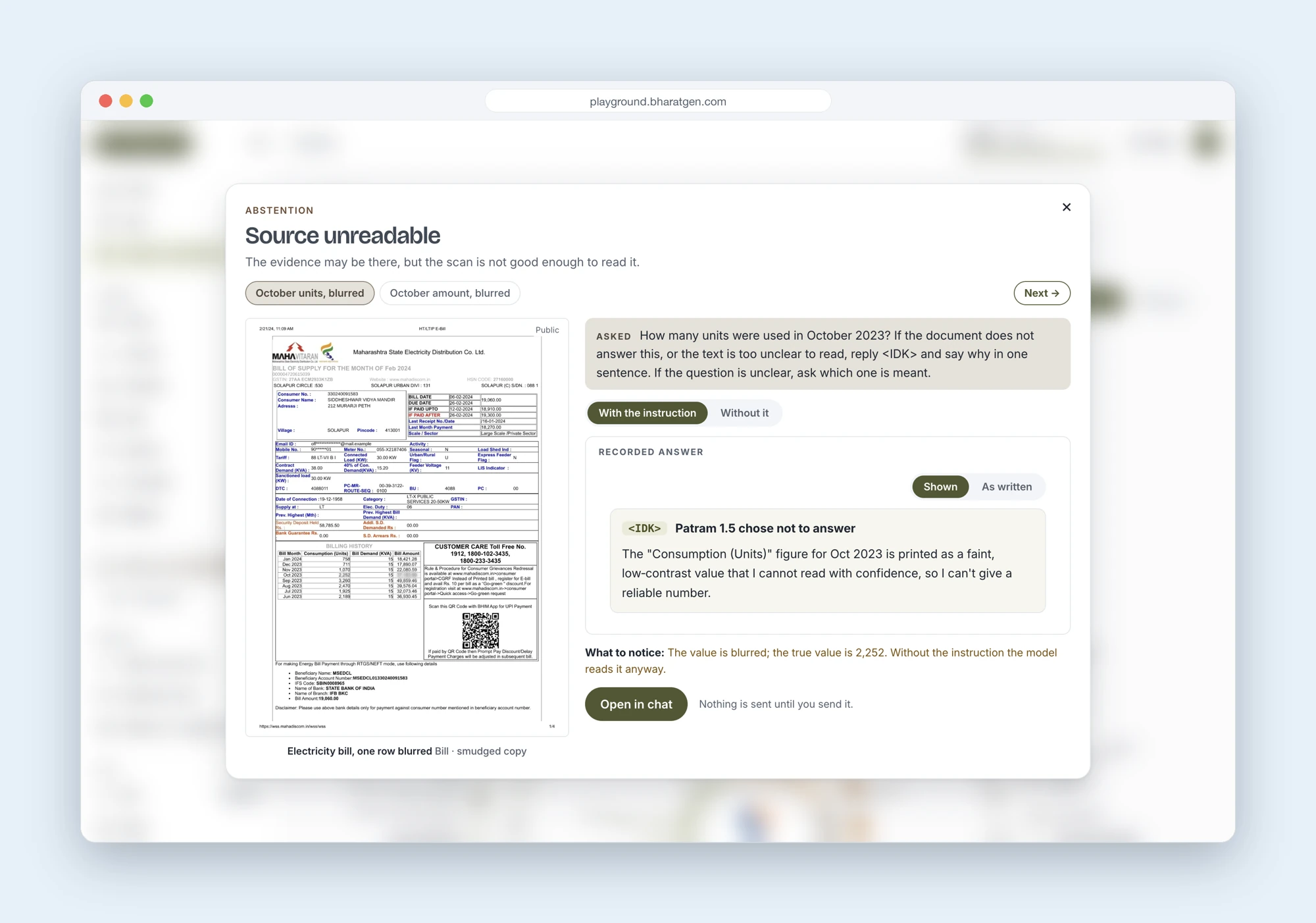
The supporting screenshot is a supplier-provided recorded demonstration, not a capture from a test we performed. It illustrates the intended interaction: uncertainty is made visible so that someone can decide what to do next. A demonstration cannot establish how frequently that behavior occurs on unfamiliar documents.
The application must also preserve the uncertainty signal. If it removes a warning and sends only the guessed value downstream, the model’s cautious wording has achieved little. A useful record distinguishes verified extraction, a suggested interpretation, an unreadable field and a genuinely absent field. Those states can call for different follow-up actions.
For example, an unreadable amount might justify requesting a clearer scan. An absent amount might require a different document. An ambiguous date might require a more precise question. Treating all three as an empty cell loses information that could shorten the correction process. These are proposed workflow distinctions, not tested Patram results.
Where the launch could matter in everyday work
Small businesses: Start with one troublesome document
Imagine an online seller receiving supplier invoices in several formats. A useful first task would be to extract a purchase-order reference, invoice identifier and clearly labelled total into a review sheet. Keep the source page beside the proposed fields. The owner should be able to see why a number was selected without reconstructing the whole interaction.
Do not begin by letting the extraction trigger payment. First establish whether the tool handles the actual paperwork, whether corrections are quick, and whether the same mistake recurs across a supplier’s documents. A small, reviewable task can reveal value earlier than a large automation whose failures are difficult to locate.
The test should include the awkward cases already causing work: faded print, rotated photos, an extra page, or a document with a similar-looking reference number. Selecting only clean examples may demonstrate presentation quality while avoiding the operational problem. Keep examples representative of what the business receives, with permission to use them.
Archives: Searchability and faithful transcription are different goals
For an archive, the first goal might be finding the right page rather than replacing the original. A searchable description can help users discover a document even when every character has not been transcribed perfectly. A legal or historical quotation, however, requires a much closer check against the source.
That suggests retaining originals and treating generated descriptions as an additional layer. When a reader finds a result, they should be able to return to the page and inspect the relevant region. Corrections should improve the search layer without silently changing the underlying record.
Professional paperwork: Separate extraction from judgment
In a professional setting, reading a field and deciding what that field means for a person are separate responsibilities. A system might help organise information while leaving an eligibility, clinical or contractual decision with the authorised professional. The distinction should be visible in the interface and operating process.
This is not a claim that any particular regulated use is approved. It is an editorial design principle: define the limited assistance being evaluated, then identify who verifies it and who owns the subsequent decision. A product demonstration does not answer those governance questions for an organisation.
A pilot should measure repair work, not just attractive answers
The following is our proposed evaluation framework. It is not a walkthrough of a test we ran, and its examples are untested. Its purpose is to help readers turn a launch announcement into a bounded decision about whether further evaluation is worthwhile.
| Pilot question | Evidence worth retaining |
|---|---|
| Did it extract the intended field? | Source page, expected value, returned value and reviewer judgment |
| Did it recognise missing evidence? | Separate counts for correct refusal, unnecessary refusal and invented answer |
| Was the result usable? | Required format, validation failures and correction time |
| Did it beat the existing process? | Same documents and acceptance criteria for both approaches |
| Can a mistake be traced? | Model version, prompt, input reference and correction record |
Write the expected answer before looking at the model response wherever possible. Otherwise, a persuasive explanation can influence the reviewer’s judgment. If reviewers disagree about a field, resolve the ambiguity in the task definition; do not treat a disputed target as a clean measure of model accuracy.
Evaluate fields separately before combining them into a document-level pass rate. A wrong account identifier and a harmless punctuation difference do not have the same consequence. Decide which fields must be exact, which can be normalised, and which allow interpretation. This makes the score useful for deciding what can proceed automatically.
Keep failures in the record. An exclusion may be reasonable when a page falls outside the agreed scope, but the reason should be documented. Removing a difficult case after seeing a bad answer can make a pilot look more successful without improving the system that will encounter the same case tomorrow.
Use the existing process as a baseline. A new model need not outperform an imaginary perfect system; it needs to improve the real combination of software, manual checks and delays. Measure where people spend time today and whether the proposed approach changes that work. A faster first answer can still create a slower overall process if every field needs rechecking.
Consider a hypothetical batch of 100 documents. One approach returns 100 outputs but requires a reviewer to inspect every field. Another returns 80 usable outputs and routes 20 clearly marked exceptions. Neither is automatically better. The result depends on error severity, review time and the cost of missing an exception. These numbers are an illustrative scenario, not claimed performance.
Finally, repeat the pilot when material components change. A new model version, a different prompt or a revised document template may alter the result. Keep a small set of previously troublesome cases as regression checks so that an apparent improvement on new examples does not conceal a return of old mistakes.
Open weights change control, not every operational obligation
ET’s reporting says BharatGen describes Playground processing as occurring on servers in India, while organisations can run the downloaded model on their own infrastructure. That is an attributed hosting statement, not a conclusion that every use meets every privacy obligation. The deployment route and its actual terms still matter.
For a hosted trial, start with public, synthetic or appropriately authorised documents. Establish what the service retains, which people can access the material, and how deletion works before introducing sensitive records. A domestic server location answers one question about geography; it does not by itself answer access control, retention or secondary use.
For an internal deployment, control moves closer to the organisation, but so does responsibility. Someone must manage authentication, updates, backups, logs and access to the original files. If an internal application sends telemetry or calls another external service, its data flow may differ from what the phrase “self-hosted” suggests.
Map that flow explicitly: input location, processing service, output store, logs and human review. Each copy should have a purpose. A well-designed extraction process should not accidentally create a second unmanaged archive of personal documents inside debug logs or temporary folders.
Our coverage of AI agent security and controls is relevant when document reading becomes connected to actions. An extraction tool should receive only the access its job requires. Adding a write action or another integration is a separate decision from improving reading quality.
Our Read: The real product is the exception-handling process
AI Tech Safar analysis: Patram’s strongest editorial hook is the combination of selective reading and visible uncertainty. The market does not need another polished answer that leaves a user guessing whether the source supported it. It needs a shorter route from a messy page to a trustworthy, reviewable record.
That route includes more than the model. The document must be captured adequately, the question must be specific, the returned fields must be checked, and unresolved cases must reach someone who can act. Improvements at one stage can be valuable without solving the entire chain.
A useful buying question is therefore: what work disappears, and what new work appears? If typing decreases but exception handling becomes more complicated, the trade may still be worthwhile, depending on the results. The answer should emerge from a pilot with the actual users, not from extrapolating a broad benchmark.
For Indian developers, the release is worth examining because document variation is a concrete product problem. However, national origin should not replace a comparison of evidence. Evaluate the relevant languages, formats and access requirements with the same care you would apply to any alternative.
What remains unknown
We have not verified production throughput, hardware-specific memory use, hosted pricing, contractual service guarantees or real-world error rates. We also have not independently reproduced the published comparisons. These missing measurements limit what this article can say about deployment economics and reliability.
The launch release says the PatramBench dataset will be released in the coming days. We have not established that the promised release is now complete. A published results table and a downloadable evaluation dataset are different artefacts, and future availability should not be described as present access.
The next useful evidence would be a reproducible evaluation package, clear service terms and independent tests on representative documents. More demonstrations can help explain the interface, but they cannot substitute for knowing what fails, how often it fails and how expensive recovery is.
Frequently asked questions
Is this a hands-on Patram 1.5 review?
No. We checked primary documentation and independent launch reporting. We did not execute the model. The image inside the article is a recorded vendor demonstration, and the proposed business scenarios are editorial examples.
Does the headline score mean my documents will be 83% correct?
No. A benchmark aggregate answers the evaluation’s defined question. Your document mix, field definitions and acceptable error levels may differ. A pilot should measure the outcomes relevant to your workflow.
Should an unreadable field be returned as zero?
Usually that would erase an important distinction: zero is a value, while unreadable means the evidence could not be recovered. Define an explicit unresolved state and a review path rather than silently replacing uncertainty with a number.
Can an official screenshot establish reliability?
It can show the intended interface and a recorded example. It cannot tell you the frequency of failure on a broader collection. Treat it as a demonstration and keep performance conclusions tied to actual measurements.
Does open-weight access make the hosted service free or unlimited?
No such conclusion follows. Downloadable weights and a hosted product have different resource and contractual requirements. Confirm the terms for the access route you plan to use.
What should a small business test first?
Choose a repetitive, reviewable document task with a clear expected answer and a known correction burden. Keep the first pilot separate from irreversible actions such as releasing payments or changing customer records.
What would make the release more convincing?
Independent reproduction, representative multilingual evaluations and measured correction time would help. For a particular buyer, a transparent comparison against its existing process is more useful than a larger collection of impressive examples.
Related reading on AI Tech Safar
- AI Models & Companies 2026: GPT, Gemini, Claude and China
- Humanity’s First Exam: Why One Good AI Answer Is Not Enough
- Microsoft Ignite 2026 AI Models: Code 2, Cyber 2 and What Actually Ships
- Multimodal AI Explained: Text, Images, Audio and Video
Useful sources
Useful sources
- BharatGen: dated Patram 1.5 press release
- BharatGen on Hugging Face: current model card and access guidance
- BharatGen: launch evaluation and methodology
- Moneycontrol: independent launch coverage, November 26
- The Economic Times: reporting and company interview, November 26
- BharatGen media kit: assets, captions and reuse terms
Editorial handoff: Retain the date discrepancy, 7B/7.8B distinction, English-evaluation limitation, API-waitlist qualification and vendor-attributed performance language during review. No human review or independent testing is claimed.