Reviewed by Imran Khan Pathan, Editor at AI Tech Safar
Reporting checked November 26, 2026. This article separates what public records show from allegations that remain under investigation.
New China AI server financing records connect companies linked to Alice Huang’s family and business network to up to 764 AI servers and computing modules, according to a November 25 Reuters investigation. The equipment was valued at about $270 million, with another $31 million in networking hardware. The records add a new infrastructure and financing dimension to the scrutiny around Nvidia’s China business.
The key caution: the filings do not establish that the servers contained Nvidia chips prohibited from export to China, or explain when and how the equipment reached its listed locations. The dollar figure represents equipment covered by financing arrangements, not necessarily new spending or 764 distinct purchases.
Key facts at a glance
| What the records/report say | What it means |
|---|---|
| Up to 764 AI servers and modules, valued at about $270 million | Assets were listed in financing-related records; the figure is not confirmed new spending. |
| About $31 million in networking equipment | Networking hardware helps link computers into larger clusters. |
| Five lease arrangements covering up to 512 servers, declared at about $200 million | Leasing can spread the cost of expensive compute infrastructure. |
| US Entity List additions covering seven Megaspeed-related entities | US export licensing restrictions apply to items subject to the Export Administration Regulations. |
| No proof in the financing records that these servers contained prohibited chips | The financing story and the separate chip-diversion investigation must not be treated as the same finding. |
What the $270 million headline actually measures
The safest way to read the headline is as a reported value attached to equipment in financing records. It is not a bank statement showing that one company paid $270 million in cash, a confirmed sales total for Nvidia, or a count of 764 brand-new servers delivered in one shipment. Reuters says the registry records equipment used to secure loans and other financing; it also cautions that the dollar figures do not necessarily represent new spending or distinct purchases.
That caveat matters because the article describes several different entries: five leasing arrangements covering up to 512 servers at a declared 1.42 billion yuan (about $200 million); a 128-server configuration with eight GPUs per server and a stated value of up to $450,000 per server; another 128-server transaction valued at $57 million and financed by an AVIC arm; and 252 computing modules pledged for a $70 million loan in April 2026. The reporting’s headline total is an aggregate of assets identified across records. Readers should not add every number in the story as if each row described a separate, non-overlapping purchase.
A financing registry can also contain different kinds of records: a lease may describe equipment supplied for use, a loan record may identify collateral, and a corporate filing may describe a guarantee. These documents answer different questions. A declared asset value is not automatically the amount borrowed, the amount paid by the borrower, the lender’s exposure after repayment, or the current market value of the equipment.
That is why “$270 million in financing records” is more precise than “$270 million of Nvidia chips sold.” Reuters reported up to 764 servers and computing modules together, plus about $31 million in networking equipment. The records do not establish a chip model, original shipment date, export route, current owner of every unit, or customer using the compute. Those are material unknowns—not minor footnotes.
What did the new China AI server financing records reveal?
Reuters said it reviewed dozens of filings in a Chinese central-bank credit registry. The registry records equipment used to secure loans and other financing. Among the companies named in the reporting is Century Litong, which rents high-performance servers to customers that need substantial computing capacity.
Five leasing arrangements between May and December 2024 covered up to 512 servers with a declared value of 1.42 billion yuan, or roughly $200 million. Four filings listed equipment at the Yangtze River Delta AI computing centre in Shanghai. A separate arrangement described 128 servers, each with eight graphics processors, for 1,024 processors in total. The filing gave a stated computing capacity of 989 PFLOPs and a value of up to $450,000 per server.
That performance figure is a number recorded in the financing documentation, not an independent benchmark of how quickly a real AI model would train or run. The records also listed more than 10,000 Nvidia ConnectX-7 networking cards and 730 BlueField-3 units at the Shanghai facility. Those are networking and data-processing components used to connect and manage large computer systems; their presence alone does not identify the processors inside every server.
Another reported transaction involved 128 servers valued at $57 million, financed by an arm of Chinese state-backed aviation and defence group AVIC and leased to Century Litong. Reuters also reported that a separate set of 252 computing modules was pledged as collateral for a $70 million loan in April 2026. The filing did not disclose where those modules were located.
How a server lease becomes a financing story
A data-centre operator can acquire or use expensive equipment through more than one route. A finance company may buy the servers and lease them to an operator; an operator may borrow against equipment it already owns; or a manufacturer may guarantee a lease so a financial institution is more willing to provide credit. The user of the compute can then be a different company again, renting capacity from the operator through a cloud or hosting contract.
In the Reuters account, Century Litong is described as a preferred Nvidia cloud partner that rents high-performance servers. Five arrangements between May and December 2024 covered up to 512 servers, while disclosures from manufacturer Jiangsu Lettall Electronic reportedly show guarantees connected to Century Litong’s equipment leases. A separate 128-server transaction was financed by an AVIC arm and leased to Century Litong. These details show how financing, ownership, leasing and customer access can sit with different parties. They do not show that any one customer bought the equipment outright.
The distinction matters for both business reporting and export-control checks. A loan document can help identify collateral and a financing relationship. A lease can help identify who has the right to use an asset. Neither automatically reveals who administers the machines, which customer receives compute, where the workloads run, or whether a particular export licence applied. Those questions usually require contracts, shipping and customs records, end-use checks, technical inventories and evidence about actual access.
Servers, GPUs, modules and networking: four different things
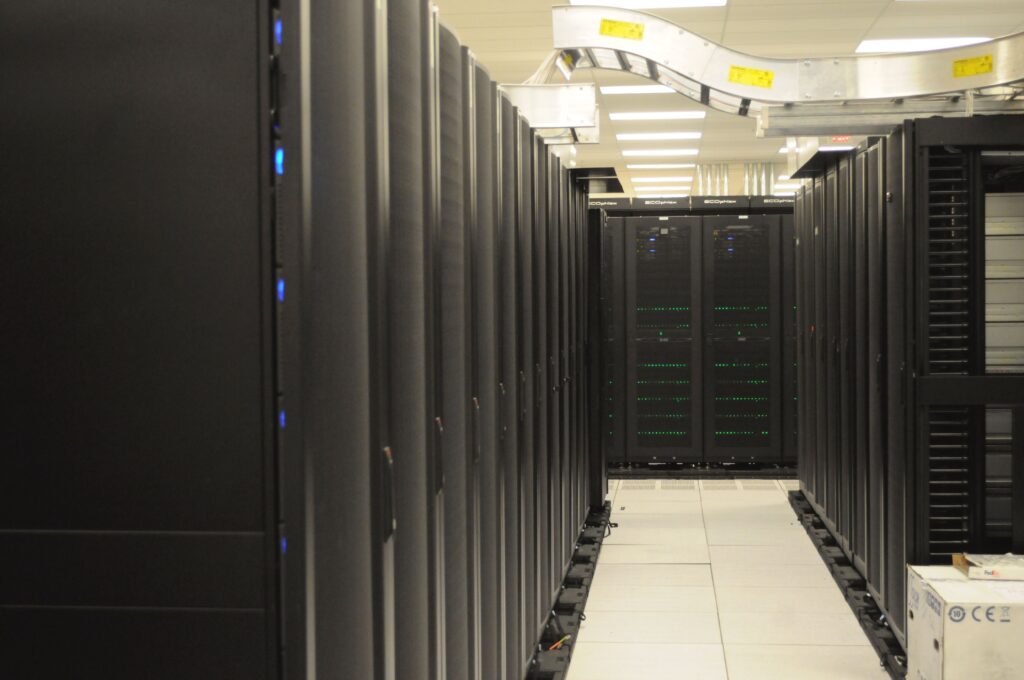
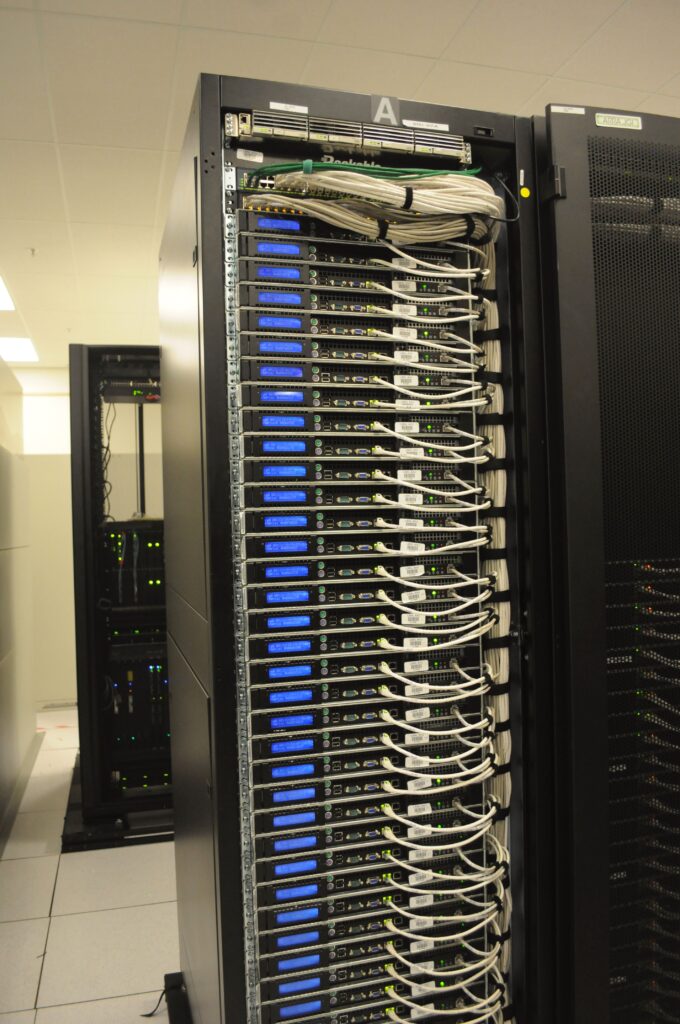
News coverage often compresses the hardware stack into the phrase “AI chips,” but the records refer to several layers. A server is a complete computer. It can contain processors, memory, storage, power supplies and one or more graphics processors (GPUs). A cluster connects many servers so a workload can be distributed across them. A computing “module” may describe a packaged compute component, but the term by itself does not identify its manufacturer, exact processor or configuration.
The reported 128-server configuration had eight GPUs in each server, or 1,024 GPUs in that described configuration. The record’s “989 PFLOPs” figure is a stated performance measure in the filing, not a result from an independent benchmark or a measure of how many useful tokens a deployed model produced. Peak floating-point figures depend on the precision and assumptions used; real training or inference performance also depends on memory, networking, software, workload and utilisation. The public report does not provide enough information to reproduce that figure or compare it fairly with another cluster.
The inventory of more than 10,000 Nvidia ConnectX-7 networking cards and 730 BlueField-3 units is relevant to the network and data-processing layer. ConnectX products are high-speed network adapters; BlueField is a data-processing unit (DPU) family. Their presence can indicate that a site was equipped to connect and manage substantial computing capacity. But network cards and DPUs are not a GPU inventory. They do not identify the accelerator model installed in each server, and they do not prove that a particular restricted GPU shipment took place.
What the Entity List action changes—and what it does not
The Bureau of Industry and Security’s final rule added seven entities in Malaysia, Singapore and Thailand to the US Entity List. The rule took effect on November 23, 2026. BIS says the additions reflect a significant risk that these entities could be involved in diversion of advanced computing commodities to unauthorised end uses or end users. For items subject to the US Export Administration Regulations (EAR), the rule sets a licence requirement and a presumption of denial for licence applications.
| Destination listed by BIS | Entities named in the rule |
|---|---|
| Malaysia | MSFusion Sdn. Bhd.; PT Megaspeed International; Speedmatrix Sdn Bhd |
| Singapore | Apex Enterprise Solutions (Singapore) Private Limited; Megaspeed International Pte. Ltd.; Swiftdata Pte. Ltd. |
| Thailand | Megaspeed (Thailand) Co., Ltd. |
These are the seven entries as grouped in the published rule. The listing applies to the named legal entities under the EAR; it is not a finding that every affiliate, customer or supplier committed a crime.
That is a consequential restriction, but its scope should be described accurately. It applies through the EAR’s rules when a listed party is involved in a covered transaction; it is not a statement that every Nvidia product is banned everywhere, nor does it by itself establish that the servers in the Chinese financing records were exported unlawfully. The rule is an administrative risk determination and licensing action. A criminal conviction would require a separate legal process and evidence.
The publication and effective dates differ: Reuters’ financing investigation appeared on November 25, while the BIS rule states that it took effect on November 23. The Commerce and Justice departments’ earlier public account says the Megaspeed investigation began in 2024, Nvidia was asked for records in May 2025, and an end-use check took place in June 2025 with Singaporean law-enforcement participation. The departments said the criminal investigation later moved to DOJ. These are separate milestones, and none should be presented as a final finding against every person or company named in the reporting.
What is established—and what remains unproven?
| Established in public reporting or official records | Not established by the financing records |
|---|---|
| Multiple filings used AI servers or modules as collateral or covered them in leases. | That the assets contained export-prohibited Nvidia GPUs. |
| Corporate records connect some companies to Alice Huang’s family and associates. | That Alice Huang personally owned every server or directed every financing arrangement. |
| The US government added seven Megaspeed-related entities to its Entity List. | That the Entity List action proves a criminal offence occurred in every reported transaction. |
| Some equipment was listed at a Shanghai data-centre location. | That Tencent bought, operated or rented the specific servers identified in the filings. Tencent denied owning or operating the project and denied a commercial relationship with Megaspeed. |
Reuters reported that Tencent said it did not develop or co-develop the facility in question, had never owned or operated that data-centre project, and had no commercial relationship with Megaspeed or its subsidiaries. Reuters also said the documents do not show that Tencent bought, rented or operated the particular servers. Those denials are important context when describing the Shanghai location.
How to read the family and corporate links fairly
Reuters says corporate records connect Century Litong, Century Longteng and Century Huatong to Alice Huang’s sister, Huang Yu, and to Kang Wei, identified as Alice Huang’s husband and an investment executive. It reports that Century Litong began as a subsidiary of Century Longteng, which is now wholly controlled by Century Huatong; it also describes earlier shareholdings involving a Shanghai state-backed investment fund and an investment company linked to Huang Yu and Kang.
That corporate map provides context for why reporters examined the financing records. It does not mean that every company in the chain was owned by Alice Huang, that she personally controlled each server, or that every transaction was directed by her. A relationship between individuals and companies is not itself evidence of a prohibited export or a crime. The article should keep those propositions separate unless a filing or official finding connects them directly.
The location also needs careful wording. Reuters says four lease filings listed equipment at the Yangtze River Delta AI computing centre in Shanghai and explains the centre’s reported corporate and government links. Tencent told Reuters it did not develop or co-develop the facility, had never owned or operated the project, and had no commercial relationship with Megaspeed or its subsidiaries. Reuters says the reviewed records do not show that Tencent bought, rented or operated the specific servers. The facility’s history and the identity of a particular server customer are different questions.
Why this matters beyond the Alice Huang story
The headline-grabbing coverage has focused heavily on personal relationships and espionage allegations. The newer records point to a more technical issue for the AI industry: compute capacity can be financed, leased and routed through several businesses, making end-user and location checks more complex. That is relevant to chipmakers, cloud providers, data-centre operators and governments writing rules for remote access to advanced AI computing.
For Nvidia, the issue is about compliance, customer oversight and the commercial consequences of export controls. For China’s AI sector, access to large clusters matters because training and serving advanced models require more than individual chips. For policymakers, the case raises a difficult enforcement question: how should rules apply when a customer can rent computing power rather than import a restricted processor directly?
This article builds on our earlier coverage of Jensen Huang’s return as Nvidia CEO and the questions that remain unresolved. The focus here is narrower: the financing records, server infrastructure and what they can—and cannot—show.
Why the evidence trail is difficult to complete
Advanced computing can cross borders in physical and virtual forms. A server can be assembled in one country, financed by a lender elsewhere, located in a third country and made available to a customer through a remote cloud account. Export rules may depend on the item, jurisdiction, destination, end user and end use. Remote access can therefore create a monitoring challenge even when no customer physically takes possession of a chip.
To establish a specific diversion chain, investigators would need to connect the relevant hardware to shipment records and identify the item’s technical specifications, route, parties, licence status and end use. They would also need evidence linking the records to actual control or access. Financing entries can help investigators find leads, but they are only one layer of that evidence. The registry is not a live device-management system and does not provide a complete map of every GPU and customer.
This is why both overstatement and understatement are risky. The records are meaningful: they show large-scale financing arrangements around AI compute and identify infrastructure in a strategically sensitive sector. But treating the records as proof of smuggling skips the missing links. Dismissing them as ordinary leasing would ignore the US government’s separate diversion-risk action and the ongoing investigation. The evidence supports scrutiny; it does not support a verdict that the documents themselves do not contain.
What the story could mean for AI companies and cloud buyers
AI Tech Safar analysis: The case highlights a control problem for the whole compute market. If a provider sells access to a cluster rather than selling individual accelerators to an end user, customer screening cannot stop at the original hardware invoice. Providers may need to know who controls the account, where workloads originate, whether usage patterns match the declared purpose, and how capacity is resold or subleased. That is a policy and compliance implication, not a claim that any named cloud customer misused these particular servers.
For chipmakers and server makers, the commercial issue is whether compliance systems can follow equipment through distributors, leasing companies, cloud partners and customers. For financiers, it is whether collateral descriptions and guarantees identify assets clearly enough to manage credit risk. For operators, it is whether a lease allows the lender or supplier to verify location and use. For governments, it is how to make rules enforceable when compute can be accessed remotely. These questions overlap, but each calls for different records and controls.
For customers buying cloud capacity, the practical lesson is to ask for clarity about the provider and region, contractual rights to use the service, data location, service continuity, and the provider’s policy for resold capacity. Those checks do not require a customer to speculate about a headline. They are ordinary procurement questions that matter whenever a workload depends on specialised hardware or a long supply chain.
For Indian AI startups and research teams, the report is not evidence that their current cloud access is affected. It is a reason to understand the dependency behind a service: which provider is responsible for capacity, what region is contractually promised, what happens if a supplier changes, and whether the workload can move. A sensible response is to review the contract and portability plan, not to assume that all Nvidia-powered services or all overseas data centres face the same restriction.
What new evidence would change the picture?
Several developments could narrow the remaining uncertainty: a public charging document or court filing; official findings from the ongoing investigation; a company disclosure identifying the GPU models and source shipments; records showing who controlled the servers and which customers received compute; or an end-use report linking a specific item to a specific transaction. A new headline about a family connection would add little unless it supplies evidence relevant to those questions.
Readers should also watch for corrections or clarifications to the financing numbers. If authorities or companies publish an asset schedule that identifies which lease and loan entries refer to the same equipment, it could change how the totals should be interpreted. Until then, the safest description is Reuters’ reported aggregate and its explicit warning that the figures do not necessarily equal new spending or distinct purchases.
Our review checked Reuters’ document-based reporting against the published BIS rule and the Commerce/Justice statement. Reuters’ report is the source for the Chinese credit-registry findings and company responses; the government records establish the Entity List action and the agencies’ stated investigation chronology. AI Tech Safar has not independently inspected the Chinese registry, tested the servers, or interviewed the companies. We therefore attribute the records to Reuters and keep allegations distinct from official determinations.
Frequently asked questions
Did the $270 million in records prove that banned Nvidia chips were in China?
No. Reuters explicitly said the records do not establish that the servers contained chips prohibited from export to China, or when and how the equipment entered the country.
What does “AI server financing” mean here?
It refers to arrangements in which high-value servers or computing modules are used in leases, loans or collateral agreements. The reported asset value is not automatically the same as new spending.
Were all of the named companies convicted of export violations?
No. The US government’s statement described an ongoing investigation into potential violations. The Entity List rule imposes licensing requirements and reflects a government risk determination; it is not a criminal conviction.
Did Tencent operate the Shanghai data centre?
Tencent told Reuters it did not develop or co-develop the facility, had never owned or operated the project, and had no commercial relationship with Megaspeed. Reuters said the records do not show Tencent bought, rented or operated the particular servers described.
Related reading on AI Tech Safar
- AI Business Guide 2026: Stocks, Infrastructure & Layoffs
- Micron Revenue: AI Memory Growth Behind the Headline
- Nvidia OpenAI Data Center Deal: Plans and Open Questions
- Q-CTRL Funding: A Major $290M Boost for AI and Quantum
Useful sources
Sources and reporting notes
- Reuters: Alice Huang-linked firms listed $270 million in AI servers in China, records show (November 25, 2026)
- US Bureau of Industry and Security: Additions to the Entity List, 91 FR 76148 (published November 25; effective November 23, 2026)
- US Departments of Commerce and Justice: Joint statement on the Megaspeed investigation (statement dated November 16, updated November 18, 2026)
- Derrick Coetzee, Front of server racks at NERSC, CC0 1.0, Wikimedia Commons
- Derrick Coetzee, Rear of rack at NERSC data center, CC0 1.0, Wikimedia Commons
Editorial note: This is a developing story. The article relies on public records, official statements and attributed reporting. Allegations are identified as allegations, and the financing filings are not presented as proof of chip smuggling.