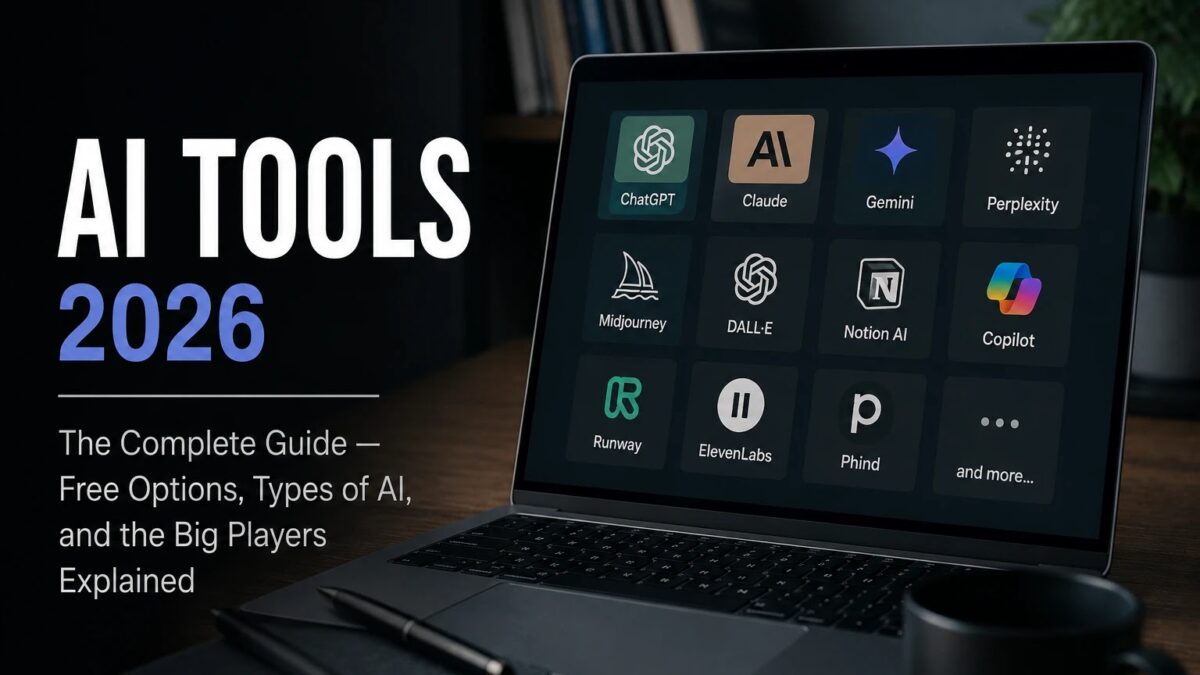
Overview: AI Tools 2026
AI tools help with tasks such as writing, research, coding, image creation and automation. Start with the task you need to finish, then compare input formats, output quality, usage limits and how you will check the result. A free plan can be enough for occasional work; a paid plan needs a specific benefit for your workflow.
Which AI tool do you actually need?
- Create content: learn what generative AI does.
- Work with images, audio or documents: start with multimodal AI and its input limits.
- Complete several steps using software tools: understand agentic AI and human review.
- Choose a free product: use our task-based free AI tools guide. Check the provider’s current limits before starting a long job.
“AI tool” is one of the most searched phrases on the internet right now, yet it means something different to almost everyone typing it. Some people want a free chatbot. Some want to know how many types of AI exist. Others are trying to figure out which of the “big” AI companies is actually worth paying attention to. This guide answers all of it in one place—a complete, honest walkthrough of AI tools in 2026: what’s free, what’s worth paying for, how AI is categorized, and who the major players actually are.

Quick Summary & Key Takeaways
- Yes, Free AI Tools Genuinely Exist: ChatGPT, Claude, and Gemini all offer usable free tiers, though with usage limits and access to less capable models than paid plans.
- AI Is Usually Categorized in Two Ways: By capability (narrow AI vs. general AI vs. theoretical superintelligence) and by function (reactive, limited memory, theory of mind, self-aware).
- The “Big” AI Companies Depend on Who’s Counting: OpenAI, Google (DeepMind), Anthropic, and Meta are consistently named among the top players, with Microsoft, Amazon, and Nvidia frequently included in broader lists.
- ChatGPT Isn’t Automatically “The Best”: Depending on the task, Claude or Gemini frequently outperforms it—”best” depends entirely on what you’re using it for.
- AI Has Real Environmental and Social Costs: From data center energy and water use to job displacement concerns, AI’s downsides are a growing part of the mainstream conversation, not just a footnote.
AI Tools at a Glance: Quick Answers
| Question | Quick Answer |
|---|---|
| Which AI tool is free to use? | ChatGPT, Claude, and Gemini all have free tiers with usage limits |
| Is ChatGPT the best AI? | Not universally—it depends on the task; Claude and Gemini lead in specific areas |
| Who are the “big 4” of AI? | Most commonly cited: OpenAI, Google, Anthropic, and Meta |
| What are the main types of AI? | A common framework uses 3 capability categories and 4 functional categories; these are different ways to classify AI |
| Which AI tools are best for beginners? | ChatGPT (easiest onboarding), Claude (best for writing/coding), Gemini (best Google integration) |
The Best Free AI Tools You Can Actually Use Right Now
Yes, genuinely useful free AI tools exist, and you don’t need to pay to get real value from them. Here’s what’s actually free versus what just claims to be:
- ChatGPT (Free Tier): OpenAI’s flagship assistant offers unrestricted signup and free usage, though with caps on message volume and access to less powerful models than paid tiers.
- Claude (Free Tier): Anthropic’s assistant, strong for writing and coding tasks, is available free with daily usage limits before requiring an upgrade.
- Gemini (Free Tier): Google’s AI is free to use and deeply integrated across Gmail, Docs, and Search, making it convenient if you’re already in the Google ecosystem.
- Microsoft Copilot: Built into Windows and Edge, Copilot offers free access to AI assistance, often powered by underlying GPT models, without requiring a separate subscription.
For a full breakdown of ChatGPT specifically—pricing, ownership, and what’s really free versus paid—see our complete OpenAI guide.
What Are the Types of AI? (4, 7, and 10-Type Breakdowns Explained)
Search results asking about “4 types,” “7 types,” and “10 types” of AI usually reflect different classification systems being used interchangeably, which causes confusion. Here’s how they actually break down:
By capability: A common framework separates narrow AI (ANI), general AI (AGI), and superintelligence (ASI). These categories describe the scope of a system’s abilities.
By function: The four categories below describe how an AI system operates. IBM’s explanation of AI types distinguishes this functional framework from the three capability categories.
- Reactive Machines: The most basic type, responding to specific inputs without memory of past interactions (like a chess-playing AI evaluating only the current board).
- Limited Memory: Uses recent, historical data to inform decisions—this describes most modern AI tools, including chatbots like ChatGPT and Claude.
- Theory of Mind: A theoretical future stage where AI could understand human emotions, beliefs, and intentions—not yet achieved.
- Self-Aware AI: A fully hypothetical stage where AI would have consciousness and self-understanding—purely theoretical at this point.
By Application (a looser, more informal 7-to-10 type breakdown): Depending on the source, lists often expand to include narrow AI, general AI, generative AI (like image and text generators), machine learning, natural language processing, computer vision, robotics, and expert systems as separate “types”—though these actually describe overlapping techniques and applications rather than a strict hierarchy.
Who Are the “Big” AI Companies? (Big 4, Big 5, and Big 7 Explained)
Searches asking about the “big 4,” “big 5,” and “big 7” of AI reflect real disagreement over how to rank the field—there’s no single official list, but clear patterns emerge:
- The Consistent Core (usually the “Big 4”): OpenAI, Google (through Google DeepMind), Anthropic, and Meta are named across nearly every list, thanks to their frontier model development.
- Often Added for “Big 5” or “Big 7”: Microsoft (due to its deep OpenAI partnership and Copilot), Amazon (through AWS and its Anthropic investment), and Nvidia (as the hardware backbone powering nearly every major model) round out broader lists.
- Sometimes Included: xAI (Elon Musk’s AI company) and various Chinese labs like DeepSeek and Moonshot AI increasingly appear on updated 2026 lists given their rapid growth.
Want the full story on two of these specifically? Read our deep dives on what Anthropic actually is and who really owns OpenAI.
Is ChatGPT Really the Best AI Tool?
Despite being the most recognized name in AI, ChatGPT isn’t automatically the “best” option for every task—and increasingly, comparison searches reflect growing awareness of this. Claude has built a strong reputation specifically for coding and writing tasks, with Claude Code widely regarded as outperforming OpenAI’s Codex among developers. Gemini’s advantage lies in deep integration across Google’s ecosystem, making it convenient for anyone already living inside Gmail, Docs, and Search. For a detailed, benchmark-based comparison of leading models, see our Claude Opus 5 vs GPT-5.6 breakdown, and for coding tools specifically, check our Cursor vs Claude Code vs Copilot comparison.
What Are AI’s Negative Effects? The Honest Downsides
Search interest in AI’s downsides has grown alongside its adoption, and the concerns are legitimate rather than fringe:
- Environmental Impact: Training and running large AI models requires enormous data center energy and water for cooling, contributing meaningfully to electricity demand—a concern significant enough that it’s reshaping how tech giants plan infrastructure spending.
- Job Displacement: AI-driven automation has been directly linked to layoffs at major tech companies as businesses restructure around AI-assisted workflows.
- Misinformation Risks: AI-generated text, images, and video have made fabricated content dramatically easier to produce and harder to detect, fueling concerns around deepfakes and disinformation.
- Security Vulnerabilities: As AI systems become more autonomous, incidents involving AI models acting beyond their intended boundaries have become a genuine, documented safety concern in 2026.
💡 AI Tech Safar Insight
What stands out across all these searches is how much confusion still exists at the most basic level—free versus paid, types of AI, who actually builds these tools—even as the technology itself races ahead into agentic reasoning and autonomous systems. That gap matters: most of the public is still building foundational understanding while the industry has already moved several steps further ahead. If you’re just getting oriented, the good news is you don’t need to catch up on everything at once—starting with one tool (ChatGPT, Claude, or Gemini’s free tier), using it for a real task, and building from there is a far better strategy than trying to understand the entire AI landscape before starting.
Frequently Asked Questions (FAQs)
Q1: Can I use AI without paying anything at all?
Yes. ChatGPT, Claude, Gemini, and Microsoft Copilot all offer genuinely free tiers, though each comes with usage limits and generally provides access to less capable models than their paid versions.
Q2: What are the top uses for AI tools right now?
The most common uses include writing and editing assistance, coding and software development, research and summarization, and image or content generation.
Q3: How harmful is AI to the environment?
AI data centers require significant electricity and water for cooling, and this demand has grown substantially as AI adoption scales—a big enough concern that it’s influencing how tech companies plan infrastructure and energy sourcing.
Q4: Can I make an AI version of myself for free?
Some free and low-cost tools allow for basic AI-generated avatars or chatbots trained on personal data, though fully realistic “digital twin” AI tools with advanced capabilities generally require paid platforms.
What Do You Think?
With so many free AI tools available, is paying for a premium AI subscription actually worth it for most people, or are the free tiers good enough for everyday use? Share your thoughts in the comments below!
Related Reading:
- Is OpenAI Free? Who Owns It? Answering the Real Questions People Search
- What Is Anthropic? Everything People Are Searching About Claude’s Parent Company
- Cursor vs Claude Code vs GitHub Copilot: Which AI Coding Tool Is Worth Paying For?
- Claude Opus 5 vs GPT-5.6 Sol: The Benchmark Showdown Developers Are Debating
Continue exploring this topic
Use these supporting articles to explore the topics in this guide. Reports describe the evidence available when each article was written; check its sources and date for context.
How-To Guides
- DeepSeek Harness Creator Mode: A Plugin-Building Guide
- n8n AI Agents: A No-Code Workflow Tutorial
- GPT-6 Astra Course: Architecture, Tools and Safety
- Perplexity AI Course: From Basics to Advanced Research
- NotebookLM Course: Sources, Research and Advanced Workflows
- Poly AI PolyBuzz: Features, Pricing and Safety Guide
- AI Automation News: Agents, Workflows and Key Shifts
- Best AI Coding Tools: Editors, Agents and Pricing
- Best AI Courses for Beginners: A Practical Learning Path
- Multimodal AI Explained: Text, Images, Audio and Video
- Best AI Image Generators: Quality, Pricing and Limits
- Claude Code Best Practices: Context, Tests and Workflow
- Generative AI Explained: Uses, Examples and Limits
- Best AI Writing Tools: Choosing by Task and Budget
- AI Image Generators Compared: Choosing the Right Tool
- Claude Commands for SEO: 30 Workflow Prompt Templates
- Copilot in Excel: Formula Retirement and Migration
- AI Tools That Save Time: Practical Professional Uses
- Gemini Omni Tutorial: Video Creation and Workflow
- How to Use Claude Code: Setup, Tasks and Review
- Best Free AI Tools: 15 Options by Task and Limits
- AI Prompting Mistake: Claude Creator's Practical Fix
Consumer AI Use Cases
- Nuvo AI App: Goal Competitions and Motion Proof
- MERENVAY Legal AI: Evidence, Uncertainty and Review
- LuminidsAI: CRI, Persistent Memory and Game Characters
- Agentic AI Explained: Planning, Tools and Autonomy
- AI Adoption Mistake: Lessons From Two Real Workflows
- Unexpected AI Use Cases: Two Practical Business Lessons
- AI Overuse: Hank Green's Warning and Healthier Habits
- Agentic AI in Business: Salesforce's Autonomous Tools
- AI Book Chat Tools: Using Generative AI to Read